
Select the Right Hydraulic Motor for Your Applications
What factors should be taken into consideration when selecting a hydraulic motor? The first thing that should be focused on is the operating conditions of the hydraulic system, following which we should decide on the output torque, speed and power as needed so as to pick a right product model and specification. Generally speaking, gear motors are simple-structured and priced affordably, often used under conditions where high speed and small torque are required while motion stability is not, for example, used for driving grinders, fans, etc. Vane motors stand out for small rotational inertia and quick responsiveness but their volumetric efficiency is not high and their mechanical characteristics are soft, all of which makes them suited for operating conditions of medium speed, small torque and frequent starting and commutation, to be specific, driving the table of grinding machines and launching machine tool operating systems, etc. Axial plunger motors offer prominent volumetric efficiency, wide speed range and good stability at low speed yet with relatively weak impact resistance. Motors of this type are often used in demanding high-pressure systems, for instance, serving as the major transmission for internal combustion locomotives, or playing an essential part in hoisting machinery, or used for lifting and turning construction machinery, mining machinery and ships. As to radial plunger motors, there is no need to use a reduction gearbox when a radial plunger motor is put into use in that the motor can itself actuate crane winches or walking machinery wheels, etc.
The following provides several calculation formulas helpful for hydraulic motors selection:
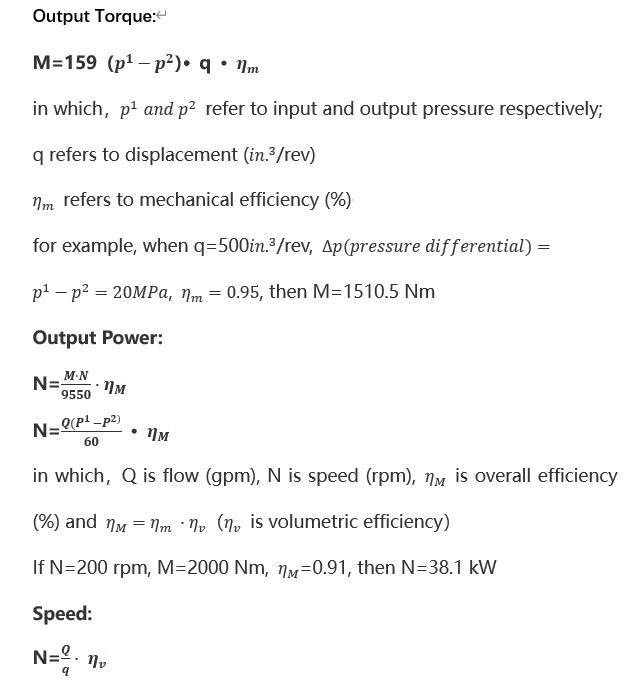
After calculating the output power, torque and speed of various hydraulic motors, you can make an initial choice based on the estimated results and the general requirements of hydraulic system to ensure the torque generated by the selected motor should satisfy the working demands of the system. Subsequently, pick the right hydraulic pump that matches up with the motor’s flow and pressure.
The following table shows the working conditions and application scope of different types of hydraulic motors and their specifications, which could guide your selection. You can either adopt low-speed motors or employ high-speed motors plus a decelerator for low-speed operation. As far as which solution is superior, it relies on your desired motor structure, area size, acceptable cost and driving torque.
Working conditions and application scope of hydraulic motors
| Model | Characteristics & Working Conditions | Application Scope |
| Gear Motors | Simple-structured and easy for manufacturing. Large speed ripple, small and invariable load torque. Suitable for use under the conditions of undemanding speed stability, non-noise limit, high speed and low torque | Rotary hydraulic system for drilling machines, ventilation equipment, engineering machines, agricultural machinery and forestry machinery |
| Vane Motors | Compact structure, small size, stable in movement and adjustable speed. Suited for conditions where small load torque is required. | Hydraulic system of grinders’ rotary table, machine tools’ operating mechanism, the automatic line and the servo mechanism |
| Gerotor Motors | Suitable for the working conditions where medium load speed is required and where few requirements are imposed on the machine size. | Plastic machinery, coal mining machinery, excavators, etc. |
| Axial Piston Motors | Compact structure, small radial dimensions and rotational inertia, adjustable speed. Suitable for occasions where high speed, large load, varying speed, slightly larger load torque, and low-speed stability are demanded. | Cranes, winches, forklifts, internal combustion locomotives, CNC machine tools, walking machinery |
| Radial Piston Motors | Suitable for occasions where large load torque, medium speed, slightly larger radial dimensions are acquired. | Plastic machinery, walking machinery, etc. |
| Internal Curved Plunger Motors | Suitable for occasions where maximum load torque, low speed and high stability are required. | Excavators, tractors, cranes, etc. |
Specifications of common hydraulic motors
| Items Model | Displacement Range ({in.}^3/rev) | Pressure (MPa) | Speed Range ( r/min) | Volumetric Efficiency (%) | Total Efficiency(%) | Mechanical Efficiency on Starting (%) | Noise | Price | ||
| Min | Max | Rated | Max | |||||||
| External gear motors | 5.2 | 160 | 16-20 | 20-25 | 150—3000 | 85—94 | 85—94 | 85—94 | Relatively Loud | the Lowest |
| Internal gear gerotor motors | 80 | 1250 | 14 | 20 | 10—800 | 94 | 76 | 76 | Low | Low |
| Double-acting vane motors | 50 | 220 | 16 | 25 | 100—2000 | 90 | 75 | 80 | Low | Low |
| Single swash plate axial piston motors | 2.5 | 560 | 31.5 | 40 | 100—3000 | 95 | 90 | 20—25 | Loud | Relatively High |
| Bent axis axial piston pump motors | 2.5 | 3600 | 31.5 | 40 | 100—4000 | 95 | 90 | 90 | Relatively Loud | High |
| Steel ball plunger motors | 250 | 600 | 16 | 25 | 10—300 | 95 | 90 | 85 | Low | Medium |
| Double swash plate piston motors | None | None | 20.5 | 24 | 5—290 | 95 | 91 | 90 | Low | High |
| Single acting crank and connecting rod radial piston motors | 188 | 6800 | 25 | 29.3 | 3—500 | >95 | 90 | >90 | Low | Relatively High |
| Single acting rodless radial piston motors | 360 | 5500 | 17.5 | 28.5 | 3—750 | 95 | 90 | 90 | Low | Relatively High |
| Multi-acting internal curved roller piston force transmission radial piston motors | 215 | 1250 | 30 | 40 | 1—310 | 95 | 90 | 95 | Low | High |
| Multi-acting internal curved steel ball piston force transmission radial piston motors | 64 | 10000 | 16—20 | 20—25 | 3—1000 | 93 | >85 | 95 | Low | Relatively High |
| Multi-acting internal curved beam force transmission radial piston motors | 1000 | 40000 | 25 | 31.5 | 1—125 | 95 | 90 | 95 | Low | High |
| Multi-acting internal curved roller force transmission radial piston motors | 8890 | 150774 | 30 | 35 | 1—70 | 95 | 90 | 95 | Low | High |
After determining the type of motor for use, select the desired motors with the right speed and torque. Calculate the pressure differential, flow and efficiency via characteristic curves related to varied specifications, and then conduct a comprehensive analysis, deciding on the particular specification for the technical and economic sake:
- If the historical cost matters most, you would better choose a motor with the right torque that can shrink the system flow and provide low pressures so as to reduce the specifications of hydraulic source, control valve and pipelines.
- If the operating cost is uppermost, a motor with high total efficiency should be an ideal choice.
- If the service life is a top priority, the motor with the smallest pressure drop is recommended.
The final choice lies in, more often than not, a compromise of the above-mentioned solutions.