RSS

2017, November

0 What Communication Type is Used for Servo Drive System?

Sometimes one has to (still) use a dedicated net just for servos but that is old. Different fieldbuses and/or servo drive interfaces may support a partial frame; for example, one may only be able to set a control word which might be position or torque command while some may support a full parameter frame or command set which exposes a plethora of servo parameters and variations between the two extremes. Speed is also a consideration i.e. may only be fast enough to do motion control or fast enough to close a servo torque loops and/or fast enough to incorporate feedback devices e.g. force or range sensors (without wiring directly to the servo drive).
0 Stepper Motor Troubleshooting

Stepper motors are now widely used in the industrial areas, but from time to time some problems with stepper motors occurs as follows. Aimed to these problems, there are some troubleshooting for your reference.

  1. How to control the direction of stepper motor?
  2. When stepper motor generates vibration and noise, how to do it?
  3. Why the stepper motor doesn’t rotate or move back and forth after it is powered?
  4. Why the torque of stepper motor is decreasing with the rise in rotational velocity?
  5. Why stepper motor can run normally at low velocity, but can’t start at certain higher velocity with some noise of whistler?
  6. How to prevent the power interference of stepper motor?
0 How to prevent stepper motor losing step?

Stepper motor is an open-loop control motor which transforms electric pulse signal into angular displacement or linear displacement.  However, there are some errors occuring between the actual angle stepper motor rotates and the theoretical step distance. There are some certain errors from one step to any other step, but the step number of each cycle of the stepper motor is the same. In the case of no step loss, the step error is not accumulated for a long time.
How to prevent step loss with stepper motor as the above mentioned? First of all, we need to know why stepper motor losses step?

  1. The rotor acceleration is slower than the rotating magnetic field of the stepper motor.
  2. The average speed of the rotor is higher than the average rotating speed of the stator magnetic field.
  3. The load inertia of stepper motor is large.
  4. The stepper motor produces the resonance.
1 Servo Drive Basics & Working Principle

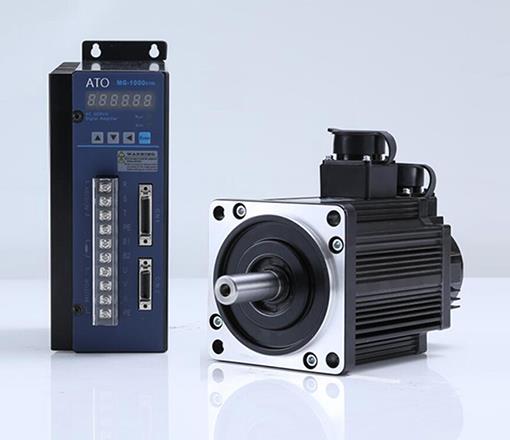
The servo drive is a kind of controller to control the servo system. Its function is similar to the frequency effect on ordinary AC motor, which belongs to a part of the servo system and is mainly applied in high-accuracy positioning system. Generally, the servo motor is controlled by three ways, location, speed and torque, so as to realize high precision positioning of transmission system.
ATO servo drive

1 Stepper Motor Basics & Working Principle

Stepper motor is an actuator transforming electric pulse into angular displacement. Popularly, when receiving a pulse signal, the stepper motor will rotate a fixed angle (namely"stepping angle") according to the direction set for the stepper motor. The angular displacement volume can be controlled by controlling the pulse number to achieve the purpose of positioning accurately. In the meantime, the rotational velocity and acceleration of motor can be controlled by controlling the pulse frequency to achieve the purpose of speed control.

0 Laser marking technology in automotive industry

Laser marking machine can provide the most professional solutions in the laser marking area of the whole automotive industry, from the car body, car frame, hub and tire, various hardware components, central control of the seat, steering wheel and instrument panel, glass, interior decoration, lighting, the assorted oils for cars, ornaments and so on.
Laser marking on the automotive components

0 How to select stepper motor and servo motor?

It depends on specific application situation, and to put it in a simple way: Nature of load (for example, vertical load or horizontal load), requirements of torque, inertia, speed, accuracy and acceleration and deceleration, requirements of upper control (such as requirements of port interface and communication), whether major controlling mode is position, torque or speed mode, whether power supply is direct or alternating current power supply, or battery powered, and voltage scope. Based on this, we can determine models of motor and supporting drives or controllers.

Blog archive