
How to Choose a Pressure Sensor?
A pressure sensor is a device used to measure the pressure of gases or liquids and convert it into an electrical signal for monitoring or control. Selecting the right pressure sensor is crucial for accurate measurement, reliable operation, and long-term performance in industrial, laboratory, or field applications. ATO Industrial Automation has prepared a comprehensive buying guide to help you choose the pressure sensor that best fits your requirements.
Review these essential considerations before making your final choice.
- Identify the Pressure Type
- Determine the Pressure Range
- Select the Sensing Technology
- Choose Pressure Sensor Output Type
- Consider Environmental Conditions
- Accuracy and Resolution
- Pressure Sensor Selection by Industry
- Common Pressure Sensor Selection Mistakes
- FAQ
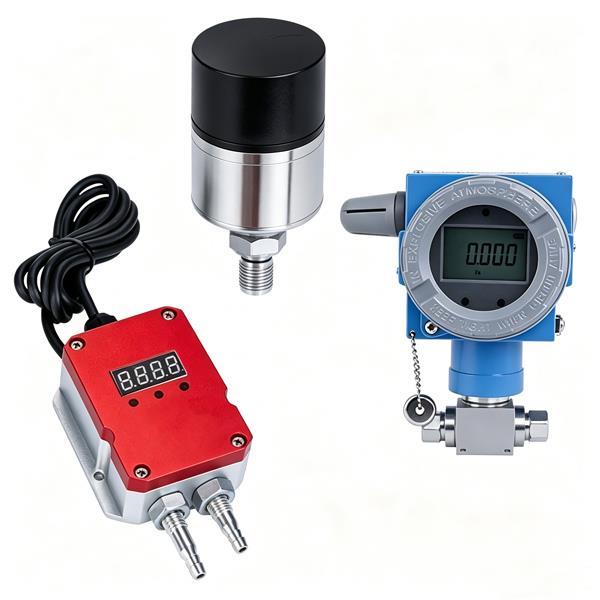
Identify the Pressure Type
| Pressure Type | Description | Typical Applications |
| Gauge Pressure | Measures relative to atmospheric pressure | Hydraulic systems, water pressure, HVAC |
| Absolute Pressure | Measures relative to a vacuum | Barometers, vacuum systems, weather instruments |
| Differential Pressure | Measures difference between two points | Flow measurement, filter monitoring, liquid level detection |
| Sealed Gauge | Similar to gauge, but sealed to a reference | Automotive, industrial equipment |
Tip: Matching the pressure type to the process ensures accurate readings and prevents pressure sensor damage.
Determine the Pressure Range
Identify the normal operating pressure
Determine the minimum and maximum pressures your system experiences.
Example: If your system operates between 20–80 PSI, the sensor should cover at least this range.
Add a safety margin
Include an extra 25–50% above the maximum operating pressure to protect the sensor from overload.
Example: For a system with a maximum of 80 PSI, select a sensor rated for 100–120 PSI.
Avoid oversizing the sensor range
Using a sensor with a much higher range than needed reduces resolution and measurement accuracy. Optimal accuracy occurs when the normal operating pressure falls between 30% – 70% of the sensor’s full scale.
Example: A 0–500 PSI sensor measuring 80 PSI will have poor resolution compared to a 0–150 PSI sensor.
Consider occasional pressure spikes
Industrial systems can experience sudden spikes due to pumps, valves, or water hammer.
Ensure the sensor can tolerate overpressure events.
Data point: Many sensors are rated for 1.5–2 times their full-scale range as overpressure protection.
Check overpressure and burst ratings
Confirm the sensor can handle the highest possible pressure in the system without damage.
Example: A sensor with a 150 PSI range and 300 PSI burst rating can safely handle short-term spikes.
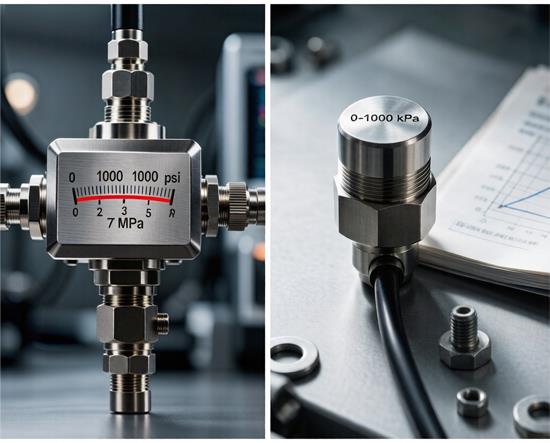
Select the Sensing Technology
| Technology | Advantages | Limitations | Best Use Case |
| Piezoresistive (MEMS) | Compact, low cost, good for liquids and gases | Sensitive to temperature changes | HVAC, general industrial |
| Capacitive | High resolution, stable output | Larger size, needs electronics | Laboratory instruments, high precision |
| Strain Gauge | Durable, high accuracy | Requires signal conditioning | Hydraulic systems, heavy machinery |
| Optical / Fiber Optic | Immune to EMI, high sensitivity | Expensive, complex installation | Chemical plants, explosive environments |
| Resonant / SAW | Ultra-accurate, long-term stability | High cost, niche applications | Aerospace, semiconductor fabs |
Choose Pressure Sensor Output Type
Pressure sensors generally offer three main output types: Analog Output, Digital Output, and Frequency Output. Each type differs in application scenarios, transmission distance, noise immunity, and cost.
- Analog Output → Traditional systems, short to medium distance, low cost
- Digital Output → Smart systems, medium to long distance, high precision
- Frequency Output → Harsh environments, long distance, high noise immunity
Consider Environmental Conditions
| Factor | Requirement |
| Temperature | Ensure sensor operates across expected range (-40°C to +125°C common) |
| Media | Materials must withstand gases, liquids, or corrosive |
| Compatibility | Fluids |
| Ingress Protection | IP ratings protect against dust and water exposure |
| Vibration & Shock | Choose vibration-resistant models for mobile or industrial environments |
Accuracy and Resolution
Accuracy
Industrial Automation Applications: ±0.5% FS is generally sufficient.
Precision Control or Laboratory Measurements: It is recommended to select ±0.1% FS or higher for greater accuracy.
Example:
System pressure range: 0–100 PSI, sensor accuracy ±0.5% FS → Maximum error: ±0.5 PSI
System pressure range: 0–100 PSI, high-precision sensor accuracy ±0.1% FS → Maximum error: ±0.1 PSI
Resolution
If small pressure variations need to be monitored, the sensor resolution should be equal to or smaller than the minimum system pressure change.
For high-precision control systems, the resolution is typically required to be ≤0.01% FS.
Example:
Sensor range: 0–100 PSI, resolution: 0.02% FS → Smallest detectable pressure change: 0.02 PSI
This is particularly important for hydraulic or flow control systems requiring precise measurement.
Pressure Sensor Selection by Industry
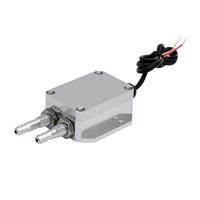
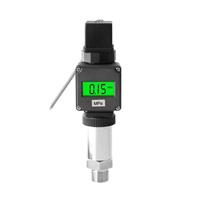
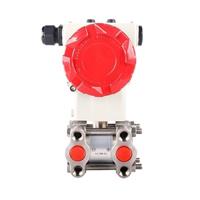
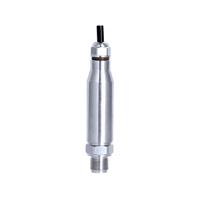
| Industry | Key Considerations | Recommended Pressure Sensor |
| HVAC / Building Automation | Accuracy, cost-effectiveness, air flow monitoring |
|
| Hydraulic / Heavy Machinery | High pressure resistance, durability, vibration resistance |
|
| Chemical / Explosive Environments | EMI immunity, explosion-proof certification, high safety level |
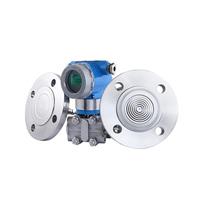
Explosion-Proof Differential Pressure Transmitter Flange Mounted |
| Laboratories / Test Systems | High accuracy, stable output, fine resolution |
|
| Water / Wastewater | Corrosion resistance, IP protection, long-term stability |
|
Common Pressure Sensor Selection Mistakes
- Choosing the Wrong Pressure Range: Selecting a pressure sensor with a range too high reduces low-pressure accuracy. In hydraulic systems, engineers typically choose a sensor with a maximum range 20–30% higher than the operating pressure.
- Ignoring Media Compatibility: Corrosive liquids or gases can damage standard stainless steel sensors. Always verify the sensor’s wetted material against your process fluid.
- Using Gauge Instead of Absolute Pressure: Absolute pressure sensors are needed for vacuum systems. Using gauge sensors can result in inaccurate measurements.
- Selecting Incorrect Output Signals: Some PLC systems cannot process voltage signals directly. Choosing the wrong output can require additional signal conditioning or converters.
FAQ
Q: What is the difference between gauge and absolute pressure sensors?
A: Gauge sensors measure relative to atmospheric pressure; absolute sensors measure relative to a vacuum. Choose based on your application and reference requirements.
Q: How often should pressure sensors be calibrated?
A: Typically once per year, or after extreme temperature or pressure events.
Q: How do I know if I need a differential pressure sensor?
A: If your process requires measuring pressure difference between two points (e.g., flow rate, filter clog detection), a differential sensor is required.
Q: What maintenance is required for pressure sensors?
A: Periodic inspection, cleaning, and calibration; battery or electronic components may require additional attention for some types.