
Features
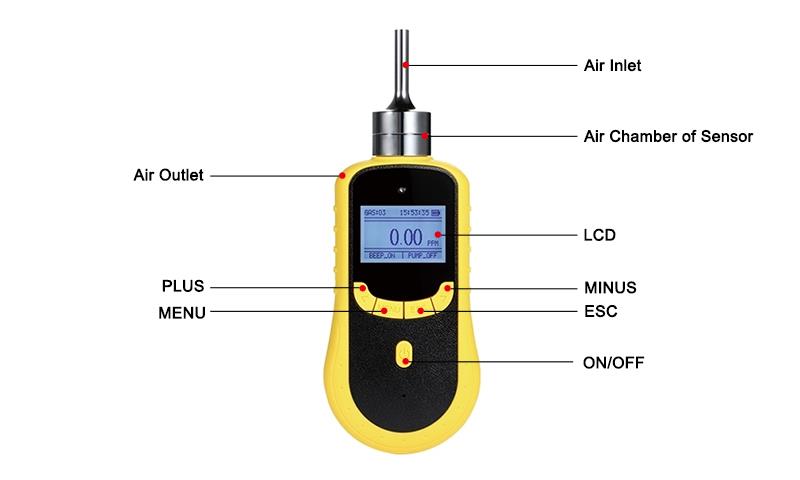
- LCD dot matrix display, direct readout of gas type, unit, concentration, local time, etc.
- Support English/Chinese operation, easy to shift.
- Gas concentration unit PPM and mg/m3 can be shift quickly.
- Built-in micro-sampling pump, 10 grades of suction are available.
- Explosion-proof certification
Gas Detector Functions
- With self-calibration and zero calibration functions, makes the detection more accurate and reliable.
- One key to restore factory setting, free from maloperation.
- With temperature and pressure compensation, able to realize the compensation for the gas concentration under different temperature and pressure environments.
- Two-stage alarm with sound and light, and alarm point is settable.
- Rechargeable lithiumpolymer battery with large capacity.
- High-strength special engineering plastic housing, with anti-slip, waterproof, dustproof and explosion-proof.
Specification
| Model | GD200-H2 |
| Sampling Method | Pump type, flow rate can be up to 750ml/min |
| Detection Principle | Electrochemistry |
| Range (Optional)* | 0 to 10 ppm, 0 to 20ppm, 0 to 100ppm, 0 to 500ppm, 0 to 1000ppm, 0 to 2000ppm, 0 to 3000ppm, 0 to 5000ppm, 0 to 10000ppm, 0 to 20000ppm, 0 to 40000ppm, 0 to 4% VOL |
| Resolution | 0.001ppm (0-10/20ppm), 0.01ppm (0-100ppm), 0.1ppm (0-500ppm), 1ppm (0-1000/2000/5000/10000/20000/40000ppm) or 0.001% VOL (0-4% VOL) |
| Accuracy | ≤±3% F.S. |
| Response Time | ≤10s |
| Repeatability | ≤±1% |
| Recovery Time | ≤10s |
| Linearity Error | ≤±1% |
| Zero Shift | ≤±1% (F.S./year) |
| Data Logging (Optional Function) | High speed data transmission by USB, available for data downloading and printing (The built-in IC card has about 2G memory, which can record 100,000 sets of data.) |
| Alarms | Sound, light and vibration |
| Display | LCD dot matrix display |
| Language | Chinese/English |
| Battery | 3.7V rechargeable lithium battery, 3.7 Watt (Charger included: Input AC 100-240V 50/60Hz with optional USA, Europe or UK plug) |
| Operating Time | 100h (Pump off) |
| Explosion-proof Grade | II 1G Ex da ia IIC T4 Ga |
| Case Material | ABS+PC |
| Protection Grade | IP66 |
| Certification | CE, ATEX (Standard: EN IEC 60079-0:2018, EN 60079-1:2014) |
| Operating Temperature | -20℃~50℃ |
| Operating Humidity | 0~95%RH (non-condensing) |
| Operating Pressure | 0.8~1.2bar |
| Dimension | 205*75*32mm |
| Weight | 300g |
| Warranty | 12 months |
| Extension Probe | About 480mm (Total Length), About 300mm (Probe Head) |
| Accessories (Optional) | Calibration kit - gas pressure regulator (calibration gas cylinder NOT included)
|
Note 1:
If you require an H2 gas detector with a measuring range not listed in the table above, please contact us with details about your operating environment. We can help you choose the right detector for your application.
- We also offer gas detectors for other common gases. Please refer to the ATO Gas Detector Catalog for available gas types and measuring ranges.
Note 2:
Regarding the flow rate for gas detectors, there are 2 types:
- Pump-Suction Type: Equipped with a built-in pump, with a flow rate of 600 mL/min. (Models: GD200, GD400, GD600)
- Diffusion Type: Not equipped with a built-in pump, with a flow rate of 300 mL/min. (Models: GD300, GD500, GD800)
If you require a customized flow rate, please let us know your specific requirements. We will evaluate whether customization is possible. A flow rate that is too high or too low can affect measurement accuracy, so we recommend using an appropriate flow rate for your application.
Flow rate only needs to be considered when sampling gas from pipelines. For measuring gas concentrations in normal ambient air, you do not need to consider the flow rate. To measure confined spaces such as pipelines, please get in touch with us and provide the detailed conditions of use.
*** Other Common Gases and Ranges Available for Portable Gas Detectors
| Gas Type | Measure Range | Resolution |
| Ammonia (NH3) | 0-10/20/50/100/200/500/1000/2000/5000ppm | 0.01ppm/0.1ppm/1ppm |
| Benzene (C6H6) | 0-1/5/10/20/50/100/200/500/1000/2000/5000/10000ppm | 0.001ppm/0.01ppm/0.1ppm/1ppm |
| Carbon Dioxide (CO2) | 0-1000/2000/5000/10000/20000/50000ppm, 0-10%/20%/30%/50%/100% VOL | 1ppm, 0.01% VOL |
| Carbon Monoxide (CO) | 0-10/20/50/100/500/1000/2000ppm | 0.001ppm/0.01ppm/1ppm |
| Chlorine (Cl2) | 0-5/10/20/50/100/200ppm | 0.001ppm/0.01ppm/0.1ppm |
| Chlorine Dioxide (ClO2) | 0-1/5/10/20/50/100ppm | 0.001ppm/0.01ppm/0.1ppm |
| Ethylene (C2H4) | 0-10/20/50/100/500/1000/2000ppm | 0.001ppm/0.01ppm/0.1ppm/1ppm |
| Flammable | 0-100% LEL | 1% LEL |
| Formaldehyde (CH2O) | 0-10/20/50/100/500/1000ppm | 0.01ppm/0.1ppm/1ppm |
| Hydrocarbons (HC) | 0-100% LEL | 1% LEL |
| Hydrogen (H2) | 0-10/20/100/500/1000/2000/3000/5000/10000/20000/40000ppm, 0-4% VOL | 0.001ppm/0.01ppm/0.1ppm/1ppm, 0.001% VOL |
| Hydrogen Chloride (HCl) | 0-10/20/50/100/200/500/1000/2000ppm | 0.01ppm/0.1ppm/1ppm |
| Hydrogen Cyanide (HCN) | 0-10/20/50/100ppm | 0.01ppm/0.1ppm |
| Hydrogen Fluoride (HF) | 0-1/5/10/50ppm | 0.001ppm/0.01ppm |
| Hydrogen Sulfide (H2S) | 0-5/10/20/50/100/200/500/1000/2000ppm | 0.001ppm/0.01ppm/0.1ppm/1ppm |
| Methane (CH4) | 0-100% LEL, 0-50%/100% VOL | 1% LEL, 0.01%VOL |
| Methyl Bromide (CH3Br) | 0-50/100/200/500/1000/2000/3000ppm | 0.1ppm/1ppm |
| Nitric Oxide (NO) | 0-20/50/100/250/500/1000ppm | 0.01ppm/0.1ppm/1ppm |
| Nitrogen (N2) | 0-99.99%/100% VOL | 0.01% VOL |
| Nitrogen Dioxide (NO2) | 0-20/50/100/500/1000ppm | 0.01ppm/0.1ppm/1ppm |
| Oxygen (O2) | 0-25%/30%/100% VOL | 0.01% VOL |
| Ozone (O3) | 0-1/5/10/20/50/100/200/500/1000/2000ppm | 0.001ppm/0.01ppm/0.1ppm/1ppm |
| Phosgene (COCl2) | 0-1/5/10ppm | 0.001ppm |
| Phosphine (PH3) | 0-10/20/50/100/500/1000/2000/3000ppm | 0.01ppm/0.1ppm/1ppm |
| Sulfur Dioxide (SO2) | 0-20/50/100/500/1000ppm | 0.01ppm/0.1ppm/1ppm |
| Sulfur Hexafluoride (SF6) | 0-1000/2000/3000ppm | 1ppm |
| Volatile Organic Compounds (VOC) | 0-1/5/10/20/100ppm | 0.01ppm/0.1ppm |
Details
Applications
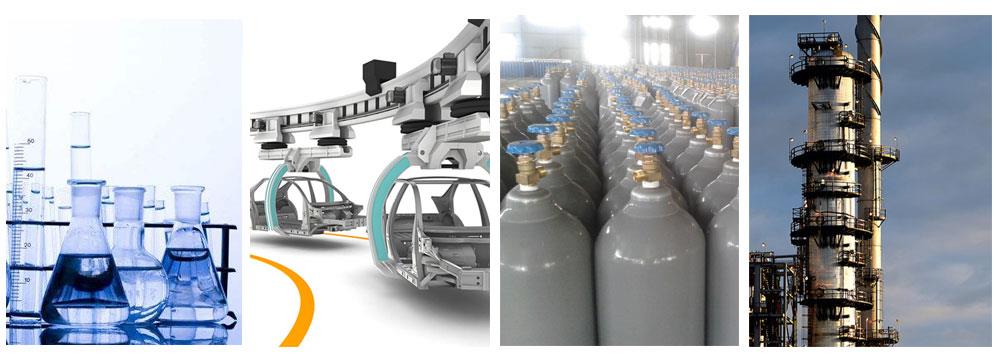
Portable hydrogen gas leak detector with alarming is suitable to monitor the concentration of H2 in the chemical workshop, hydrogen bottle tank storage area, new energy reaserch and development, laboratory, automobile industry, glass industry, fuel cell industry, battery room and so on.
 Tips: Case Study - Portable Hydrogen (H2) Gas Detector for Fuel Cell Company
A new energy company has been engaged in research and development, testing and production of various fuel cells for many years. The company has many hydrogen pipelines for the hydrogen (H2) is the main power source in the production process. To prevent the substandard process from the leakage of the hydrogen, the engineer made an inquiry about detecting the leakage of hydrogen to us.
They needed a portable hydrogen detector to detect H2 leaks at the ports of each pipeline, record the detection value in real time and save a set of data every 2s recording interval. Furthermore, they also required transmitting the data to computer for the analysis.
After the communication with the engineers based on their requirements, we recommended them a portable hydrogen (H2) gas detector ATO-GAS-H2, with measuring range of 0-1000ppm and resolution of 1ppm and also with data transmission and storage function.
After using this H2 gas detector for a period of time, they were very satisfied with the detection results. The hydrogen gas detector not only is accurate in detection, fast in response time, but also real-time records the detecting value and save the data.

Can we do it locally? What is the cal gas you recommend?
Since we only have a binary hydrogen/methane mixture and need to measure hydrogen, our thought was we could calibrate the unit using 100% methane as a zero or blank, and 100% hydrogen at the other end. The 2 gases have significantly different thermal conductivities, so as long your detector can provide accurate readings in such an environment, we can calculate the hydrogen vs. methane.
a) Could you explain how the detection is carried out during a measurement/pump cycle?
b) What is the diameter of the air inlet of the portable detector system?
If these 4 units work well in my applications, I will likely be purchasing 4 more.
Thanks for the update. In fact, these three ranges 0-100%LEL, 0-500ppm and 0-1000ppm can all measure H2 leakage.
Can you tell me what the accuracy and repeatability for this unit is? Also, If we were wanting to use it to detect around 27,500ppm, how many calibration points should we have and at what concentrations?
Also, is the calibration gas that used hydrogen mixed in air?
Do you have information on gas flow rates at different pump speeds in order to calculate the volume of gas being analyzed over time?
Do you have H2 on/off rates for the sensor? By this I mean how long does it take the sensor to register H2 presence and how long does it take for the sensor to reset.
Do you have any reference literature that would help understand the sensor capabilities?
In what gases and gas compositions can the device operate? We intend to measure in a stream what primarily consists of methane and carbon dioxide, but also contains smaller fractions of nitrogen and oxygen. As far as my knowledge goes, it does not contain any carbon monoxide.
Are temperatures lower than the indicated of -20oC detrimental for the device? We intend to measure around -35oC.
We want to measure process streams. To me it’s not fully clear what and how the inlet of the device works. Could you please elaborate? Like, can we attach BSP connections to it? Additionally, where is the outlet valve?
I want to use the detector in a laboratory-scale application. In a small closed system producing approximately 1-10 mmol of H2 per hour, which portable gas detector should I prefer for hydrogen production? I want a simpler way to determine the concentration rather than using a gas chromatography system with a TCD detector. Thank you.
I want to do soil gas field measurements and I'm looking for a portable gas detector, which tells me the exact amount of gases present at certain depth up to between 60 cm and 1m. Is your product able to manage these field conditions for these types of measurements and is it included with a probe that can be attached to the end of the flexible tube or there is no probe needed at all?
Thank you in advance!
Can these detectors be utilized as inline hydrogen meters? Specifically, is it possible to connect them to an exhaust gas line to measure the concentration of hydrogen in the exhaust gas, assuming that the hydrogen levels are low and within the detectable range of the device? What is the maximum continuous operating time for these detectors? I assume the fixed detector can operate 24/7, but could you confirm if this is correct? Additionally, what are the other implications of choosing a higher or lower maximum detectable range?
2. We plan to measure the H2 concentration in a mixed gas mixture generated during semiconductor manufacturing. Due to the variety of gases in the mixture, we are concerned about potential cross-interference. What types of gases might interfere with hydrogen measurements?

Industrial Vibration Sensor, RS485/4-20mA/0-5V/0-10V

Portable Oxygen (O2) Gas Detector, 0 to 30% Vol

Handheld Carbon Monoxide (CO) Gas Detector, 0 to 500/1000/2000 ppm

Handheld Ammonia (NH3) Gas Detector, 0 to 50/100/500 ppm

Portable Chlorine (Cl2) Gas Detector, 0 to 10/50/100 ppm

Portable Ozone (O3) Gas Detector, 0 to 10/20/50 ppm

Portable VOC Gas Detector, 0 to 100/200/1000 ppm

Fixed Ammonia (NH3) Gas Detector, 0 to 50/100/200 ppm

Fixed Carbon Monoxide (CO) Gas Detector, 0 to 100/500/1000 ppm
