
Features
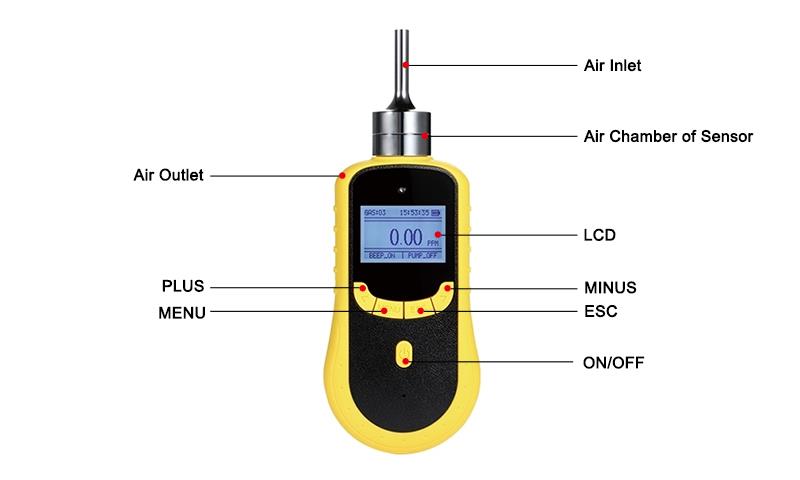
- LCD dot matrix display, direct readout of gas type, unit, concentration, local time, etc.
- Support English/Chinese operation, easy to shift.
- Gas concentration unit PPM and mg/m3 can be shift quickly.
- Built-in micro-sampling pump, 10 grades of suction are available.
- Explosion-proof certification
Gas Detector Functions
- With self-calibration and zero calibration functions, makes the detection more accurate and reliable.
- One key to restore factory setting, free from maloperation.
- With temperature and pressure compensation, able to realize the compensation for the gas concentration under different temperature and pressure environments.
- Two-stage alarm with sound and light, and alarm point is settable.
- Rechargeable lithiumpolymer battery with large capacity.
- High-strength special engineering plastic housing, with anti-slip, waterproof, dustproof and explosion-proof.
Specification
| Model | GD200-NH3 |
| Sampling Method | Pumping suction, flow rate can be up to 750ml/min |
| Detection Principle | Electrochemistry |
| Gas | Ammonia (NH3) |
| Range (Optional) * | 0 to 10ppm, 0 to 20ppm, 0 to 50ppm, 0 to 100ppm, 0 to 200ppm, 0 to 500ppm, 0 to 1000ppm, 0 to 2000ppm, 0 to 5000ppm |
| Resolution | 0.01ppm (0-10/20/50ppm), 0.1ppm (0-100/200ppm), or 1ppm (0-500/1000/2000/5000ppm) |
| Accuracy | ≤±3% F.S. |
| Response Time | ≤10s |
| Repeatability | ≤±1% |
| Recovery Time | ≤10s |
| Linearity Error | ≤±1% |
| Zero Shift | ≤±1% (F.S./year) |
| Data Logging (Optional Function) | High speed data transmission by USB, available for data downloading and printing (The built-in IC card has about 2G memory, which can record 100,000 sets of data.) |
| Alarms | Sound, light and vibration |
| Display | LCD dot matrix display |
| Language | Chinese/English |
| Battery | 3.7V rechargeable lithium battery, 3.7 Watt (Charger included: Input AC 100-240V 50/60Hz with optional USA, Europe or UK plug) |
| Operating Time | 100h (Pump off) |
| Explosion-proof Grade | II 1G Ex da ia IIC T4 Ga |
| Case Material | ABS+PC |
| Protection Grade | IP66 |
| Certification | CE, ATEX (Standard: EN IEC 60079-0:2018, EN 60079-1:2014) |
| Operating Temperature | -20℃~50℃ |
| Operating Humidity | 0~95%RH (non-condensing) |
| Operating Pressure | 0.8~1.2bar |
| Dimension | 205*75*32mm |
| Weight | 300g |
| Warranty | 12 months |
| Extension Probe | About 480mm (Total Length), About 300mm (Probe Head) |
| Accessories (Optional) | Calibration kit - gas pressure regulator (calibration gas cylinder NOT included)
|
Note 1:
If you require an XX gas detector with a measuring range not listed in the table above, please contact us with details about your operating environment. We can help you choose the right detector for your application.
- We also offer gas detectors for other common gases. Please refer to the ATO Gas Detector Catalog for available gas types and measuring ranges.
Note 2:
Regarding the flow rate for gas detectors, there are 2 types:
- Pump-Suction Type: Equipped with a built-in pump, with a flow rate of 600 mL/min. (Models: GD200, GD400, GD600)
- Diffusion Type: Not equipped with a built-in pump, with a flow rate of 300 mL/min. (Models: GD300, GD500, GD800)
If you require a customized flow rate, please let us know your specific requirements. We will evaluate whether customization is possible. A flow rate that is too high or too low can affect measurement accuracy, so we recommend using an appropriate flow rate for your application.
Flow rate only needs to be considered when sampling gas from pipelines. For measuring gas concentrations in normal ambient air, you do not need to consider the flow rate. To measure confined spaces such as pipelines, please get in touch with us and provide the detailed conditions of use.
*** Other Common Gases and Ranges Available for Portable Gas Detectors
| Gas Type | Measure Range | Resolution |
| Ammonia (NH3) | 0-10/20/50/100/200/500/1000/2000/5000ppm | 0.01ppm/0.1ppm/1ppm |
| Benzene (C6H6) | 0-1/5/10/20/50/100/200/500/1000/2000/5000/10000ppm | 0.001ppm/0.01ppm/0.1ppm/1ppm |
| Carbon Dioxide (CO2) | 0-1000/2000/5000/10000/20000/50000ppm, 0-10%/20%/30%/50%/100% VOL | 1ppm, 0.01% VOL |
| Carbon Monoxide (CO) | 0-10/20/50/100/500/1000/2000ppm | 0.001ppm/0.01ppm/1ppm |
| Chlorine (Cl2) | 0-5/10/20/50/100/200ppm | 0.001ppm/0.01ppm/0.1ppm |
| Chlorine Dioxide (ClO2) | 0-1/5/10/20/50/100ppm | 0.001ppm/0.01ppm/0.1ppm |
| Ethylene (C2H4) | 0-10/20/50/100/500/1000/2000ppm | 0.001ppm/0.01ppm/0.1ppm/1ppm |
| Flammable | 0-100% LEL | 1% LEL |
| Formaldehyde (CH2O) | 0-10/20/50/100/500/1000ppm | 0.01ppm/0.1ppm/1ppm |
| Hydrocarbons (HC) | 0-100% LEL | 1% LEL |
| Hydrogen (H2) | 0-10/20/100/500/1000/2000/3000/5000/10000/20000/40000ppm, 0-4% VOL | 0.001ppm/0.01ppm/0.1ppm/1ppm, 0.001% VOL |
| Hydrogen Chloride (HCl) | 0-10/20/50/100/200/500/1000/2000ppm | 0.01ppm/0.1ppm/1ppm |
| Hydrogen Cyanide (HCN) | 0-10/20/50/100ppm | 0.01ppm/0.1ppm |
| Hydrogen Fluoride (HF) | 0-1/5/10/50ppm | 0.001ppm/0.01ppm |
| Hydrogen Sulfide (H2S) | 0-5/10/20/50/100/200/500/1000/2000ppm | 0.001ppm/0.01ppm/0.1ppm/1ppm |
| Methane (CH4) | 0-100% LEL, 0-50%/100% VOL | 1% LEL, 0.01%VOL |
| Methyl Bromide (CH3Br) | 0-50/100/200/500/1000/2000/3000ppm | 0.1ppm/1ppm |
| Nitric Oxide (NO) | 0-20/50/100/250/500/1000ppm | 0.01ppm/0.1ppm/1ppm |
| Nitrogen (N2) | 0-99.99%/100% VOL | 0.01% VOL |
| Nitrogen Dioxide (NO2) | 0-20/50/100/500/1000ppm | 0.01ppm/0.1ppm/1ppm |
| Oxygen (O2) | 0-25%/30%/100% VOL | 0.01% VOL |
| Ozone (O3) | 0-1/5/10/20/50/100/200/500/1000/2000ppm | 0.001ppm/0.01ppm/0.1ppm/1ppm |
| Phosgene (COCl2) | 0-1/5/10ppm | 0.001ppm |
| Phosphine (PH3) | 0-10/20/50/100/500/1000/2000/3000ppm | 0.01ppm/0.1ppm/1ppm |
| Sulfur Dioxide (SO2) | 0-20/50/100/500/1000ppm | 0.01ppm/0.1ppm/1ppm |
| Sulfur Hexafluoride (SF6) | 0-1000/2000/3000ppm | 1ppm |
| Volatile Organic Compounds (VOC) | 0-1/5/10/20/100ppm | 0.01ppm/0.1ppm |
Details
Applications
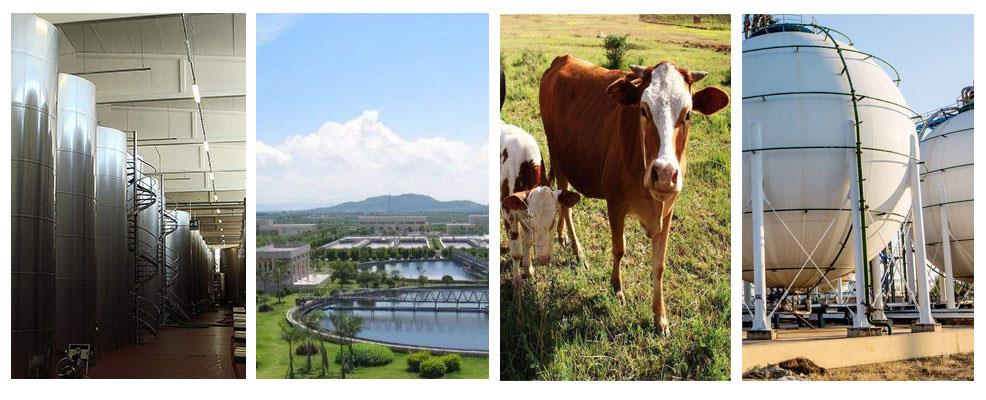
Handheld NH3 gas detector with built-in micro-pump is widely used in refrigerated space, liquid ammonia tank storage area, laboratory, livestock farm, sewage treatment plant, denitrification chemical industry, etc., to monitor the leakage of NH3 gas and give an alarm to protect humans and animals.
Tips: Ammonia (NH3) Gas Detector for Livestock Farm
The harm caused by ammonia to the pig farm may be far beyond our imagination, including the growth and development of pigs, the respiratory resistance, estrus, pregnancy and childbirth. Therefore, the developed countries in Europe and the United States have made strict requirements for the ammonia concentration in pig farms. EU requires that the ammonia (NH3) shall be lower than 10PPM while the United States requires to be lower than 15PPM.
The NH3 gas in the pig farm is mainly from the degradation and decomposition of feces and urine discharged by pigs every day. In cold seasons (winter and spring), the delivery room and nursery house are closed to keep warm. Large amount of ammonia, hydrogen sulfide and carbon dioxide produces and accumulates in the rooms. As the concentration gets higher, the risk becomes greater. To solve this problem, ATO launched the ammonia (NH3) gas detector, which has a proper price and excellent performance. It can provide a strong guarantee for improving the farming environment.

1. What is the outside diameter of the sampling probe at the top of the unit?
2. Can the alarm be turned off so that this can be used as a quantitative detector?
3. What type of sensor is this? Electrochemical, PID etc?
5. Does it have an internal pump to take samples? What is the flow rate of this pump?
I see from the table below that this sensor is recommended for the detection of NH3 gas concentration in the air.
Is the sensor still accurate when rather than in air ammonia is in hydrogen (with no air)?
0.01 ppm or better?
Battery-powered is preferred but can be 120VAC.
It will need to show instant results and hold the low, high, and average readings.
I am contacting you because the detector does not seem to detect any ammonia and I would therefore like to ask for some clarifications.
We would like to connect the sensor to a line in which a mixture of hydrogen and a few ppm of ammonia are flowing. What is the suggested flow rate for the detector to be able to correctly take a sample of gas?
Would you have any advice to improve the reading of the detector?
1) What are the different micro sampling pump options? I am interested in using a flow rate of around ~10 ml/min to up to 100 ml/min.
2) Can the detector function if the background gas is oxygen?

Portable Oxygen (O2) Gas Detector, 0 to 30% Vol

Handheld Carbon Monoxide (CO) Gas Detector, 0 to 500/1000/2000 ppm

Handheld Hydrogen Sulfide (H2S) Gas Detector, 0 to 50/100/500 ppm

Portable Hydrogen (H2) Gas Detector, 0 to 500/1000/2000 ppm

Portable Carbon Dioxide (CO2) Infrared Gas Detector, 0 to 2000/5000/10000 ppm

Fixed Ammonia (NH3) Gas Detector, 0 to 50/100/200 ppm
Handheld Carbon Monoxide (CO) Gas Detector, 0 to 500/1000/2000 ppm
Handheld Hydrogen Sulfide (H2S) Gas Detector, 0 to 50/100/500 ppm