
DC current sensor has measuring range of 50A/100A/200A/300A/400A/500A/600A/800A/1000A/1200A to 1500A.
Specification:
| Model | ATO-AHKC-EKAA | ATO-AHKC-EKBA | ATO-AHKC-EKCA |
| Shipping weight | 1kg | ||
| Hole diameter * | 20mm | 40mm | 55mm |
| Measuring range of input current * | DC 0-50A ~ 0-500A | DC 0-200A ~ 0-1000A | DC 0-500A ~ 0-1500A |
| Output signal | DC 4-20mA | ||
| Zero offset current | ±0.05mA | ||
| Offset current drift | ±0.04mA/℃ | ||
| Linearity | ≤0.2%FS | ||
| Power supply * | DC 24V±10% or DC 12V±10% | ||
| Accuracy | 1.0%F.S. | ||
| Response time | ≤1ms | ||
| Withstand voltage | AC 2500V (between input, output and power supply) | ||
| Work temperature | -25~+70℃ | ||
| Storage temperature | -40~+85℃ | ||
| Humidity | ≤95%RH (no dew formation, no corrosive gas) | ||
| Elevation | ≤3500m | ||
| Measuring method | Split-core type | ||
| Installation | Screw fixation | ||
50A to 1500A DC current sensor dimensional diagram: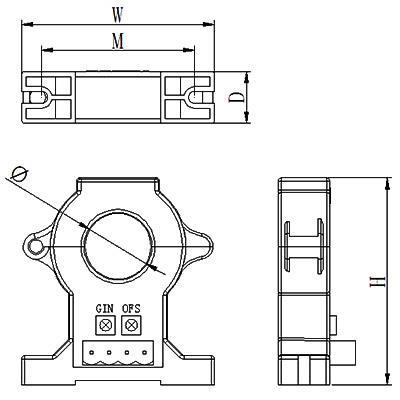
| Model | Dimension (mm) | ||||
| W | H | D | Φ (Hole diameter) | M (Mounting) | |
| ATO-AHKC-EKAA | 60 | 64 | 16 | 20 | 47 |
| ATO-AHKC-EKBA | 100 | 102 | 24 | 40 | 80 |
| ATO-AHKC-EKCA | 115 | 110 | 27 | 55 | 95.5 |
50A to 1500A DC current sensor wiring diagram: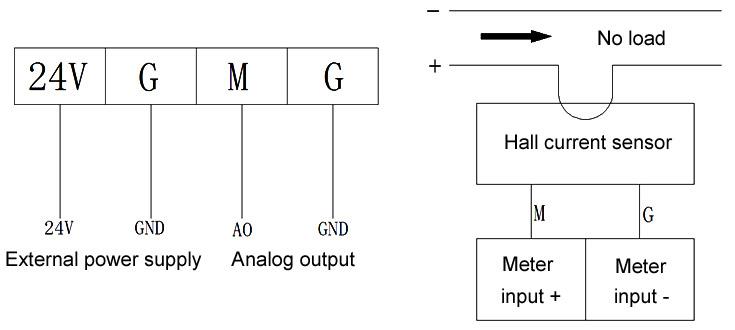
Details

Tips: The advantages of Hall effect current sensor
- High accuracy: The precision of Hall effect current sensor is high, the accuracy is better than 1.0%FS in the operating temperature zone, some can reach 0.5%FS, and this accuracy is suitable for any waveform measurement. While the accuracy of general current transformer is generally 3~5%FS, and is only suitable for 50Hz sine wave.
- Good linearity: Hall current sensor has good linearity and is better than 0.1%.
- Dynamic performance: The Hall effect current sensor dynamic performance is very good. Some of the response time can be less than 5us, tracking speed di/dt is higher than 50A/μs, This excellent dynamic performance provides a key basis for improving the performance of modern control systems. Compared with this, the response time of ordinary current transformer is 10-12ms, which cannot meet the needs of the development of industrial control system.
- Working frequency band: The Hall current sensor has a wide working frequency band and the accuracy is 1% in the 0-100kHz frequency range. The accuracy is 0.5% in the 0-5kHz frequency range.
- Measuring range: The Hall current sensor measurement range is large. Hall sensor current measurement is up to 50000A, can measure AC and DC current, it also has no special requirements for waveform. AC current transformers can only measure AC current, and the frequency must be rated frequency, such as 50Hz. The error of current transformer for 60Hz measurement is relatively large. The output signal cannot be directly connect to the electronic detection circuit.
- Overload capacity: The Hall effect current sensor's overload capacity is very strong, when the original current overload, the current sensor reached saturation condition, it can be automatically protected, even if the overload current is 20 times to the rated value, the current sensor will not be damaged.
In addition, Hall sensor also has the advantages of small size, light weight, high sensitivity and strong anti-electromagnetic interference ability. This makes Hall sensors be used in the industrial field extensively, and the market space is gradually increasing.
Product reviews
Can DC current sensors be calibrated?
Sherylk

5/19/2021 1:56 AM
Can your DC current sensor be calibrated? Is that what the adjustment screws are in blue?
Was this review helpful? (0/0)
Do you have a recommended validation method for how to verify the sensor is measuring the current properly using the entire range of 0-400A?
DeLisle
12/12/2022 7:26 PM
I have bought the 0-400A DC current sensor, and I require a way of validating the sensor. Do you have a recommended validation method for how to verify the sensor is measuring the current properly using the entire range of 0-400A?
Was this review helpful? (0/0)
Why current sensor is outputting too much current on a line
wendy
6/14/2023 2:17 AM
We have 2 of these, in the 200 amp range: https://www.ato.com/dc-current-sensor-50a-to-1500a
I installed one of them a few months ago for one of our large solar pumps, which should be drawing 90 amps DC from the solar panels. It has been working fine. I tested it yesterday with a multi-meter and it was outputting 13mA.
Recently I installed the other one on a larger solar pump which should be drawing about 120 amps. For some reason it is always outputting more than 20mA. I was seeing 50mA on it yesterday.
I removed the DC current sensor from the smaller pump and installed it on the DC line for the larger pump, and that one was showing me 35 mA on that line, even though a clamp meter was showing me 119 amps DC.
Yesterday I ordered a 300 amp version of that current sensor from your website, just in case I needed a bigger range.
Do you have any guesses as to why it's outputting too much current on a line that should be a maximum of 120 amps on the sensor that can read up to 200 amps?
Was this review helpful? (0/0)
Solve the problem of current sensor
harrison
6/14/2023 3:35 AM
Thank you. I did double-check the zero point today and it was at 3mA. I adjusted it with the pot so that it was at 4mA. But now it's showing 92mA on the output end.
I tried using the span pot to change the output, but moving the span pot all the way from left to right doesn't change the output at all. Would you say the sensor is probably burned out, since the 2nd pot doesn't have any effect on the output?
I tried using the span pot to change the output, but moving the span pot all the way from left to right doesn't change the output at all. Would you say the sensor is probably burned out, since the 2nd pot doesn't have any effect on the output?
Was this review helpful? (0/0)
Supporting Facilities
Dixina
8/5/2025 8:52 PM
Can you recommend a panel meter that works with the ATO-CUS-DC1500 Hall-effect DC current sensor?
Was this review helpful? (0/0)
Only registered users can write reviews
Customers who bought this item also bought

Isolated DC Voltage Sensor 10mV to 1000V, Power Supply DC 12V/24V
ATO-VOS-DC1000
$141.96
DC voltage sensor uses modulation and demodulation technology to achieve input/output/power supply isolation. Isolated voltage transducer has measuring range from DC 10mV/50mV/75mV/5V/150V/300V/500V to 1000V, supply voltage DC 12V/24V, accuracy 0.2%FS, output signal 0-5V/0-10V/0-20mA/4-20mA and strong anti-interference capability. DC voltage sensor is widely used for voltage isolated measuring and control, such as electric power, remote monitoring, medical equipment, etc.

AC Current Sensor 50A/100A/400A/600A/1000A/1200A to 1500A
ATO-CUS-AC1500
$87.36
Hall effect AC current sensors are non-invasive current sensors, with 1.0%FS accuracy, 1ms fast response time, 0-50A ~ 0-1500A measuring range, 4-20mA output signal, 12V/24V power supply, fixed installation, excellent linearity and strong anti-interference capacity. Open loop AC current sensors can be connected to AD, DSP and PLC directly. AC current sensors are now widely used for AC current measurement.

Inductive Proximity Sensor for Metal, 2 Wire, M24, 12V-24V
ATO-PROS-I24
$39.75
M24 proximity sensor is compact and can stably detect a variety of metal objects with a standard detection distance of 10mm. It supports DC 12V-24V power supply and has IP67 protection level. The proximity sensor can be installed in unshielded type, has strong anti-interference ability and long service life, and is sold directly by the manufacturer.

3 Phase AC Voltage Transducer 10V to 500V, Output 0-5V/4-20mA/0-20mA
ATO-VOS-3AC500
$177.78
3 phase AC voltage transducer is a special voltage sensor for three-phase AC voltage measurement. Voltage transducer has a measuring range from AC 10V to 500V, supply voltage DC 12V/24V, output signal DC 0-5V/0-20mA/4-20mA. 3 phase voltage transducer is mainly used for power monitoring, power control and dispatching systems in petroleum, coal, metallurgy, railway and other industries.

Non-invasive DC Current Sensor 400A/1000A/2000A/10000A to 20000A
ATO-CUS-DC20000
$122.98
Hall effect DC current sensor is non-invasive current sensors, with split-core structure, 1ms fast response time, 1.0%FS accuracy, 4-20mA output signal, 12V/24V power supply, strong anti-interference capacity. Open loop current sensors are widely used for DC current monitoring of battery/power inverter/UPS/solar power supply.
Related products

Hall Effect Current Sensor 50A/100A/200A/500A/800A/1000A
ATO-CUS-ACDC2000
$77.75
Hall effect current sensors are AC/DC universal current sensors, through-hole design, 1.0%FS accuracy, 0-4V/0-5V output signal, ±15V power supply, 5us fast response time, fixed installation. Open loop current sensors are widely used for AC/DC current measurement of VFD/DC motor drive/servo control system.

Current Sensor AC/DC 50 amp/100 amp/1000 amp to 2000 amp
ATO-CUS-ACDC2000S
$74.18
AC/DC current sensors have a small size, square-hole design, 1.0%FS accuracy, 0-4V/0-5V output signal, ±15V power supply, 5us fast response time, excellent linearity, strong anti-interference capacity. Open loop current sensors are widely used for AC/DC current measurement of dc motor drive/plating and welding control system.

Hall Effect Current Sensor 400A/2000A/3000A/5000A/8000A to 20000A
ATO-CUS-ACDC20000
$122.98
Hall effect current sensors are AC/DC universal current sensors, with non-invasive structure, 5us fast response time, 1.0%FS accuracy, 0-5V output signal, ±15V power supply, measuring range can be 0-400A ~ 0-20000A or even higher current. Open loop current sensors are widely used for AC and DC high current detection, such as the high frequency switching power supply and solar power supply management system.

Split-core AC Current Sensor 400A/2000A/8000A/10000A to 20000A
ATO-CUS-AC20000
$151.19
Hall effect AC current sensors have non-invasive structure, with 1.0%FS accuracy, 1ms fast response time, 0-400A ~ 0-20000A measuring range, 4-20mA output signal, 12V/24V power supply, excellent linearity and strong anti-interference capacity. Open loop AC current sensors can be connected to AD, DSP and PLC directly. AC current sensors are now widely used for high current measurement of control systems.