
Proximity Sensor
Proximity sensors & switches are divided into inductive proximity sensor, capacitive proximity sensor, magnetic proximity sensor, ultrasonic proximity sensor and microwave proximity sensor, etc. Proximity sensor can support using with PLC, SCM, Sr circuit, Electronic counter, solid state relay, miniature relay and other products. In an automatic control system, proximity sensor can be used as a device for the limit, count, positioning control and automatic protection.
Proximity sensor has a small size, cheap price, fast frequency response, wide voltage range, anti-interference ability, long life, low power consumption, no mechanical wear, no sparks, no noise, corrosion resistance, vibration resistance and other characteristics. So proximity sensor can be used in poor work environments.
Proximity Sensor Types
Inductive Proximity Sensor
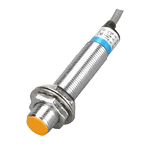 The inductive proximity sensor consists of a high-frequency oscillation circuit, a detection circuit, an amplifying circuit, a shaping circuit and an output circuit. The sensing element used for detection is the detection coil, which is an integral part of the oscillating circuit.
Capacitive Proximity Sensor
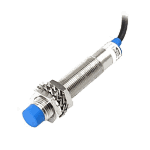 Capacitive sensors are constructed from many different media, such as copper, indium tin oxide (ITO), and printing inks. Copper capacitive sensors can be implemented on standard FR4 PCBs as well as flexible materials. ITO allows up to 90% transparency for capacitive sensors (for one-layer solutions such as touch phone screens).
Magnetic Proximity Sensor
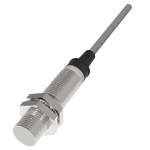 Hall magnetic proximity sensor is a non-contact position detection switch with the function of converting a magnetic quantity signal into an electrical signal. ATO magnetic proximity sensors are at a low price, providing M8, M12, and M18 thread sizes for you to choose from, NPN/ PNP, and NO/ NC signal output, which are mainly used for special-purpose machinery, automatic controls, packaging and conveyor systems.
Photoelectric proximity sensor
Photoelectric proximity sensor detects by emitting a beam of light (usually infrared or laser) and receiving changes in the light reflected or blocked by the object. It can detect a variety of objects, has a fast response speed and a long detection distance, and is often used in packaging lines, robot vision systems, etc., but may be affected by strong light or dust.
Ultrasonic proximity sensor
Ultrasonic proximity sensors emit high-frequency sound waves and detect their return time to determine the distance and existence of the target object. It is suitable for detecting transparent, reflective or irregularly shaped objects, and is commonly used in material level detection, obstacle detection and automatic parking systems. Its advantage is a wide detection range, and its disadvantage is that it is sensitive to wind and temperature changes.
Laser proximity sensor
Laser proximity sensor uses a high-precision laser beam for non-contact measurement, and is usually used for high-precision position measurement and distance feedback control. It can detect extremely small objects and long-distance targets, and is often used in industrial robots, precision assembly lines and other fields. The disadvantage is that the price is relatively high and there are certain requirements for environmental cleanliness.
Microwave proximity sensor
Microwave proximity sensor emits high-frequency microwave signals and detects the presence and movement of objects by analyzing changes in reflected waves. It has strong penetrating ability and is suitable for harsh environments such as smoke, dust, rain and snow. It is often used in security systems, traffic monitoring and intelligent lighting sensing systems. It has good stability, but its sensitivity is affected by the target material and direction.
Limit Switch vs. Proximity Sensor & Switch
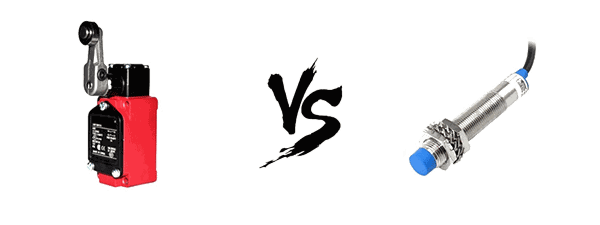
- Proximity sensors are non-contact switches with long life and are suitable for passing objects. Limit switches are contact switches. Due to the internal contacts, the working life is relatively shorter.
- Limit switches are used for position detection in one direction. For two-way position detection, using a proximity sensor is better.
- Use limit switch for protection function. Use a proximity sensor to detect when an object passes a certain point.
- The limit switch usually has 1 NO + 1 NC contact. Generally, only one group of contacts is used, so there are 2 wires. Proximity sensors generally adopt 2-wire, 3-wire and 4-wire, so they have more wires than limited switches. Some proximity sensors have to confirm it is PNP or NPN based on the connected equipment.
How to Change the PNP Proximity Sensor to NPN?
The polarity of the proximity sensor has two types, PNP and NPN. The principle of PNP and NPN sensors is to use the saturation and cut-off of triodes to output two states, which belong to switch sensors, but the output signals are diametrically opposite. high level and low level. NPN output is low level 0, and PNP output is a high level 1. The following video shows you how to change the PNP (NPN) type proximity sensor to the NPN (PNP) type.


Analog Output Inductive Proximity Sensor, Cylindrical, 0-10V/4-20mA

Hall Magnetic Proximity Sensor, M18, NPN/ PNP, NO/NC

Analog Output Inductive Proximity Sensor, M18, Flush/Non-flush

Inductive Proximity Sensor, Ring Type, 10mm, PNP

Inductive Proximity Sensor, Ring Type, 6mm, NPN

Magnetic Reed Proximity Sensor for Doors, NO Contact

Inductive Proximity Sensor, Ring Type, 15mm, 2 Wire

Inductive Proximity Sensor, Ring Type, 21mm, M12

Small Proximity Sensor, Inductive, NPN NO, M4/M5/φ3/φ4

Square Inductive Proximity Sensor, Rectangular, NPN/PNP, NO/NC

M12 Proximity Sensor, Inductive, NPN NO, Unshielded, 4mm

Ultrasonic Proximity Sensor, Cylindrical, NPN/PNP, NO/NC


