
Ultrasonic proximity sensor (analog output type) has short-circuit protection and reverse connection protection, which is safer. With a protection level of IP67 and an operating temperature range of -25℃ to +70℃, it can be used in complex or harsh environments and is suitable for automation applications that continuously monitor the position or distance of objects.
Specification
| Model | ATO-UB300-18GM45-U/I/IU | ATO-UB500-18GM45-U/I/IU | ATO-UB1000-18GM55-U/I/IU |
| Detection range | 30-300mm | 50-500mm | 60-1000mm |
| Signal output | 0-10V/4-20mA/0-10V + 4-20mA | ||
| Blind zone | 0-30mm | 0-50mm | 0-60mm |
| Resolution | 0.1mm | 0.15mm | 0.17mm |
| Repeatability | 0.15% offull-scale value | ||
| Absolute accuracy | ±1% (built in temperature drift compensation) | ||
| Switching hysteresis | 2mm | ||
| Switching frequency | 45Hz | 31Hz | 19Hz |
| Response time | 22ms | 32ms | 52ms |
| Power-Up Timer | <500ms | ||
| Operating voltage | 10-30V DC, Reverse Polarity Protection | ||
| LED red ligh | No target is always bright, and no target flashes when studying | ||
| LED green light | Detected that the target is always bright, and the target flashes when studying | ||
| Overpower protection | 200mA, redlight and green light flashing at the same time | ||
| Load impedance | I/<300 Ohm, U/>1k Ohm | ||
| No-load current | ≤30mA | ||
| Material | Plastic, Nickel Plated, Brass, Urethane Foam | ||
| Connection type | 5pin M12 connector | ||
| Protection class | IP67 | ||
| Environmental temperature | -25℃~+70℃ (248~343K) | ||
| Storage temperature | -40℃~+85℃ (233~358K) | ||
| Weight | 32g | 38g | |
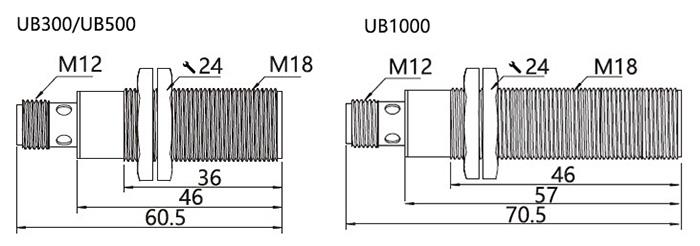
Dimension (unit: mm)
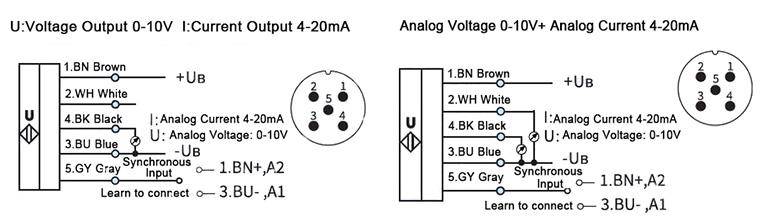
Wiring diagram
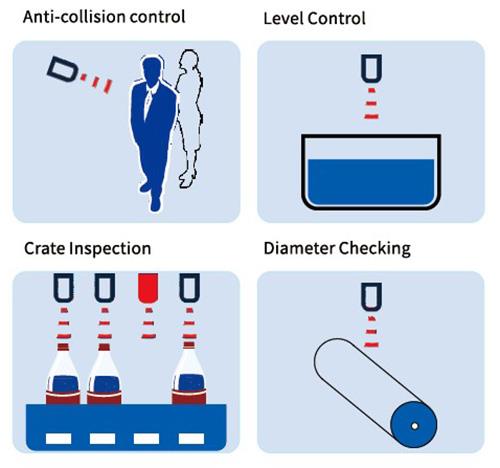
Applications
Tips: Application advantages of ultrasonic proximity sensors
Ultrasonic proximity sensors have excellent material adaptability and detection stability, and are almost not affected by color, transparency or surface reflection. They are suitable for a variety of complex application environments, including:
- Liquid detection: It can accurately detect various liquids, such as pure water, oils and various chemical solvents.
- Color insensitivity: Easily identify inks, inks and fiber fabrics of different colors, and color changes do not affect the detection effect.
- Reflective material detection: It can also detect highly reflective materials such as gold foil and silver foil reliably, avoiding common misjudgments of photoelectric sensors.
- Transparent material detection: It is suitable for detecting transparent materials such as glass bottles, glass plates, transparent PP/PE/PET films, etc.
- Bulk materials and level control: It can be used for automatic level detection and control of grains, granular materials, etc. It can also be applied to powdered materials: such as coal, wood chips, cement, etc., and can also achieve stable non-contact level monitoring.
Only registered users can write reviews
Related products

Analog Output Proximity Sensor, Inductive, Flush/ Non-flush, IP67
ATO-PS-LR12X
$173.90
Reasonable price analog output proximity sensor online for sale, analog inductive sensor has flush/ non-flush two installation types for selection, three output methods can be chosen, M12 connector or 2m PVC cable two connection types. It has an IP67 protection level, and can operate reliably in dust and water vapor environments. M12 proximity sensor is widely used in displacement measurement, thickness measurement, material differentiation and other fields.

Analog Output Proximity Sensor, Inductive, M12 Connector/ 2m PVC Cable
ATO-PS-LR18X
$164.45
Good price proximity sensor for sales, with withstand voltage 1000V/ AC 50/ 60Hz 60s, two installation types (flush and non-flush) for selection, three output methods and two connection types can be chosen. The sensor has a repeatability of ≤±3%, and can maintain a stable output in multiple tests. It has advantages of light weight, small size and long service life.

Analog Output Inductive Proximity Sensor, Cylindrical, 0-10V/4-20mA
ATO-PS-LR30X
$173.97
Good price analog inductive proximity sensor with flush/ non-flush two installation types, supply voltage 15-30VDC, detection range 2-10mm/ 3-15mm, 0-10v/ 0-10v+0-20mA/ 0-20mA/ 4-20mA three output methods. M30 proximity sensor has an operating temperature range of -25℃ to 70℃ and IP67 protection level, making it suitable for various industrial environments.

Analog Output Inductive Proximity Sensor, M18, Flush/Non-flush
ATO-AIPS-LR18X
$164.45
Lower cost analog output proximity sensor for sale online. The inductive sensor analog output with flush/ non-flush two installation types for selection, M12 connector/ 2m PVC cable two connection types are available. The sensor supports a variety of analog signal output methods, including 0–10V, 0–20mA, 4–20mA and 0–10V+0–20mA. M18 proximity sensor has advantages of light weight, small size and long service life.