Ultrasonic Proximity Sensor, Cylindrical, NPN/PNP, NO/NC

$511.62
Affordable price cylindrical ultrasonic proximity sensor has three optional detection ranges of 30–300mm, 50–500mm and 60–1000mm, supports 1 NPN and 1 PNP switch output, NO/NC adjustable, suitable for a variety of automated detection scenarios. Its IP67 protection grade ensures stable operation in harsh environments and can be used for non-contact detection of targets of various materials.
SKU: ATO-UPROS-18GME2E3
*
*
Free Shipping
Delivery date: 6-12 days

Ultrasonic proximity sensor supports 10–30V DC wide voltage input and has reverse connection protection. The operating temperature range is -25℃ to +70℃, and the storage temperature can reach -40℃ to +85℃, so it can handle complex working conditions without any pressure.

Specification

ModelATO-UB300-18GM45-E2/E3ATO-UB500-18GM45-E2/E3ATO-UB1000-18GM55-E2/E3
Detection range30-300mm50-500mm60-1000mm
Signal output1 NPN/1 PNP switch output, NO/NC adjustable  (E2: NPN, E3: PNP)
Blind zone0-30mm0-50mm0-60mm
Resolution0.1mm0.15mm0.17mm
Repeatability0.15% offull-scale value
Absolute accuracy±1% (built in temperature drift compensation)
Switching hysteresis2mm
Switching frequency45Hz31Hz19Hz
Response time22ms32ms52ms
Power-Up Timer<500ms
Operating voltage10-30V DC, Reverse Polarity Protection
LED red lighNo target is always bright, and no target flashes when studying
LED green lightDetected that the target is always bright, and the target flashes when studying
Overpower protection200mA, redlight and green light flashing at the same time
Load impedanceI/<300 Ohm, U/>1k Ohm
No-load current≤30mA
MaterialPlastic, Nickel Plated, Brass, Urethane Foam
Connection type5pin M12 connector
Protection classIP67
Environmental temperature-25℃~+70℃ (248~343K)
Storage temperature-40℃~+85℃ (233~358K)
Weight32g38g


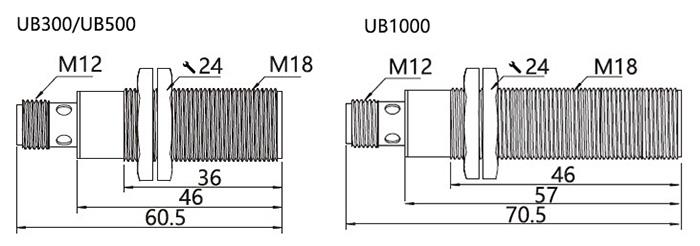
Dimension (unit: mm)

Ultrasonic proximity sensor dimensions

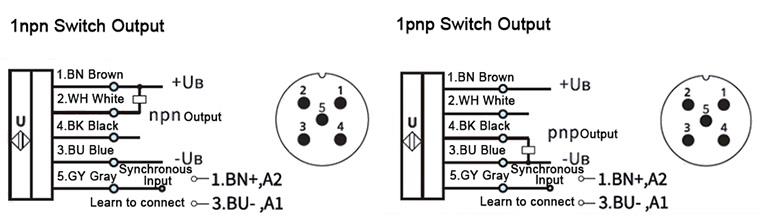
Wiring diagram

Ultrasonic proximity sensor npn/pnp wiring

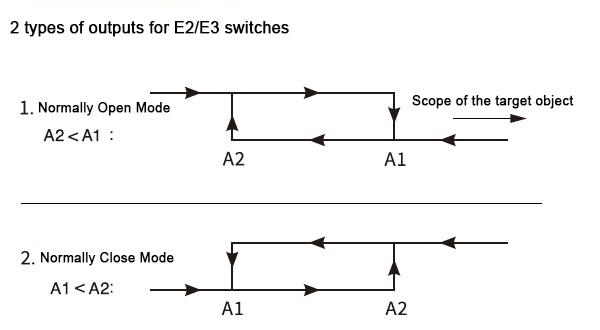
Output method

Ultrasonic proximity sensor output method

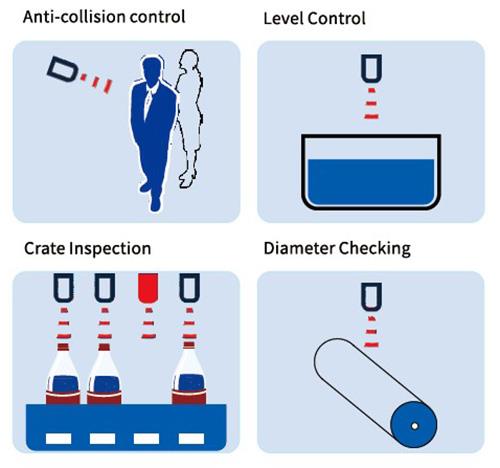
Applications

Ultrasonic proximity sensor applications

Tips: Principle of ultrasonic proximity sensor

Ultrasonic proximity sensors use the characteristics of sound waves to provide a non-contact, accurate detection solution for the state and distance of objects. The sensor transmits a high-frequency mechanical sound wave and receives the sound wave reflected back from the object. After calculating the time or energy between the emission and reception of the sound wave, the precise distance or state of the target object is obtained.

Ultrasonic proximity sensors are different from ordinary proximity switches and photoelectric sensors. Compared with inductive or capacitive proximity switches, it has a longer detection distance. Compared with photoelectric sensors, it can be used in harsher environments and is not affected by the color of the target object, dust, water mist, etc. in the air. Ultrasonic sensors are suitable for detecting objects in different states, such as liquids, transparent materials, reflective materials, and particulate matter.

Write your review
  • Only registered users can write reviews
*
*
  • Bad
  • Excellent
*
*
*
*

Ultrasonic proximity sensor supports 10–30V DC wide voltage input and has reverse connection protection. The operating temperature range is -25℃ to +70℃, and the storage temperature can reach -40℃ to +85℃, so it can handle complex working conditions without any pressure.

Specification

ModelATO-UB300-18GM45-E2/E3ATO-UB500-18GM45-E2/E3ATO-UB1000-18GM55-E2/E3
Detection range30-300mm50-500mm60-1000mm
Signal output1 NPN/1 PNP switch output, NO/NC adjustable  (E2: NPN, E3: PNP)
Blind zone0-30mm0-50mm0-60mm
Resolution0.1mm0.15mm0.17mm
Repeatability0.15% offull-scale value
Absolute accuracy±1% (built in temperature drift compensation)
Switching hysteresis2mm
Switching frequency45Hz31Hz19Hz
Response time22ms32ms52ms
Power-Up Timer<500ms
Operating voltage10-30V DC, Reverse Polarity Protection
LED red lighNo target is always bright, and no target flashes when studying
LED green lightDetected that the target is always bright, and the target flashes when studying
Overpower protection200mA, redlight and green light flashing at the same time
Load impedanceI/<300 Ohm, U/>1k Ohm
No-load current≤30mA
MaterialPlastic, Nickel Plated, Brass, Urethane Foam
Connection type5pin M12 connector
Protection classIP67
Environmental temperature-25℃~+70℃ (248~343K)
Storage temperature-40℃~+85℃ (233~358K)
Weight32g38g


Dimension (unit: mm)

Ultrasonic proximity sensor dimensions

Wiring diagram

Ultrasonic proximity sensor npn/pnp wiring

Output method

Ultrasonic proximity sensor output method

Applications

Ultrasonic proximity sensor applications

Tips: Principle of ultrasonic proximity sensor

Ultrasonic proximity sensors use the characteristics of sound waves to provide a non-contact, accurate detection solution for the state and distance of objects. The sensor transmits a high-frequency mechanical sound wave and receives the sound wave reflected back from the object. After calculating the time or energy between the emission and reception of the sound wave, the precise distance or state of the target object is obtained.

Ultrasonic proximity sensors are different from ordinary proximity switches and photoelectric sensors. Compared with inductive or capacitive proximity switches, it has a longer detection distance. Compared with photoelectric sensors, it can be used in harsher environments and is not affected by the color of the target object, dust, water mist, etc. in the air. Ultrasonic sensors are suitable for detecting objects in different states, such as liquids, transparent materials, reflective materials, and particulate matter.

Only registered users can write reviews