
Power Transducer
High-quality power transducers for sale online. ATO power transducers are devices that measure voltage, current, power or energy in power systems. ATO offers different types of power transducers, from single phase to three phase, with detection types including current, voltage, power and frequency. ATO power transducers are all mounted on 35mm standard rails, with ABS fireproof material as the shell, response time less than 400ms, and accuracy up to 0.2% or 0.5%. These power transducers have the advantages of high accuracy, high stability and long service life, and are rugged and suitable for most environments.
What is a Power Transducer?
A power transducer is a device used to measure voltage, current, power or energy in a power system and convert it into a standardized signal (such as 4-20mA, 0-5V or RS485, etc.) for remote monitoring, control or data acquisition for use by monitoring systems. The main function of a power transducer is to measure AC or DC power parameters (such as active power, reactive power, apparent power) in real time, and convert electrical parameters into standard signals for easy reading by PLC, DCS or other automation systems. At the same time, the power transducer provides electrically isolated power to prevent high voltage or high current from causing damage to subsequent equipment and the human body. It is suitable for applications such as industrial power monitoring, energy management, and equipment protection.
Single Phase Power Transducer vs. Three Phase Power Transducer
Single Phase Power Transducer:
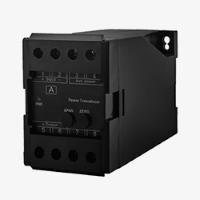 Single phase power transducer is suitable for single-phase AC systems, which is commonly used in low-power occasions such as household electricity, small equipment, and lighting circuits. Single phase power transducer directly measures single-phase voltage and current, requiring only 1 voltage and 1 current input, and is suitable for low-power, symmetrical loads. Application scenarios of single phase power transducer include household electricity monitoring, small commercial equipment (such as air conditioners, charging piles) and laboratory single-phase load testing.
Three Phase Power Transducer:
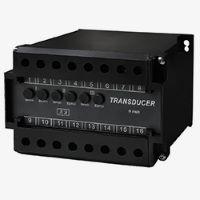 Three phase power transducer is suitable for three phase AC systems, mainly used in medium and high power occasions such as industrial motors, power distribution systems, photovoltaic inverters, and large power equipment. Three phase power transducer needs to measure three-phase voltage and current, requires multi-channel synchronous sampling, complex algorithm (involving vector synthesis), and can handle unbalanced loads. The application scenarios of three phase power transducers include industrial motor energy efficiency monitoring, substations, and power management of distribution cabinets.
The Difference Between Current Transducer and Voltage Transducer
Current transducer: The current transducer is a device that converts the current signal (AC or DC) in the power system into a standardized output signal, which is often used in monitoring and control loops. It achieves high-precision measurement through principles such as mutual inductor (CT), Hall effect or shunt resistor, and provides electrical isolation to protect back-end equipment.
Voltage transducer: The voltage transducer is a device that converts a voltage signal (AC or DC) into a standard signal in proportion, usually using technologies such as resistor voltage division, voltage transformer (PT) or isolation amplifier. It is characterized by high input impedance and wide range coverage.
How to Maintain ATO Power Transducers?
- Ensure that the power transducer housing is free of cracks, deformation or damage to prevent dust and moisture from entering and affecting operation.
- Check whether the cable terminals are firm, loose or oxidized to avoid poor contact causing measurement errors or signal loss.
- Use a multimeter or oscilloscope to measure the input voltage and current regularly to ensure that power transducer works within the rated range.
- Ensure that the power transducer is installed in a clean and dry environment to avoid moisture, dust or corrosive gases that affect performance.
- The power transducer should operate within the specified ambient temperature range.
- Abnormal fluctuations in power transducer readings or increased errors may require recalibration.

1-phase AC Current Transducer, 0-1A/5A/10A/20A

3-phase AC Current Transducer, 0-1A/5A/10A/20A

DC Current Transducer, 0-1A/5A/10A/75mV

1-phase AC Voltage Transducer, 0~120V/300V/450V/600V

3-phase AC Voltage Transducer, 0~120V/300V/450V/600V

DC Voltage Transducer, 0-50V/150V/300V/400V/600V

Active Power Transducer, 3 Phase 3 Wire/ 3 Phase 4 Wire

Reactive Power Transducer, 3 Phase 3 Wire/ 3 Phase 4 Wire

Active and Reactive Combined Transducer, 3 Phase 3 Wire/ 3 Phase 4 Wire


