
The DC voltage transducer with a reasonable price has an output voltage of 0-10VDC/0-5VDC/1-5VDC and an output current of 0-1mA/0-10mA/0-20mA/4-20mA. The working environment temperature is 0~50℃ and the humidity is <80% relative humidity (no condensation). The storage condition is the temperature is -20~70℃ and the relative humidity is less than 70% (no condensation).
Specification
| Model | ATO-PT-HDB-DV |
| DC Input | 0-50V, 0-150V, 0-300V, 0-400V, 0-600V, customization (optional) |
| Allow Overload | Voltage×1.2 times the nominal value lasts |
| Accuracy | 0.2, 0.5 (optional) |
| Response Time | ≤400ms |
| Output Channel | 1 channel, 2 channels, 3 channels (optional) |
| Output Voltage | 0-10V, 0-5V, 1-5V (load resistance = input voltage/10mAdc) |
| Output Current | 0-1mA, 0-10mA, 0-20mA, 4-20mA (Load resistance=10VDC/output current) |
| Other Output | RS485, customization |
| Output Ripple | ≤0.5% RO peak |
| Work Environment tTemperature and Humidity | 0~50℃/less than 80% relative humidity (no condensing) |
| Storage Conditions Temperature and Humidity | -20~70℃/less than 70% relative humidity (no condensation) |
| Aux.power Supply | DC12V, DC24V, AC220V, DC220V, AC110V, DC110V, 2-wire circuit power supply (optional) |
| Isolation | Input/output/power supply/shell |
| Power Consumption | DC about 3W, AC about 4VA |
| Material of Shell | ABS fireproof material |
| Weight | About 300 grams |
| Compressive Strength | AC2kVrms/min |
| Insulation Resistance | >100MΩ at DC500V |
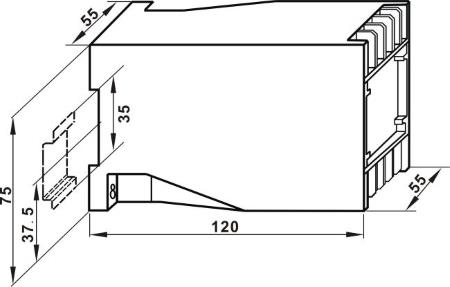
| Dimension | 120 (L) × 55 (W) × 75 (H) mm |
| Installation Method | 35mm standard guide rail or fixed on the cabinet |
Dimension (Unit: mm)
Calibration Fine Tuning
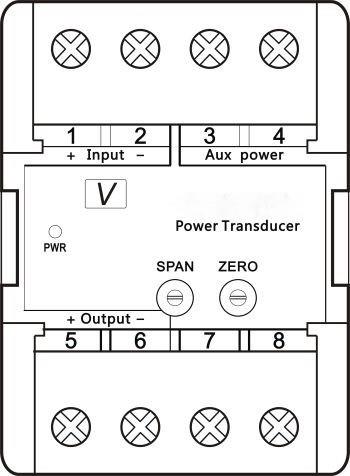
PWR: Power indicator
SPAN: Calibration full scale potentiometer
ZERO: Zero potentiometer
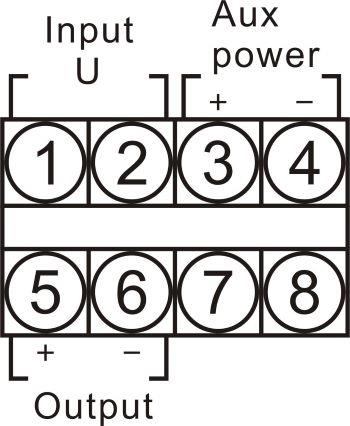
Wiring
Tips: Maintenance of power transducer
- Check the appearance regularly: Make sure the power transducer housing is free of cracks, deformation or damage to prevent dust and moisture from entering and affecting the operation. Check whether the cable terminals are firm, loose or oxidized to avoid poor contact causing measurement errors or signal loss. Wipe the surface with a dry soft cloth to avoid dust accumulation affecting heat dissipation and insulation performance.
- Monitor input and output signals: Use a multimeter or oscilloscope to measure the input voltage and current regularly to ensure operation within the rated range. Check the analog or digital output of the transmitter to ensure that it matches the monitoring system to avoid drift or abnormality.
- Environmental maintenance: Ensure that the power transducer installation environment is clean and dry to avoid moisture, dust or corrosive gases affecting performance. The power transducer should operate within the specified ambient temperature to avoid overheating or overcooling that affects its life. If there is mechanical vibration in the installation environment, it is recommended to use shock-absorbing pads or install it in a stable position to prevent long-term vibration from causing loose wiring or internal damage.
- Preventive maintenance: Abnormal fluctuations in power transducer readings or increased errors may require recalibration. Overheating of the power transducer may be due to overload or high ambient temperature and should be checked in time. Signal transmission is unstable or lost. Check whether the wiring and communication lines are intact.
Only registered users can write reviews
Related products

Frequency Transducer, 40-60Hz/45-55Hz/55-65Hz/0-100Hz
ATO-PT-F
$175.54
Reliable frequency transducer, the range is 40-60Hz/45-55Hz/55-65Hz/0-100Hz. The working environment temperature of the frequency transducer is 0~50℃, the working environment humidity is <80% relative humidity, and the compressive strength is AC2Kvrms/min. It has a wide range of applications and is durable.

Reactive Power Transducer, 3 Phase 3 Wire/ 3 Phase 4 Wire
ATO-PT-Q3
$206.31
Good price reactive power transducer for sale. The measurement of the reactive power transducer is three-phase three-wire or three-phase four-wire. The standard range is 0~173.2var, 0~866var, 0~3000var, 0~±173.2var, 0~±866var, etc. The reactive power transducer has high accuracy and sensitive response, with an accuracy of 0.2/0.5 and a response time of less than 400ms.

Active and Reactive Combined Transducer, 3 Phase 3 Wire/ 3 Phase 4 Wire
ATO-PT-PQ3
$243.23
Active and reactive combined transducer for sale at a low price. The measurement of the active and reactive combined transducer is 3-phase 3-wire or 3-phase 4-wire. The active and reactive combined transducer has high accuracy and sensitive response, with an accuracy of 0.2/0.5 and a response time of less than 400ms.

Active Power Transducer, 3 Phase 3 Wire/ 3 Phase 4 Wire
ATO-PT-P3
$205.23
High-quality active power transducer for sale. The measurement of the active power transducer is 3-phase 3-wire or 3-phase 4-wire. The standard range is 0~173.2W, 0~866W, 0~3000W, 0~±173.2W, 0~±866W. The response time is less than 400ms.