
The economical and affordable fixed PH3 phosphine gas detector adopts high-quality sensors and advanced micro-processing technology. The operating temperature is -20~+50℃. It uses gas diffusion to detect whether there are toxic gases in the air. It can work continuously for a long time. The working voltage is 12-30V DC, it can detect 0-100/1000/3000 ppm, the gas leak detector can display data and alarm reminders on the screen, and the response speed is fast.
Specification
| Model | GD300-PH3 |
| Detection Principle | Electrochemistry |
| Gas | Phosphine (PH3) |
| Range (Optional) | 0 to 10ppm, 0 to 20ppm, 0 to 50ppm, 0 to 100ppm, 0 to 500ppm, 0 to 1000ppm, 0 to 2000ppm, 0 to 3000ppm |
| Resolution | 0.01ppm (0-10/20/50ppm), 0.1ppm (0-100ppm), or 1ppm (0-500/1000/2000/3000ppm) |
| Calibration Kit | Gas pressure regulator (calibration gas cylinder NOT included) |
| Accuracy | ≤±3% F.S. |
| Response Time | ≤10s |
| Repeatability | ≤±1% |
| Recovery Time | ≤10s |
| Linearity Error | ≤±1% |
| Zero Shift | ≤±1% (F.S./year) |
| Signal Output (Optional) | 4-20mA and RS485 Relay output: one group of relay output (1NO+1NC, 5A/30V) for one alarm (default), or two groups of relay output (2NO+2NC, 5A/30V) for high/low alarm (optional). |
| Alarms | Sound, light |
| Display | High light nixie tube display |
| Installation | Wall-mounted, piping type, flow-type (according to the detected environment) |
| Connection | Power connection type: G1/2 male thread explosion-proof flexible pipe Pipe-mounted type: M45*P2.0 |
| Operating Time | 24h |
| Explosion-proof Grade | II 2G Ex db IIC T4 Gb |
| Protection Grade | IP65 |
| Certification | CE, ATEX (Standard: EN IEC 60079-0:2018, EN 60079-1:2014) |
| Working Voltage | 12-36V DC |
| Case Material | Die-casting aluminum housing |
| Operating Temperature | -20℃~50℃ |
| Operating Humidity | 0~95%RH (non-condensing) |
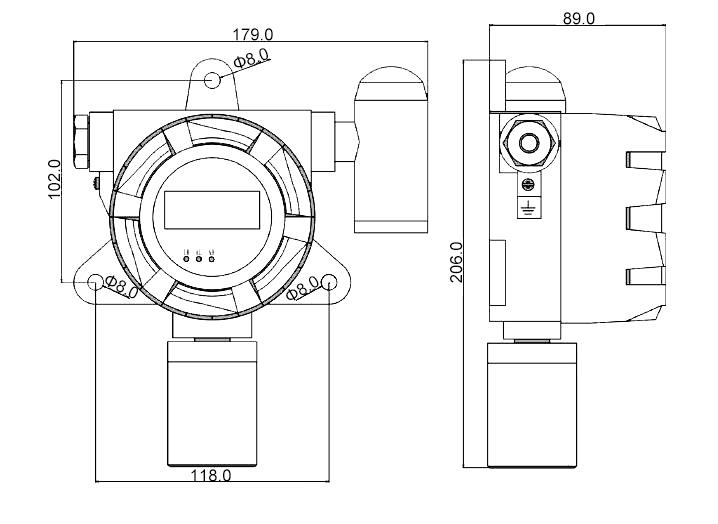
| Dimension | 206*179*90mm |
| Weight | ≤1.6kg |
| Power Adapter | Input 100-240VAC 50/60Hz, Output 24VDC 1A (Optional USA plug, Europe plug, AU plug or UK plug) |
| Accessories (Optional) | Calibration kit - gas pressure regulator (calibration gas cylinder NOT included)
|
Notes
Regarding the flow rate for gas detectors, there are 2 types:
- Pump-Suction Type: Equipped with a built-in pump, with a flow rate of 600 mL/min. (Models: GD200, GD400, GD600)
- Diffusion Type: Not equipped with a built-in pump, with a flow rate of 300 mL/min. (Models: GD300, GD500, GD800)
If you require a customized flow rate, please let us know your specific requirements. We will evaluate whether customization is possible. A flow rate that is too high or too low can affect measurement accuracy, so we recommend using an appropriate flow rate for your application.
Flow rate only needs to be considered when sampling gas from pipelines. For measuring gas concentrations in normal ambient air, you do not need to consider the flow rate. To measure confined spaces such as pipelines, please get in touch with us and provide the detailed conditions of use.
Dimensions (Unit: mm)
Installation Guide
The following precautions apply when connecting the GD300 series fixed gas detector to a pipeline:
- Working pressure should be stable at 1 bar ±10%, and the flow rate should be controlled at 300 mL/min.
- Working temperature is -20°C to +50°C.
- Working humidity is 0–95% RH. When the humidity is above 60% RH, it is recommended to use a dehumidifier or add a filter. When the humidity is above 95% RH, the gas is essentially saturated with water, making measurement impossible.
- The gas detector should be installed indoors. If it is installed outdoors, a rain cover should be added to protect the entire instrument.
- For the second pipeline connection method of the GD300 gas detector, the pipe-mounted installation, the detector mounting thread size is M45 × P2.0. During installation, hold the detector with both hands, keeping the sensor parallel to the mounting thread. Align it with the threaded port, rotate the detector clockwise, and install it in the desired position. To prevent gas leakage at the threaded connection, an appropriate amount of thread seal tape can be wrapped around the sensor head thread before installation.
***Other Common Gases and Ranges Available for Fixed Gas Detectors
| Gas Type | Measure Range | Resolution |
| Ammonia (NH3) | 0-50/100/200/500/1000/2000/5000ppm | 0.01ppm/0.1ppm/1ppm |
| Benzene (C6H6) | 0-1/10/50/100/200/1000/2000/5000/10000ppm | 0.001ppm/0.01ppm/0.1ppm/1ppm |
| Carbon Dioxide (CO2) | 0-1000/2000/5000/9999ppm, 0-2/5/10/20/25/30/50/100%VOL | 0.1ppm/1ppm/0.001%VOL/0.01%VOL/0.1%VOL |
| Carbon Monoxide (CO) | 0-10/20/50/100/500/1000/2000ppm | 0.01ppm/0.1ppm/1ppm |
| Chlorine (Cl2) | 0-5/10/20/50/100ppm | 0.001ppm/0.01ppm/0.1ppm |
| Chlorine Dioxide (ClO2) | 0-1/5/10/20/50/100ppm | 0.001ppm/0.01ppm/0.1ppm |
| Combustible Gas (EX) | 0-100%LEL | 1%LEL |
| Ethylene (C2H4) | 0-10/20/50/100/500/1000/2000ppm | 0.01ppm/0.1ppm/1ppm |
| Formaldehyde (CH2O) | 0-10/20/50/100/500/1000ppm | 0.01ppm/0.1ppm/1ppm |
| Hydrocarbons (HC) | 0-100%LEL | 1%LEL |
| Hydrogen (H2) | 0-10/20/500/1000/2000/5000/9999ppm, 0-2/4% VOL, 0-100% LEL | 0.1ppm/1ppm/0.001%VOL/1%LEL |
| Hydrogen Chloride (HCL) | 0-10/20/50/100/200ppm | 0.01ppm/0.1ppm |
| Hydrogen Cyanide (HCN) | 0-10/20/50/100ppm | 0.01ppm/0.1ppm |
| Hydrogen Sulfide (H2S) | 0-5/20/50/100/200ppm | 0.001ppm/0.01ppm/0.1ppm |
| Methane (CH4) | 0-50/100%VOL, 0-100%LEL | 0.01%VOL/0.1%VOL/1%LEL |
| Nitric Oxide (NO) | 0-1/5/10/20/50/100/250/500/1000ppm | 0.001ppm/0.01ppm/0.1ppm/1ppm |
| Nitrogen (N2) | 0-99.99/0-100%VOL | 0.01%VOL/0.1%VOL |
| Nitrogen Dioxide (NO2) | 0-1/5/10/20/50/100/500/1000ppm | 0.001ppm/0.01ppm/0.1ppm/1ppm |
| Nitrogen Oxides (NOX) | 0-1/5/10/20/50/100/250/500/1000ppm | 0.001ppm/0.01ppm/0.1ppm/1ppm |
| Oxygen (O2) | 0-25/30/100%VOL | 0.01%VOL/0.1%VOL |
| Ozone (O3) | 0-1/5/10/20/50/100ppm | 0.001ppm/0.01ppm/0.1ppm |
| Phosphine (PH3) | 0-10/20/50/100/500/1000/2000/3000ppm | 0.01ppm/0.1ppm/1ppm |
| Sulfur Dioxide (SO2) | 0-1/5/10/20/50/100/500/1000ppm | 0.001ppm/0.01ppm/0.1ppm/1ppm |
| Volatile Organic Compounds (VOC) | 0-1/5/10/20/50/100/200/500/1000/2000/5000/10000ppm | 0.001ppm/0.01ppm/0.1ppm/1ppm |
Note: Some common gases and the measuring ranges are listed in the above table. For more information, please feel free to contact us.
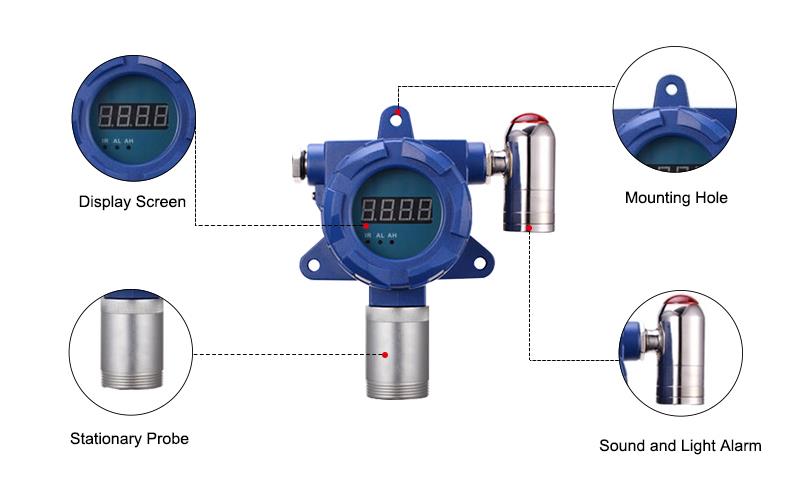
Details
Application

Tips: How Does a Fixed Phosphine (PH3) Gas Detector Work?
- Gas Collection: The primary task of a gas detector is to collect air samples from the surrounding environment. This is usually accomplished through an air inlet or sampling line.
- Gas Sensor: The gas leak detector has a built-in phosphine gas sensor, which usually uses chemical sensing elements, such as semiconductor sensors, electrochemical sensors, or infrared sensors. These gas sensors work by reacting to phosphine molecules, causing changes in electrical resistance, electrical current, or optical signals.
- Signal Processing: The gas sensor generates an electrical signal that correlates to the detected phosphine concentration. This signal is fed into a built-in microprocessor or control unit for processing.
- Data Analysis: A microprocessor analyzes the signal generated by the sensor and converts it into a concentration reading. If the concentration exceeds a preset safety threshold, the gas monitor triggers an gas alarm.
- Alarm Systems: Fixed phosphine gas detectors are often equipped with audible, light, or digital interface alarm systems, as well as features that can transmit information to a monitoring room or automatically shut down the device. This helps to detect dangers early and take necessary measures.
- Maintenance and Calibration: To ensure the accuracy and reliability of your gas detector for home, regular maintenance and calibration are required. This includes replacing or cleaning sensor elements, verifying gas detector performance, and calibrating measurements.

Fixed Nitrogen Dioxide (NO2) Gas Detector, 0 to 100/500/1000 ppm

Fixed Benzene (C6H6) Gas Detector, 0 to 10/100/200/1000/10000 ppm

Portable Benzene (C6H6) Gas Detector, 0 to 500/2000/5000/10000 ppm

Fixed Hydrogen Cyanide (HCN) Gas Detector, 0 to 10/20/50/100 ppm

Explosion-Proof Multi Gas Detector, 5-Gas, CO, H2S, O2, LEL, VOC

Fixed Carbon Dioxide (CO2) Gas Detector, 0 to 9999 ppm
