
ATO fixed HCN hydrogen cyanide gas detector uses high quality sensors, and advanced micro-process technology, with data display and high/low alarm, fast response, high precision and good stability. Explosion proof, suitable for different kinds of situations.
Specification
| Model | GD300-HCN |
| Detection Principle | Electrochemistry |
| Gas | Hydrogen Cyanide (HCN) |
| Range (Optional) | 0 to 10ppm, 0 to 20ppm, 0 to 50ppm, 0 to 100ppm |
| Resolution | 0.01ppm(0-10/20/50ppm), 0.1ppm(0-100ppm) |
| Calibration Kit | Gas pressure regulator (calibration gas cylinder NOT included) |
| Accuracy | ≤±3% F.S. |
| Response Time | ≤10s |
| Repeatability | ≤±1% |
| Recovery Time | ≤10s |
| Linearity Error | ≤±1% |
| Zero Shift | ≤±1% (F.S./year) |
| Signal Output (Optional) | 4-20mA and RS485 Relay output: one group of relay output (1NO+1NC, 5A/30V) for one alarm (default), or two groups of relay output (2NO+2NC, 5A/30V) for high/low alarm (optional). |
| Alarms | Sound, light |
| Display | High light nixie tube display |
| Installation | Wall-mounted, piping type, flow-type (according to the detected environment) |
| Connection | Power connection type: G1/2 male thread explosion-proof flexible pipe Pipe-mounted type: M45*P2.0 |
| Operating Time | 24h |
| Explosion-proof Grade | II 2G Ex db IIC T4 Gb |
| Protection Grade | IP65 |
| Certification | CE, ATEX (Standard: EN IEC 60079-0:2018, EN 60079-1:2014) |
| Working Voltage | 12-36V DC |
| Case Material | Die-casting aluminum housing |
| Operating Temperature | -20℃~50℃ |
| Operating Humidity | 0~95%RH (non-condensing) |
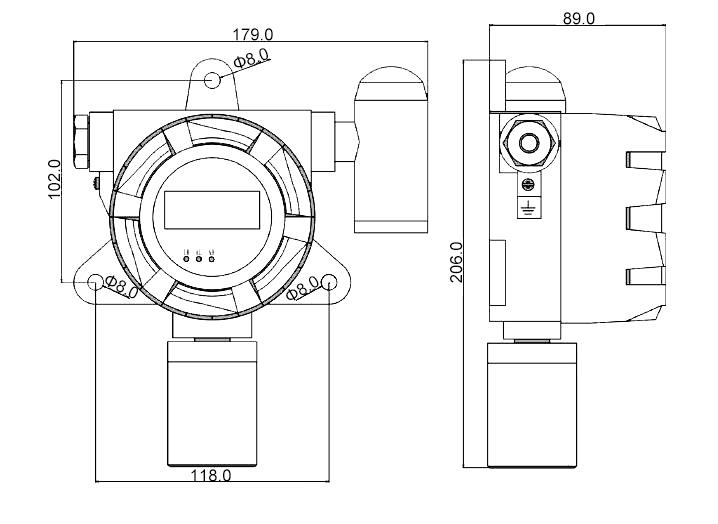
| Dimension | 206*179*90mm |
| Weight | ≤1.6kg |
| Power Adapter | Input 100-240VAC 50/60Hz, Output 24VDC 1A (Optional USA plug, Europe plug, AU plug or UK plug) |
| Accessories (Optional) | Calibration kit - gas pressure regulator (calibration gas cylinder NOT included)
|
Notes
Regarding the flow rate for gas detectors, there are 2 types:
- Pump-Suction Type: Equipped with a built-in pump, with a flow rate of 600 mL/min. (Models: GD200, GD400, GD600)
- Diffusion Type: Not equipped with a built-in pump, with a flow rate of 300 mL/min. (Models: GD300, GD500, GD800)
If you require a customized flow rate, please let us know your specific requirements. We will evaluate whether customization is possible. A flow rate that is too high or too low can affect measurement accuracy, so we recommend using an appropriate flow rate for your application.
Flow rate only needs to be considered when sampling gas from pipelines. For measuring gas concentrations in normal ambient air, you do not need to consider the flow rate. To measure confined spaces such as pipelines, please get in touch with us and provide the detailed conditions of use.
Dimensions (Unit: mm)
Installation Guide
The following precautions apply when connecting the GD300 series fixed gas detector to a pipeline:
- Working pressure should be stable at 1 bar ±10%, and the flow rate should be controlled at 300 mL/min.
- Working temperature is -20°C to +50°C.
- Working humidity is 0–95% RH. When the humidity is above 60% RH, it is recommended to use a dehumidifier or add a filter. When the humidity is above 95% RH, the gas is essentially saturated with water, making measurement impossible.
- The gas detector should be installed indoors. If it is installed outdoors, a rain cover should be added to protect the entire instrument.
- For the second pipeline connection method of the GD300 gas detector, the pipe-mounted installation, the detector mounting thread size is M45 × P2.0. During installation, hold the detector with both hands, keeping the sensor parallel to the mounting thread. Align it with the threaded port, rotate the detector clockwise, and install it in the desired position. To prevent gas leakage at the threaded connection, an appropriate amount of thread seal tape can be wrapped around the sensor head thread before installation.
***Other Common Gases and Ranges Available for Fixed Gas Detectors
| Gas Type | Measure Range | Resolution |
| Ammonia (NH3) | 0-50/100/200/500/1000/2000/5000ppm | 0.01ppm/0.1ppm/1ppm |
| Benzene (C6H6) | 0-1/10/50/100/200/1000/2000/5000/10000ppm | 0.001ppm/0.01ppm/0.1ppm/1ppm |
| Carbon Dioxide (CO2) | 0-1000/2000/5000/9999ppm, 0-2/5/10/20/25/30/50/100%VOL | 0.1ppm/1ppm/0.001%VOL/0.01%VOL/0.1%VOL |
| Carbon Monoxide (CO) | 0-10/20/50/100/500/1000/2000ppm | 0.01ppm/0.1ppm/1ppm |
| Chlorine (Cl2) | 0-5/10/20/50/100ppm | 0.001ppm/0.01ppm/0.1ppm |
| Chlorine Dioxide (ClO2) | 0-1/5/10/20/50/100ppm | 0.001ppm/0.01ppm/0.1ppm |
| Combustible Gas (EX) | 0-100%LEL | 1%LEL |
| Ethylene (C2H4) | 0-10/20/50/100/500/1000/2000ppm | 0.01ppm/0.1ppm/1ppm |
| Formaldehyde (CH2O) | 0-10/20/50/100/500/1000ppm | 0.01ppm/0.1ppm/1ppm |
| Hydrocarbons (HC) | 0-100%LEL | 1%LEL |
| Hydrogen (H2) | 0-10/20/500/1000/2000/5000/9999ppm, 0-2/4% VOL, 0-100% LEL | 0.1ppm/1ppm/0.001%VOL/1%LEL |
| Hydrogen Chloride (HCL) | 0-10/20/50/100/200ppm | 0.01ppm/0.1ppm |
| Hydrogen Cyanide (HCN) | 0-10/20/50/100ppm | 0.01ppm/0.1ppm |
| Hydrogen Sulfide (H2S) | 0-5/20/50/100/200ppm | 0.001ppm/0.01ppm/0.1ppm |
| Methane (CH4) | 0-50/100%VOL, 0-100%LEL | 0.01%VOL/0.1%VOL/1%LEL |
| Nitric Oxide (NO) | 0-1/5/10/20/50/100/250/500/1000ppm | 0.001ppm/0.01ppm/0.1ppm/1ppm |
| Nitrogen (N2) | 0-99.99/0-100%VOL | 0.01%VOL/0.1%VOL |
| Nitrogen Dioxide (NO2) | 0-1/5/10/20/50/100/500/1000ppm | 0.001ppm/0.01ppm/0.1ppm/1ppm |
| Nitrogen Oxides (NOX) | 0-1/5/10/20/50/100/250/500/1000ppm | 0.001ppm/0.01ppm/0.1ppm/1ppm |
| Oxygen (O2) | 0-25/30/100%VOL | 0.01%VOL/0.1%VOL |
| Ozone (O3) | 0-1/5/10/20/50/100ppm | 0.001ppm/0.01ppm/0.1ppm |
| Phosphine (PH3) | 0-10/20/50/100/500/1000/2000/3000ppm | 0.01ppm/0.1ppm/1ppm |
| Sulfur Dioxide (SO2) | 0-1/5/10/20/50/100/500/1000ppm | 0.001ppm/0.01ppm/0.1ppm/1ppm |
| Volatile Organic Compounds (VOC) | 0-1/5/10/20/50/100/200/500/1000/2000/5000/10000ppm | 0.001ppm/0.01ppm/0.1ppm/1ppm |
Note: Some common gases and the measuring ranges are listed in the above table. For more information, please feel free to contact us.
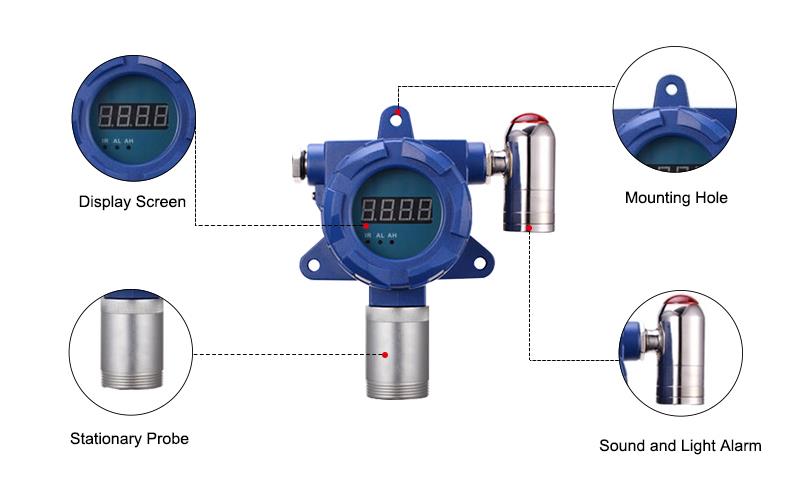
Details
Application

Tips: What industries can gas detectors be used for?
- Oil and gas: It can be used in oil and gas application sites and various industrial activity sites. When oil and gas are extracted, transported, stored and smelted, there will be flammable hydrocarbon gases with explosion risks and toxic gases such as hydrogen sulfide. Therefore, gas detector is an important instrument for exploration of drilling channels, as well as oil and gas terminals and smelters.
- Semiconductor production: In semiconductor production, phosphorus, arsenic, boron and gallium are often used as additives, and hydrogen is used as a carrier gas for reactants and reducing air. At the same time, the use of many highly toxic substances and flammable gases produces many Combustible and toxic gases make gas detectors an indispensable instrument.
- Wastewater treatment: Due to poor governance, sewage wastewater is very common in many cities and towns, and harmful gases such as methane and hydrogen sulfide are naturally emitted from sewage and wastewater, and the smell is pungent, so gas purifiers can come in handy here. .
- Hospital: There will be many toxic substances in medical laboratories and medical waste gas, and in large-scale hospitals, on-site equipment power supplies and backup power stations will be used, so gas detection equipment is required to ensure the safety and health of patients and doctors.

Fixed Ethylene (C2H4) Gas Detector, 0 to 50/100/500/1000/2000 ppm

Fixed Hydrogen Chloride (HCl) Gas Detector, 0 to 10/20/50/100/200 ppm

Fixed Sulfur Dioxide (SO2) Gas Detector, 0 to 20/50/100 ppm
