
Electrolytic Capacitor
An electrolytic capacitor is a polarized capacitor whose anode or positive plate is made of a metal that forms an insulating oxide layer through anodization. This oxide layer acts as the dielectric of the capacitor. A solid, liquid, or gel electrolyte covers the surface of this oxide layer, serving as the cathode or negative plate of the capacitor.
ATO.com online store offers two series of electrolytic capacitors: Aluminum Electrolytic Capacitor and SMD Electrolytic Capacitor. The aluminum electrolytic capacitor has wide range capacity from 10μF to 1000μF, rated voltage from 16V to 450V. For SMD electrolytic capacitor series, the capacity from 22μF to 470μF, rated voltage 16V to 50V.
High voltage electrolytic capacitors providing good electrical performance, wide application range and high reliability and electrolytic capacitors can be applied for air conditioners, tape recorders, washing machines, communication machines and other household appliances.
What is Electrolytic Capacitor?
Electrolytic capacitor is a kind of capacitor, the metal foil is the positive electrode (aluminum or tantalum), the oxide film (aluminum oxide or tantalum pentoxide) close to the positive electrode is the dielectric, and the cathode is made of conductive material and electrolyte (the electrolyte can be liquid or tantalum pentoxide). Solid) and other materials together, because the electrolyte is the main part of the cathode, so the electrolytic capacitor is named. At the same time, the positive and negative electrolytic capacitors should not be wrongly connected. Aluminum electrolytic capacitors can be divided into four categories: lead-type aluminum electrolytic capacitors; horn-type aluminum electrolytic capacitors; bolt-type aluminum electrolytic capacitors; solid aluminum electrolytic capacitors.
Electrolytic Capacitor vs. Ceramic Capacitor
Electrolytic capacitors are capacitors made of metal foil (aluminum/tantalum) as the positive electrode, the insulating oxide layer of the metal foil (alumina/tantalum pentoxide) as the dielectric, and conductive materials, electrolytes and other materials to form the cathode. Electrolytic capacitors are mostly used for filtering, decoupling, signal coupling, time constant setting, and DC blocking in medium and low frequency circuits.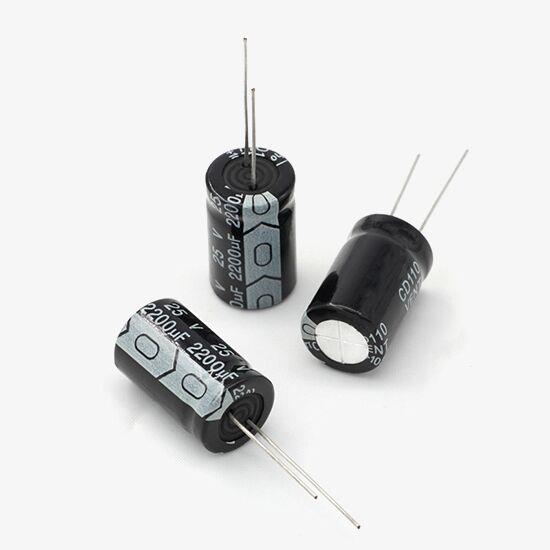
A ceramic capacitor is a capacitor made of ceramic material as a medium, a layer of metal film is coated on the surface of the ceramic, and then sintered at high temperature as an electrode. Ceramic capacitors are mostly used as loop capacitors and pad capacitors in high-stability oscillation circuits, which play the roles of filtering, decoupling, and signal coupling.
The differences between electrolytic capacitors and ceramic capacitors are:
- Electrolytic capacitors have large capacity, polarity, and large equivalent series inductance; ceramic capacitors have small capacity, non-polarity, and small equivalent series inductance.
- Electrolytic capacitors have good low-frequency characteristics and are mostly used in low-frequency circuits; ceramic capacitors have good high-frequency characteristics and are mostly used in high-frequency circuits.
- Electrolytic capacitors can filter out low-frequency ripples, so they can be used as low-pass filters; ceramic capacitors can filter out high-frequency ripples, so they can be used as high-pass filters.
- Electrolytic capacitors cannot be used in pure AC power circuits; ceramic capacitors can be used in pure AC circuits.
How does Electrolytic Capacitor Work?
Electrolytic capacitors are usually made of metal foil (aluminum/tantalum) as the positive electrode, and the insulating oxide layer of the metal foil (alumina/tantalum pentoxide) as the dielectric. Electrolytic capacitors are divided into aluminum electrolytic capacitors and tantalum electrolytic capacitors by their positive electrodes. capacitor. The negative electrode of aluminum electrolytic capacitors consists of thin paper/film or electrolyte polymer soaked in an electrolyte (liquid electrolyte); the negative electrode of tantalum electrolytic capacitors is usually manganese dioxide. Electrolytic capacitors get their name because they use electrolytes as negative electrodes (note the distinction from dielectrics).
The electrolytic capacitor is divided into two poles, which can store a certain amount of electricity. When the positive charge is full, the electrode becomes negative, and it will discharge. When the positive charge comes again, it will charge again, and when the negative electrode comes, it will discharge again. Therefore, the electrolytic capacitor has passing AC and blocking DC, because there are many storage points, it can be used as a filter capacitor.

100μF 16V Aluminum Electrolytic Capacitor

10μF 25V Aluminum Electrolytic Capacitor

100μF 35V Aluminum Electrolytic Capacitor

220μF 35V Aluminum Electrolytic Capacitor

1000μF 35V Aluminum Electrolytic Capacitor

22μF 50V Aluminum Electrolytic Capacitor

100μF 50V Aluminum Electrolytic Capacitor

220μF 50V Aluminum Electrolytic Capacitor

100μF 450V Aluminum Electrolytic Capacitor

10μF 400V Aluminum Electrolytic Capacitor

100μF 16V SMD Electrolytic Capacitor

470μF 16V SMD Electrolytic Capacitor

220μF 16V SMD Electrolytic Capacitor

22μF 25V SMD Electrolytic Capacitor

100μF 25V SMD Electrolytic Capacitor

470μF 25V SMD Electrolytic Capacitor

33μF 35V SMD Electrolytic Capacitor

100μF 50V SMD Electrolytic Capacitor

220μF 50V SMD Electrolytic Capacitor


