
Water Chiller
Water chiller is a machine that removes heat from a liquid coolant via a vapor-compression, adsorption refrigeration, or absorption refrigeration cycles. This liquid can then be circulated through a heat exchanger to cool equipment, or another process stream (such as air or process water).
Industrial water chiller is used for controlled cooling of products, mechanisms and machinery in a variety of industries. A chiller removes heat from the process water and transfers it to air via a heat exchange process. Water cooled chiller is widely used in various industrial freezing process in the need of chilled water fields, such as plastics, electroplating, electronics, chemical, pharmaceutical, printing, food processing, etc.
The industrial water chiller machines provided from ATO store are air-cooled type, with high efficiency and competitive price, a wide range of cooling capacity from 1/2 ton (1750W) to 17 ton (60kW), compressors power up to 20 HP.
Features of Air-cooled Water Chiller:
- Use fully enclosed compressors and electronic control components, equipped with condensers and evaporators made of high-quality copper tubes for heat exchange.
- Equipped with various safety protection devices, stable performance, low noise, long service life and simple operation.
- The LCD screen is used for easy and convenient operation, and the running status is clear at a glance.
- The models have a single compressor or multiple compressor combination refrigeration system. The compressor can automatically and alternately run according to the load change, to achieve the effect of saving energy consumption.
- Enclosure box structure and compact design, can check the operation of the unit at any time. The unit can bring its own water tank and circulating water pump according to the cooling capacity, without the need for a cooling tower and cooling water pump, and the installation and maintenance are simple and convenient.
Types of Water Chiller:
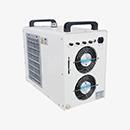
Air-cooled water chiller. An air-cooled condenser unit typically features finned coils. This increases the surface area of the condenser in contact with air. One or more fans are used to blow air over the finned coil to further improve heat transfer. The amount of heat rejected by an air-cooled condenser depends on the rate of airflow over the coils and the air's dry-bulb temperature. The advantage of using air-cooled water chillers is their simplicity and low cost.
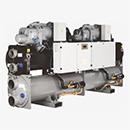
Water-cooled water chiller. Water-cooled condensers typically operate with a cooling tower. Cooling towers are heat exchangers, but instead of the usual conduction-convection type of heat exchangers, it generates cooling by bringing water and air into contact. They supply cooling water to the condenser unit which is used to cool the refrigerant. Water cooled industrial chillers are used in large industrial plants where a cooling water supply is readily available. Cooling is provided to the condenser at a much higher efficiency compared to air-cooled types.
Differences Between Air-cooled and Water-cooled Chiller:
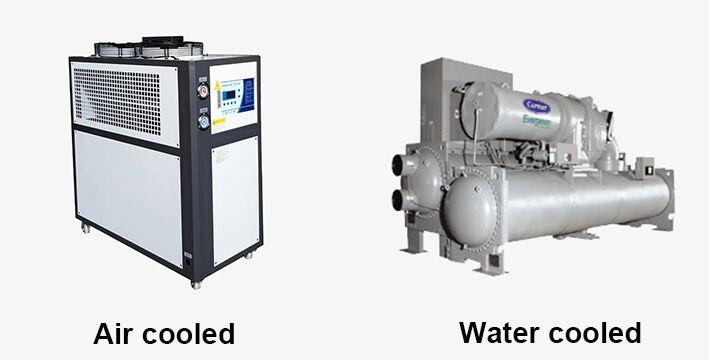
- Condenser. Air-cooled chillers have condensers that use ambient air to cool hot refrigerant. Refrigerant flows through a series of tubes mechanically assembled with an array of closely spaced fins. A fan blows ambient air through the fins and over the outside of the tubes, cooling the refrigerant flowing inside. The excess heat is released to the air and can be recovered for use elsewhere in the facility. Contrastingly, water-cooled chillers use water to cool the refrigerant in the condenser. Water-cooled condensers are typically tube-in-tube, tube-in-shell, or plate-type heat exchangers in which water from a cooling tower or other water source cools the refrigerant. The refrigerant and cooling water do not come in direct contact with each other, rather they flow in separate passageways within the heat exchanger which are in close contact for efficient heat transfer.
- Environmental Installation Considerations. High Temperature Environments: Water-cooled chillers work great in high temperature environments since they do not rely on ambient air for cooling. Thus, they can be placed in hot mechanical rooms or in spaces with minimal ventilation. Small Spaces: The condenser on water-cooled chillers is more compact than an equivalently sized air-cooled unit. This can result in an overall smaller unit, especially in the case of high capacity chillers.
- Cost Considerations. With indoor installation of an air-cooled chiller, costs associated with duct work, fans, and controls for maintaining proper air temperature in the room may exist. Energy consumption costs may be higher for these chiller models due to its basic operating design. Often times water-cooled units have a lower initial price. However, they generally have more operational costs, and will typically require the installation of a cooling tower. When using a cooling tower in conjunction with a water-cooled chiller, additional costs may accrue from the regular monitoring of water quality, treatment of the water, and the operation of fans and pumps.
How to Maintain Industrial Water Chiller?
Besides learning how to use, we also need know how to maintain the water chiller. Maintain the industrial water chiller periodically according to the specification to ensure the normal running.
- Keep the machine room dry, clean and ventilative.
- Do not stop the unit by cutting off the main power unless it is emergent.
- Do not open or close any stop valve during debugging and running water chiller.
- If fire occurs, switch off the general power and eradicate the fire with fire extinguisher.
- The working environment should be far away from the flammable matter such as gasoline and alcohol in case of explosion.
- Check the running state of the unit frequently, including water quality of cooling water and chilled water, water temperature, water pressure, water filter, water pump, cooling tower.
- If the unit stops due to malfunction, it is required to find out the reason and repair it before restart it. If there is refrigerant leak or chilled water leak, turn off all of the switches. If the unit can not be stopped through the controller, stop it through the emergency stop button on the electric control cabinet and cut off the general power.
How to Install Industrial Air-cooled Water Chiller?

- First of all, check whether the base conforms to the footing properly size of water chiller in the general diagram. The base should be smooth and level.
- Put the base steel in the prescriptive position.
- Put the refrigerant unit on the base steel.
- There should be no space between the base steel and body foot plate of the refrigerant circulate system of chiller.
- Adjusting shim should be put between the base steel and the concrete foundation. Adjust the base steel to be level (the altitude difference should be within 0.5 mm every meter).
- Lift the refrigerant unit and put the damper rubber blanket on the base steel, and then put the unit on the damper rubber blanket.
- After installation, ensure that the horizontal slope should be within the range. If it is beyond the range, adjust the unit. Put a pad (the pad is provided by the installer) between the footing and the shock pad, and then check the horizontal slope until it is passed.

1/2 Ton Air Cooled Industrial Water Chiller

1 Ton Air Cooled Industrial Water Chiller

1.5 Ton Air Cooled Industrial Water Chiller

2 Ton Air Cooled Industrial Water Chiller

3 HP 2.5 Ton Air Cooled Industrial Water Chiller

4 HP 3.5 Ton Air Cooled Industrial Water Chiller

5 HP 4 Ton Air Cooled Industrial Water Chiller

8 HP 6 Ton Air Cooled Industrial Water Chiller

10 HP 8 Ton Air Cooled Industrial Water Chiller

15 HP 12 Ton Air Cooled Industrial Water Chiller


