
RTD Sensor
RTD sensor (Resistance Temperature Detector Sensor) is a high-precision temperature sensor that uses the property that metal resistance changes with temperature to measure temperature. The core of the RTD sensor is a resistor element made of pure metal (such as platinum, copper, nickel), whose resistance value increases linearly with increasing temperature. Compared with thermocouples, the output of RTD is closer to linear, especially in a wider temperature range.
Features of RTD Sensors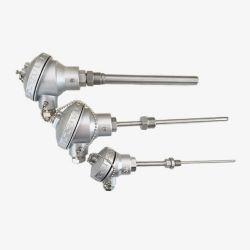
- High accuracy and stability: RTD sensors have extremely high temperature measurement accuracy in the range of -200°C to +600°C, which is better than thermocouples and thermistors. Its metal resistance physical properties are stable, and its long-term drift is small, which is suitable for applications that require high reliability.
- Good repeatability: Under the same temperature conditions, the measurement results of RTD sensors are highly consistent, which is suitable for industrial process control and laboratory environments that require stable and repeatable data.
- Slow response speed: Due to its large heat capacity, the response time of RTD sensors is in the second level, which is slower than that of thermocouples (milliseconds) and is not suitable for fast dynamic temperature monitoring.
- Self-heating effect exists: The resistance temperature detector sensor needs to be powered by a constant current source. Excessive current will cause self-heating, and it is necessary to balance the measurement accuracy and power consumption.
- Various materials and types: The core material of the RTD sensor is metal, and its resistance value changes with temperature. Different metal materials determine the temperature measurement range, linearity, stability and cost of the RTD. Common materials include platinum, nickel and copper.
How Does an RTD Sensor Work?
RTD sensors work by the property that metal resistance changes with temperature. They use constant current excitation and voltage measurement to calculate temperature. They have the characteristics of high precision, good stability, and good linearity, but they need to pay attention to the self-heating effect and lead resistance compensation.
- Working process: When the RTD sensor is working, a constant small current (usually ≤1mA) is first applied by the external circuit to avoid the self-heating effect. After the current flows through the RTD sensor, a corresponding voltage drop will be generated. By accurately measuring this voltage value and combining it with the known excitation current, the real-time resistance value of the RTD can be calculated. Finally, according to the standard resistance-temperature relationship of the RTD sensor probe of this model, the resistance value is converted into an accurate temperature reading. The whole process relies on a stable current source and high-precision voltage measurement to ensure the accuracy of the temperature data.
- Error elimination: In order to eliminate the influence of lead resistance on measurement accuracy, resistance temperature detector sensors use different wiring methods. The 2-wire system has a simple structure but large lead error and is only used in low-precision scenarios. The 3-wire system offsets the lead resistance by adding compensation wires, becoming the mainstream solution in the industry. The 4-wire system completely isolates the excitation and measurement circuits, completely eliminating the influence of the leads, and is suitable for laboratory-level high-precision measurements.
ATO offers a variety of affordable RTD sensors with a temperature measurement range from -200℃ to 450℃ to meet your various temperature measurement needs. RTD sensors are small in size and have excellent performance, making them ideal for temperature measurement in industrial process control, laboratory equipment, automobiles, and medical equipment. Buy the right RTD sensor for your project now!

RTD Sensor Probe, Pt100, 3 Wire

RTD Sensor, Pt100, Sheath, 3 Wire

RTD Sensor, Pt100, Thermowell

RTD Sensor with transmitter, Pt100, 2 Wire

Digital Temperature Sensor with transmitter, Pt100, 2 Wire

RTD Pt100 to 4-20mA/RS485 Converter

RTD Pt100 Temperature Sensor, Waterproof


