
I am Watanabe from Japan and I'm a postgraduate student. I'm writing to you for the first time.
I'm contacting you to enquire about <Gas-H2>.
I'm interested in your product and I want to use it to measure H2 in the air. So I have questions about your product.
1) Is this machine high precision? It's said that there is about 0.5‰H2 in the air so I wonder whether this machine can measure by after the decimal point.
2)Were there any people who bought it to measure the H2 in the air? If you know about that or thesis, please tell me about that.
Fixed gas detector from reliable manufacturer, applicable gas hydrogen. Detecting range 0-1000/2000/5000/10000 ppm, real time display, sound and light alarm, remote control, output signal 4-20mA and RS485. H2 gas detector for detecting and monitoring hydrogen leak in 24 hours, small size, high reliability, acceptable price.
Features
- Hydrogen gas detector adopts high precision sensor for accurate gas leak detection.
- Hydrogen gas detector is equipped with 3-wire system 4-20mA analog output, relay output, RS485 output (optional).
- The H2 gas detector is compatible with various controlled alarms, PLC, DCS and other control system, and can be remote monitored.
- Explosion-proof design, fast, relaible and stable.
- Infrared ray controller can remote control the alarm point settings, zero calibration, and address modification.
- Two-stage alarm with sound and light, and the alarm point is settable.
- The hydrogen gas detector has self-calibration function, and three standard keys will be used to realize on-site maintenance.
- The H2 gas detector can output one or two on-off signals, can drive ventilator, solenoid valve or other external devices.
Specification
| Model | GD300-H2 |
| Detection Principle | Electrochemistry (0-10/20/500/1000/2000/5000/9999ppm, 0 to 2%/4% VOL), Catalytic Combustion (0-100% LEL) |
| Gas | Hydrogen (H2) |
| Range (Optional) | 0 to 500ppm, 0 to 1000ppm, 0 to 2000ppm, 0 to 5000ppm, 0 to 9999ppm, 0 to 2% VOL, 0 to 4% VOL, 0-100% LEL |
| Resolution | 0.1ppm (0-10/20ppm), 1ppm (0-500/1000/2000/5000/9999ppm), 0.001% VOL (0-2% VOL, 0-4% VOL), 1 %LEL (0-100% LEL) |
| Calibration Kit | Gas pressure regulator (calibration gas cylinder NOT included) |
| Accuracy | ≤±3% F.S. |
| Response Time | ≤10s |
| Repeatability | ≤±1% |
| Recovery Time | ≤10s |
| Linearity Error | ≤±1% |
| Zero Shift | ≤±1% (F.S./year) |
| Signal Output (Optional) | 4-20mA and RS485 Relay output: one group of relay output (1NO+1NC, 5A/30V) for one alarm (default), or two groups of relay output (2NO+2NC, 5A/30V) for high/low alarm (optional). |
| Alarms | Sound, light |
| Display | High light nixie tube display |
| Installation | Wall-mounted, piping type, flow-type (according to the detected environment) |
| Connection | Power connection type: G1/2 male thread explosion-proof flexible pipe Pipe-mounted type: M45*P2.0 |
| Operating Time | 24h |
| Explosion-proof Grade | II 2G Ex db IIC T4 Gb |
| Protection Grade | IP65 |
| Certification | CE, ATEX (Standard: EN IEC 60079-0:2018, EN 60079-1:2014) |
| Working Voltage | 12-36V DC |
| Case Material | Die-casting aluminum housing |
| Operating Temperature | -20℃~50℃ |
| Operating Humidity | 0~95%RH (non-condensing) |
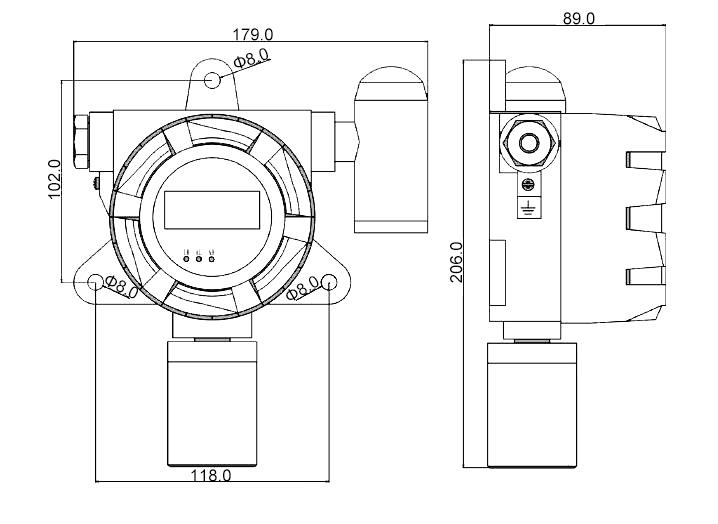
| Dimension | 206*179*90mm |
| Weight | ≤1.6kg |
| Power Adapter | Input 100-240VAC 50/60Hz, Output 24VDC 1A (Optional USA plug, Europe plug, AU plug or UK plug) |
| Accessories (Optional) | Calibration kit - gas pressure regulator (calibration gas cylinder NOT included)
|
Notes
Regarding the flow rate for gas detectors, there are 2 types:
- Pump-Suction Type: Equipped with a built-in pump, with a flow rate of 600 mL/min. (Models: GD200, GD400, GD600)
- Diffusion Type: Not equipped with a built-in pump, with a flow rate of 300 mL/min. (Models: GD300, GD500, GD800)
If you require a customized flow rate, please let us know your specific requirements. We will evaluate whether customization is possible. A flow rate that is too high or too low can affect measurement accuracy, so we recommend using an appropriate flow rate for your application.
Flow rate only needs to be considered when sampling gas from pipelines. For measuring gas concentrations in normal ambient air, you do not need to consider the flow rate. To measure confined spaces such as pipelines, please get in touch with us and provide the detailed conditions of use.
Dimensions (Unit: mm)
Installation Guide
The following precautions apply when connecting the GD300 series fixed gas detector to a pipeline:
- Working pressure should be stable at 1 bar ±10%, and the flow rate should be controlled at 300 mL/min.
- Working temperature is -20°C to +50°C.
- Working humidity is 0–95% RH. When the humidity is above 60% RH, it is recommended to use a dehumidifier or add a filter. When the humidity is above 95% RH, the gas is essentially saturated with water, making measurement impossible.
- The gas detector should be installed indoors. If it is installed outdoors, a rain cover should be added to protect the entire instrument.
- For the second pipeline connection method of the GD300 gas detector, the pipe-mounted installation, the detector mounting thread size is M45 × P2.0. During installation, hold the detector with both hands, keeping the sensor parallel to the mounting thread. Align it with the threaded port, rotate the detector clockwise, and install it in the desired position. To prevent gas leakage at the threaded connection, an appropriate amount of thread seal tape can be wrapped around the sensor head thread before installation.
***Other Common Gases and Ranges Available for Fixed Gas Detectors
| Gas Type | Measure Range | Resolution |
| Ammonia (NH3) | 0-50/100/200/500/1000/2000/5000ppm | 0.01ppm/0.1ppm/1ppm |
| Benzene (C6H6) | 0-1/10/50/100/200/1000/2000/5000/10000ppm | 0.001ppm/0.01ppm/0.1ppm/1ppm |
| Carbon Dioxide (CO2) | 0-1000/2000/5000/9999ppm, 0-2/5/10/20/25/30/50/100%VOL | 0.1ppm/1ppm/0.001%VOL/0.01%VOL/0.1%VOL |
| Carbon Monoxide (CO) | 0-10/20/50/100/500/1000/2000ppm | 0.01ppm/0.1ppm/1ppm |
| Chlorine (Cl2) | 0-5/10/20/50/100ppm | 0.001ppm/0.01ppm/0.1ppm |
| Chlorine Dioxide (ClO2) | 0-1/5/10/20/50/100ppm | 0.001ppm/0.01ppm/0.1ppm |
| Combustible Gas (EX) | 0-100%LEL | 1%LEL |
| Ethylene (C2H4) | 0-10/20/50/100/500/1000/2000ppm | 0.01ppm/0.1ppm/1ppm |
| Formaldehyde (CH2O) | 0-10/20/50/100/500/1000ppm | 0.01ppm/0.1ppm/1ppm |
| Hydrocarbons (HC) | 0-100%LEL | 1%LEL |
| Hydrogen (H2) | 0-10/20/500/1000/2000/5000/9999ppm, 0-2/4% VOL, 0-100% LEL | 0.1ppm/1ppm/0.001%VOL/1%LEL |
| Hydrogen Chloride (HCL) | 0-10/20/50/100/200ppm | 0.01ppm/0.1ppm |
| Hydrogen Cyanide (HCN) | 0-10/20/50/100ppm | 0.01ppm/0.1ppm |
| Hydrogen Sulfide (H2S) | 0-5/20/50/100/200ppm | 0.001ppm/0.01ppm/0.1ppm |
| Methane (CH4) | 0-50/100%VOL, 0-100%LEL | 0.01%VOL/0.1%VOL/1%LEL |
| Nitric Oxide (NO) | 0-1/5/10/20/50/100/250/500/1000ppm | 0.001ppm/0.01ppm/0.1ppm/1ppm |
| Nitrogen (N2) | 0-99.99/0-100%VOL | 0.01%VOL/0.1%VOL |
| Nitrogen Dioxide (NO2) | 0-1/5/10/20/50/100/500/1000ppm | 0.001ppm/0.01ppm/0.1ppm/1ppm |
| Nitrogen Oxides (NOX) | 0-1/5/10/20/50/100/250/500/1000ppm | 0.001ppm/0.01ppm/0.1ppm/1ppm |
| Oxygen (O2) | 0-25/30/100%VOL | 0.01%VOL/0.1%VOL |
| Ozone (O3) | 0-1/5/10/20/50/100ppm | 0.001ppm/0.01ppm/0.1ppm |
| Phosphine (PH3) | 0-10/20/50/100/500/1000/2000/3000ppm | 0.01ppm/0.1ppm/1ppm |
| Sulfur Dioxide (SO2) | 0-1/5/10/20/50/100/500/1000ppm | 0.001ppm/0.01ppm/0.1ppm/1ppm |
| Volatile Organic Compounds (VOC) | 0-1/5/10/20/50/100/200/500/1000/2000/5000/10000ppm | 0.001ppm/0.01ppm/0.1ppm/1ppm |
Note: Some common gases and the measuring ranges are listed in the above table. For more information, please feel free to contact us.
Details
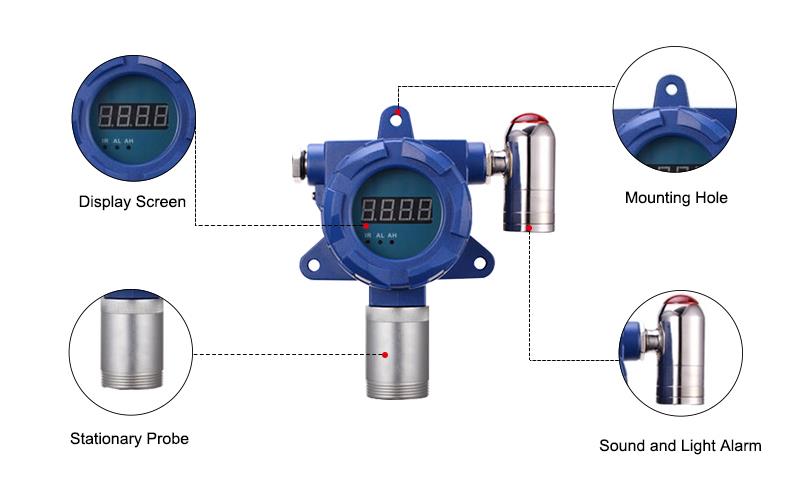
Tips: The necessity of a hydrogen gas detector
Hydrogen (H2) has the physical properties of colorless and odorless, and the flame is transparent when burned. Therefore, the presence of hydrogen in the environment is not easy to detect by the senses. Generally, Ethyl mercaptan is added to the hydrogen gas so that it can be detected by the senses and make the flame appear color. However, when judging whether hydrogen has leaked, we cannot judge by ignition. Because using an open flame to check hydrogen is tantamount to igniting a time bomb, which is very dangerous. Therefore, it is necessary to use a hydrogen gas detector to monitor the environment where H2 may leak on-line.
Hydrogen is mainly stored in liquid form. The liquid H2 overflows and evaporates suddenly in a large area, which can also cause hypoxia in the environment, and may form an explosive mixture with the air, causing a combustion and explosion accident.
ATO hydrogen gas detector is an instrument that can continuously detect the concentration of H2 in the environment. It uses the natural diffusion method to detect the H2 concentration, with an electrochemical sensor. The use of hydrogen detectors can reduce the occurrence of H2 explosion accidents.
Product reviews
I am interested in your hydrogen gas detector
Mrux

6/29/2021 9:14 PM
Was this review helpful? (0/0)
Do you have any suggestions for the measurement range of the hydrogen gas detector we are going to buy?
Jan
11/15/2021 8:21 PM
I am involved with a project where we are researching blending a small percentage of hydrogen into a natural gas distribution system. I found your portable hydrogen sensor while looking for a hydrogen detector that could help us confirm whether or not hydrogen is leaking out of joints where natural gas is not. Could you help me confirm if this would be a suitable use for the detector? If it is, do you have a recommendation for a measuring range?
Was this review helpful? (0/0)
I've purchased an H2 detector for lab research purposes.
Albin
5/30/2022 12:03 AM
I'm doing hydrogen production, so once I plug the H2 detector in (with the pump on), it is showing some reading (28ppm). But the reading is dropping slowly after that, (26ppm, then 24ppm, then 20ppm). Which reading should I get for the experiment? Because the reading is fluctuating.
Was this review helpful? (0/0)
Can the ATO-GAS-H2 detect H2 in air?
Annette
7/27/2022 3:09 AM
Can the ATO-GAS-H2 detect H2 in air? For example, if we pump H2 into a light fixture, would the detector be able to detect if H2 leaks outside of the fixture?
Was this review helpful? (0/0)
Are there known interactions of the H2 measures provided by the sensor in the presence of NH3?
DeLisle
12/12/2022 8:19 PM
Are there known interactions of the H2 measures provided by the sensor in the presence of NH3? For instance, if we have 1 ppm of H2 and 1 ppm of NH3, which value will the sensor read?
Was this review helpful? (0/0)
Has new gas detector to be bought every two years?
marge
4/6/2023 9:39 PM
I read in the YT-95H-:XX manual that the lifespan is two years.
Does this mean that a new detector has to be bought every two years?
Thank you, best regards.
Does this mean that a new detector has to be bought every two years?
Thank you, best regards.
Was this review helpful? (0/0)
Is there a reason for no classification label on H₂ detector?
niki
5/9/2023 8:17 PM
For the H₂ detector itself, I don’t see any label regarding its class / zone ratings.
As far as I’m aware, classified equipment must have its class / zone markings on its body.
Would there be a reason for not having a classification label on the sensor?
As far as I’m aware, classified equipment must have its class / zone markings on its body.
Would there be a reason for not having a classification label on the sensor?
Was this review helpful? (0/0)
Had a question regarding gas detector
nealon
5/9/2023 9:27 PM
We have recently purchased the H₂ detector (ATO-GAS-H2-A) and had a question regarding its ATEX rating.
I see that the detector is rated for ATEX zone 2 on the website, but the cable gland seemed too big compared to the cable that gas can go in and out of the detector freely, making contacts with the circuit boards.
Are we supposed to use a special cable or some gasket to seal the cable gland if we were to use the detector in a hazardous environment?
Was this review helpful? (0/0)
What is the limiting factor of gas detector?
nikos
5/10/2023 2:22 AM
To confirm, is that 1 bar gauge or absolute?
And what is the limiting factor?
And what is the limiting factor?
Was this review helpful? (0/0)
What is the maximum gas pressure the unit can safely detect?
cynthia
5/10/2023 3:46 AM
Additionally, what is the maximum gas pressure the unit can safely detect?
Was this review helpful? (0/0)
Some question of gas detector
melody
6/6/2023 8:18 PM
Thank you for the response. It really helps us with ensuring the safety of our project here. I saw on the website under specs for the detector, it says that it has certifications from CE and ATEX and also rated for Ex d II. I’ll attach the screen shot here.
Would that information on the website be false then?
Would that information on the website be false then?
Was this review helpful? (0/0)
I have a few questions of detector
zhen
7/25/2023 1:38 AM
I am a researcher at De Nora Tech in Ohio. I have a water electrolysis test setup that generates high-purity H2 and high purity O2, and I am interested in sensors that are able to measure the concentration of H2 and O2 in these streams.
I see that ATO has both hydrogen and oxygen-fixed gas detectors (SKU# ATO-GAS-H2-A and ATO-GAS-O2-A respectively) and the specs seem to be close to what we need for resolution and LDL.
I have a few questions that I hope you can help me out with.
First, we need to set up our system with a flow-through sensor. I believe these are intended for use in measuring the ambient concentrations of gases, but is it possible to pass our product stream over the sensing unit with a tee fitting or something along those lines? If you’ve ever seen these sensors used in this way, do you know if there’s a specific flow rate we need to maintain?
Additionally, what pressure ranges are these sensors able to operate at?
Was this review helpful? (0/0)
About fixed gas detector
Karl
11/11/2024 11:14 PM
Can the fixed detector directly detect H2 in combustion exhaust containing CO2, N2, O2 and some other minor components (the temperature is not high)? The H2 flow rate varies.
Was this review helpful? (0/0)
Only registered users can write reviews
Customers who bought this item also bought

Fixed Carbon Dioxide (CO2) Gas Detector, 0 to 9999 ppm
GD300-CO2
$757.85
Economical price fixed gas detector from ideal supplier, for carbon dioxide detection. Measuring range 0-1000/2000/5000/9999 ppm for selection, remote control output signal 4-20mA and RS485, monitor CO2 concentration and sound & light alarm, high accuracy 3% F.S, fast response within 10s, 24h work and real-time display.

Fixed Nitrogen (N2) Gas Detector, 0 to 100% Vol
GD300-N2
$742.46
Buy nitrogen gas detector from high-quality manufacturer at good price. Measuring range 0-100% Vol, supports remote control, optional output signal 4-20mA and RS485, high accuracy 3% F.S, fast response within 10s. N2 gas detector for nitrogen concentration detecting and leak monitor, sound and light alarm, 24h online, real-time display, fixed mounting.

Fixed Hydrocarbons (HC) Gas Detector, 0 to 100%LEL
GD300-HC
$416.59
Cost-effective fixed Hydrocarbons (HC) gas detector for sale, with sound & light alarm, advanced sensor, measuring range from 0 to 100% LEL. This Hydrocarbons vapor monitor is designed to continuously monitor and detect the presence of HC gases in various industrial settings, such as oil refineries, chemical plants, and offshore drilling platforms.

Handheld Carbon Monoxide (CO) Gas Detector, 0 to 500/1000/2000 ppm
GD200-CO
$398.76
Handheld carbon monoxide (CO) detector use high accuracy sensor, pump suction type, selectable measuring range of 0 to 500 ppm, 0 to 1000 ppm, 0 to 2000 ppm, gas leak alarm with audible, visual and vibrating, compact size and light weight, long working time, easy to carry and operation.

Portable Hydrogen (H2) Gas Detector, 0 to 500/1000/2000 ppm
GD200-H2
$784.62
Portable hydrogen (H2) gas detector draws the gas sample by a micro pump, with high accuracy and reliability, measurement ranging from 0 to 500ppm, 1000ppm, 2000ppm, 5000ppm for your choice. Real-time LCD display, audible, visual & vibrating alarm, durable and compact design, easy to carry and operate. High precision H2 detector with measuring range 0-10ppm (0.001ppm) is also available.
Related products
Fixed Carbon Dioxide (CO2) Gas Detector, 0 to 9999 ppm
GD300-CO2
$757.85
Economical price fixed gas detector from ideal supplier, for carbon dioxide detection. Measuring range 0-1000/2000/5000/9999 ppm for selection, remote control output signal 4-20mA and RS485, monitor CO2 concentration and sound & light alarm, high accuracy 3% F.S, fast response within 10s, 24h work and real-time display.

Fixed Methane (CH4) Gas Detector, 0 to 100% LEL
GD300-CH4
$2,093.23
Buy fixed methane gas detector online at good price. Measuring range 0-100% LEL, resolution 1% LEL, optional output signal 4-20mA and RS485, high accuracy 3% F.S. CH4 gas detector 24-hour works to detect and monitor methane concentration, sound and light alarm, real-time display, remote control is available.
Fixed Nitrogen (N2) Gas Detector, 0 to 100% Vol
GD300-N2
$742.46
Buy nitrogen gas detector from high-quality manufacturer at good price. Measuring range 0-100% Vol, supports remote control, optional output signal 4-20mA and RS485, high accuracy 3% F.S, fast response within 10s. N2 gas detector for nitrogen concentration detecting and leak monitor, sound and light alarm, 24h online, real-time display, fixed mounting.

Fixed Oxygen (O2) Gas Detector, 0 to 25% / 30% Vol
GD300-O2
$434.77
Fixed gas detector for detecting oxygen concentration. Measuring range 0~25% or 0~30% for selection, output signal 4-20mA and RS485, high accuracy 3% F.S. O2 gas detector has sound and light alarm, real-time display, remote control, small size, lightweight, low price.

Fixed Ozone (O3) Gas Detector, 0 to 1/5/10/20/50/100 ppm
GD300-O3
$869.43
Reliable manufacturer Ozone gas detector for sale. Available measuring range 0-1/5/10/20/50/100 ppm, sound and light alarm by remote control, output signal 4-20mA and RS485, high accuracy 3% F.S, fast response within 10s. O3 gas concentration detector is fixed mounting, small size, compact structure, competitive price.