
AC voltage sensor has measuring range of AC 10V/50V/100V/200V/300V/500V/800V to 1000V.
Specification:
| Model | ATO-WBV412M05 | ATO-WBV414M05 |
| Shipping weight | 1kg | |
| Measuring range of input voltage * | AC 0-10V ~ 0-1000V | |
| Short-time overload | 2 times of nominal input voltage, 1s in duration, interval time 10s, repeat 10 times | |
| Linear measurement range | 0% ~ 120% measuring range | |
| Frequency range | 25Hz ~ 3kHz | |
| Output signal * | DC 0-5V, 0-10V (only for power supply DC 24V), 1-5V | DC 4-20mA, 0-20mA |
| Power supply | DC 9V~36V | |
| Accuracy | 0.2%F.S. | |
| Load capacity | 5mA | 300Ω |
| Response time | ≤300ms | |
| Temperature drift | 100*10-6/℃ | 150*10-6/℃ |
| Static power consumption | 0.6W | |
| Output ripple voltage | ≤10mV (RMS) | |
| Isolation features | Isolation between input, output and power supply | |
| Isolation voltage | Input and output: AC 2.5kV, 1min Power supply and input: AC 2.5kV, 1 min Power supply and output: AC 2.5kV, 1 min | |
| Work temperature | -25~+70℃ | |
| Storage temperature | -40~+85℃ | |
| Protection features | EMC standards: EN61326: 2006 Safety standards: EN60100:2001 | |
| Mean time between failures | >50000h | |
| Housing material | PC + fire-retardant ABS | |
| Wiring | Terminal connection | |
| Installation | DIN rail (NS35/7.5, NS35/15, EN50022), or screw (M3) fixation | |
Voltage sensor AC 10V to 1000V dimensional drawing (unit: mm):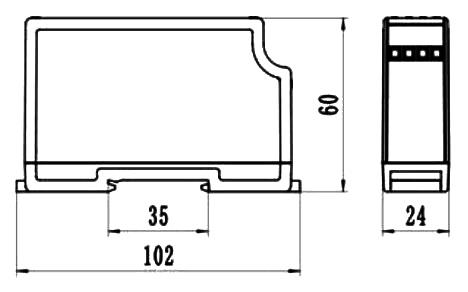
Voltage sensor AC 10V to 1000V wiring diagram: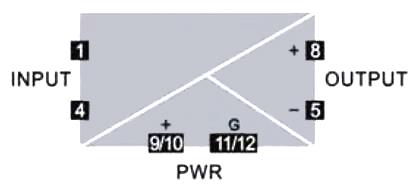
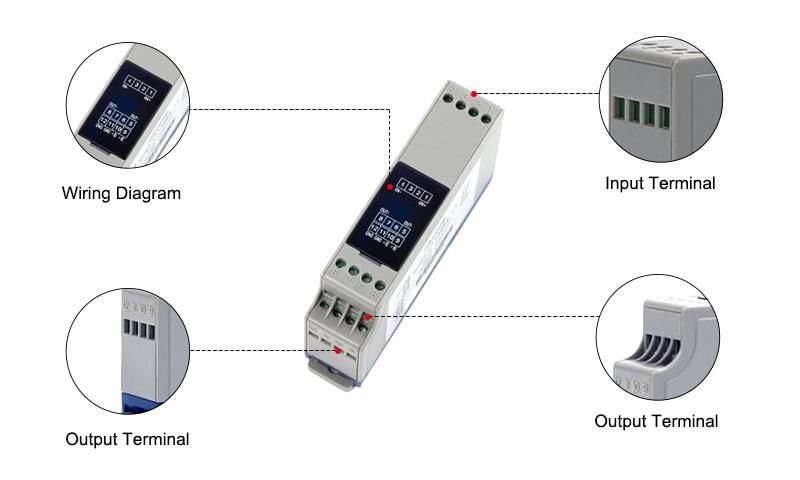
Details
Tips: How to choose a voltage sensor?
In the voltage measurement, the appropriate voltage sensor should be selected according to the specific situation. The basic principles of voltage sensor selection are:
- The range of the measured voltage is an important basis for selecting a voltage sensor, so there must be a wide enough voltage measurement range.
- Confirm the output signal and power supply of the voltage transducer.
- The response time is fast enough, especially for overload protection, the response time of the voltage sensor must be fast enough.
- The voltage sensor should have a wide enough frequency range and high enough measurement accuracy. If the frequency exceeds the measurement range, waveform distortion will occur in actual use.
- The voltage transducer has sufficiently high input impedance. The input resistance of the voltage sensor is the additional load of the circuit under test. In order to reduce the impact of the access of the measurement circuit on the circuit under test, it is required to have higher input impedance.
- Confirm whether the voltage sensor isolation level is met environmental requirements, the isolation voltage is high enough, and the safety factor reaches the standard.
- The voltage sensor should have high anti-interference ability, because the measured voltage often contains some components that do not need to be measured, such as noise interference.
Product reviews
Good AC voltage sensor
Beacher

7/26/2021 2:01 AM
I bought the voltage sensor to monitor and stabilize the current of the motors on my playmobile. It makes sure my controller knows when to stop when the current draw increases. It has a wide measuring range and high accuracy. I think it is very reliable.
Was this review helpful? (0/0)
Support multiple power inputs
Kekran
12/26/2024 6:19 PM
This sensor supports 12V, 24V, and 36V DC power inputs, which is very flexible. I use a 24V power supply in my application, and the sensor works stably after it is connected, without any power incompatibility or voltage instability.
Was this review helpful? (0/0)
Measuring RMS Values
Conlos
12/11/2025 7:14 PM
Do both the ATO-VOS-AC1000 and ATO-CUS-ACDC1500 voltage sensors measure and output RMS values?
Was this review helpful? (0/0)
Only registered users can write reviews
Customers who bought this item also bought

AC Current Sensor, 5A/10A/20A/50A/100A/150A to 400A
ATO-CUS-AC400
$117.38
AC current sensor adopts electromagnetic isolation principle, small size, light weight, low price, fast response, high accuracy, good stability, and DIN rail installation. AC current sensor is widely used for AC current measurement of various occasions, especially for sine-wave ac current with power frequency 50Hz.

AC Current Sensor, 5mA/100mA/1A/2A/5A to 10A
ATO-CUS-AC10
$72.63
AC current sensor adopts linear photoelectric isolation or modulation and demodulation principle, best cost performance, fast response, high accuracy, good stability, small size, light weight, input current terminal connection, DIN rail installation, widely used for AC current measurement of various occasions.

Isolated DC Voltage Sensor 10mV to 1000V, Power Supply DC 12V/24V
ATO-VOS-DC1000
$141.96
DC voltage sensor uses modulation and demodulation technology to achieve input/output/power supply isolation. Isolated voltage transducer has measuring range from DC 10mV/50mV/75mV/5V/150V/300V/500V to 1000V, supply voltage DC 12V/24V, accuracy 0.2%FS, output signal 0-5V/0-10V/0-20mA/4-20mA and strong anti-interference capability. DC voltage sensor is widely used for voltage isolated measuring and control, such as electric power, remote monitoring, medical equipment, etc.

DC Current Sensor 1mA/1A/5A/10A/100A to 800A
ATO-CUS-DC800
$85.56
DC current sensor has best cost performance, fast response, high accuracy, good stability, small size, light weight, DIN rail installation, widely used for DC current measurement of various occasions.

DC Voltage Sensor, 50mV-1000V Input, 2.5V/5V Output
ATO-VOS-DC5
$149.23
The DC voltage sensor offers a wide range of input options, including DC 50mV, 75mV, 50V, 100V, 200V, 300V, 500V, and 1000V. The output type is a tracking current output, with DC 2.5V±2.5V or 5V±5V. The accuracy class is 0.2, and it can handle a load capacity of up to 5mA. The voltage sensor responds in less than 15 microseconds and has a temperature drift of 160 x 10⁻⁶/℃. Auxiliary power requirements include DC +12V, +15V, or +24V, with a static current draw of ≤30mA.
Related products

3 Phase AC Voltage Transducer 10V to 500V, Output 0-5V/4-20mA/0-20mA
ATO-VOS-3AC500
$177.78
3 phase AC voltage transducer is a special voltage sensor for three-phase AC voltage measurement. Voltage transducer has a measuring range from AC 10V to 500V, supply voltage DC 12V/24V, output signal DC 0-5V/0-20mA/4-20mA. 3 phase voltage transducer is mainly used for power monitoring, power control and dispatching systems in petroleum, coal, metallurgy, railway and other industries.
Isolated DC Voltage Sensor 10mV to 1000V, Power Supply DC 12V/24V
ATO-VOS-DC1000
$141.96
DC voltage sensor uses modulation and demodulation technology to achieve input/output/power supply isolation. Isolated voltage transducer has measuring range from DC 10mV/50mV/75mV/5V/150V/300V/500V to 1000V, supply voltage DC 12V/24V, accuracy 0.2%FS, output signal 0-5V/0-10V/0-20mA/4-20mA and strong anti-interference capability. DC voltage sensor is widely used for voltage isolated measuring and control, such as electric power, remote monitoring, medical equipment, etc.

Voltage Sensor for DC Bidirectional Voltage, Power Supply 12V/15V/24V
ATO-VOS-BDC1000
$169.96
DC voltage sensor with supply voltage DC 12V/15V/24V is a special voltage sensor for bidirectional voltage tracking. The measuring range of input voltage is from ±50mV, ±50V, ±200V, ±500V to ±1000V. The output signal can be DC 2.5±2.5V, 5±5V, 12±8mA, or 10±10mA.

Isolated DC Voltage Sensor for Ripple Voltage 10mV to 1000V
ATO-VOS-RDC1000
From $134.81
DC voltage sensor is a special voltage sensor for unidirectional ripple DC voltage measurement. It has a measuring range from DC 10mV/50mV/75mV/5V/150V/300V/500V to 1000V, output signal 0-5V/0-10V/0-20mA/4-20mA, supply voltage DC 12/24V, IP20 and DIN rail installation. Isolated DC voltage transducer uses modulation and demodulation technology to achieve input/output/power supply isolation.