6 Digit Display Controller for Load Cells

$327.09
6 digit display controller can be used with load cells, force sensors and weighing sensors, 4-20mA or 0-10V transmitting signal output. This digital panel meter can display gross, net, peak and valley value alternately. Software with RS485 communication cable allows you to log the data on a PC.
SKU: ATO-DPM-DY800
*
Free Shipping
Delivery date: 6-12 days

A 6 digit display controller is a device designed to control and drive a 6 digit display unit, which can cooperate with load cells, force sensors and weighing sensors to use. It serves as the interface between the display unit and an external system, such as a microcontroller or a computer.

Specification

  • Model: ATO-DPM-DY800 (Click it to view user manual)
  • Power Supply Voltage: 10~30V DC
  • Measurement Accuracy: <0.01%
  • Measuring Speed: 5~320Hz
  • Temperature Drift: <10ppm
  • Display Scale: - 99999~999999
  • Transmission Output: 0~10V, 4-20mA
  • Communication Rate: 2400~115200
  • Switch Output: 6-Way Relay Normally Open Node Output
  • Switch Input: 2-Way Open Input
  • Node Drive Capability: 3A/250V AC or 30V DC (Resistive Load)
  • Measurement Channel: 5V Power Supply
  • Working Environment: - 20~ 70°C
  • Relative Humidity: <90% (No Condensation)

Note: You can use software + RS485 communication cable to log/record the data on a PC.

Dimension (Unit: mm)
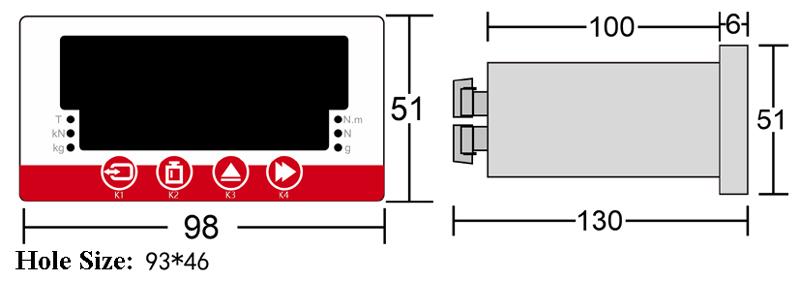
6 digit display controller dimension

Key Description

keyK1K2K3K4
Key FrameLong press to enter parameter modificationLong press to enter calibrationPage turningLong press to press the zero clearance
Parameter ModificationSave and go to the next parameterQuitAddRight shift
DemarcateOutCalibration factor/Clear
Interface TestingSelect next functionOutOutput modificationSelect

Tips: How does a 6 digit display controller work with load cells?

A 6-digit display controller is typically used to interface with load cells for measuring weight or force. Load cells are transducers that convert a physical force into an electrical signal. The display controller receives this electrical signal from the load cells and processes it to provide a readable weight or force measurement on a 6-digit display. How a 6-digit display controller works with load cells?

  • Load Cell Interface: The load cells are connected to the display controller through appropriate wiring. Load cells typically have multiple wires for power supply and signal transmission. The exact wiring configuration depends on the specific load cell and display controller being used.
  • Amplification and Signal Conditioning: The electrical signal generated by the load cells is usually very weak and needs amplification and conditioning for accurate measurement. The display controller includes an amplifier and signal conditioning circuitry to strengthen and stabilize the load cell signal. This ensures that the measured weight or force is accurate and reliable.
  • Analog-to-Digital Conversion: After amplification and conditioning, the analog signal from the load cells is converted into a digital format suitable for processing by the display controller. An analog-to-digital converter (ADC) is employed for this purpose. The ADC samples the analog signal at regular intervals and converts it into a digital value that represents the weight or force being measured.
  • Data Processing: Once the analog signal is converted into a digital format, the display controller processes the data to calculate the weight or force value. This may involve applying calibration factors, performing linearization, and implementing any necessary algorithms for the specific load cell and measurement requirements. The processed data is typically stored in the controller's memory for display purposes.
  • Display Output: The display controller drives the 6 digit display to show the measured weight or force value in a human-readable format. The display may be comprised of seven-segment LED displays or other suitable technologies. The controller updates the display continuously or at regular intervals to reflect any changes in the measured value.

In this video, we've shown the step-by-step process for the seamless integration of ATO's DY800 load cell display controller with PC software and load cell to establish a digital weight sensing system.

Product reviews
I have a few question of controller
5
lolly
Avatar
8/1/2023 1:25 AM
Apologies for the questions, just about ready to order a test set-up but wanted to make sure it seems reasonable.
We are trying to measure displacement vs a load of a pipe being uplifted through the soil. The setup is very similar to the one below.
We are hoping to use the following:
500kg load cell (S type) (https://www.ato.com/tension-load-cell-s-type-50kg-to-20-ton)
RS485 Communication cable to PC – custom order
Recommended software to read data on a computer -custom order
Electric Linear Actuator (4000N, 450mm stroke) (https://www.ato.com/electric-linear-actuator)
Actuator relay switch for operation
The main question with this is:  I am hoping to measure displacement and load at the same time. Can I attain displacement information from this actuator or any ATO actuator?
If so, how could I route this to a computer?
Also, is there a way to control the speed of the actuator?
Hoping to utilize around 1mm/s.
Was this review helpful? Yes No (0/0)
ATO Responded
1. If you want to record the measurement data of a 500kg load cell (S type) to PC, you can use the DY800 meter. Via RS485 Communication cable to PC, but when reading data, the load cell should be in a stable state, not in the process of pulling.
2. Electric Linear Actuator (4000N, 450mm stroke) can be configured with Hall signal feedback, and you can calculate the displacement by reading the Hall signal.
But currently, we do not have a matching controller and software that can record displacement data on a PC. Also, our controller cannot control the running speed of the Linear Actuator. The running speed of this Linear Actuator is about 3-4mm/s, not 1mm/s.
Confuse the sensitivity
5
Clare
Avatar
10/24/2023 1:57 AM
This is for prototyping and testing of a product that we are planning to go to production with.

Regarding the sensitivity of the DYHW-120 load cell:

The data sheet that came with the product, says 0.9mV/V

On ATO's website, it says 3mV/V

On Amazon, it says 2.0 mV/V  /- 10%.

Can you advise how we can know the correct value so that we may properly progarm our boards?
Was this review helpful? Yes No (0/0)
ATO Responded
The sensitivity is Not fixed and can be used above 0.5MV/V. We have already calibrated it for you when it leaves the factory. The sensitivity is based on the nameplate label diagram of the sensor.
Read the value of sensor
5
Amilie
Avatar
8/8/2024 3:08 AM
I just need something to give me the direct reading from the sensor.
Was this review helpful? Yes No (0/0)
ATO Responded
If you want to read the value of this sensor and record it on the computer, we recommend this display controller SKU: ATO-DPM-DY800.
How to Switch Output Signal
5
James
Avatar
1/29/2025 9:03 AM
Hello, how do I switch the output signal from 4-20mA to 0-10V?
Was this review helpful? Yes No (0/0)
ATO Responded
Once you select an output signal when placing an order, you cannot switch to another type of output signal.
Some questions
4
Riven
Avatar
5/12/2025 9:34 PM
We noticed that the specification of this digit display controller lists the measurement speed as 5-320 Hz. However, we require a minimum sampling rate of 1000 Hz. Can you use your load cell with another supplier's interface?
Was this review helpful? Yes No (0/0)
ATO Responded
1. If you want to measure impact force at a sampling rate of more than 1000 Hz, we can provide another handheld force gauge with a sampling rate of up to 2000 Hz.
2. The bridge voltage of our load cell is between 5-10 volts and uses a 4-wire connection. If you are using a PhidgetBridge 4-input interface from another supplier that meets these requirements, then it should be compatible.
Power Supply Voltage
5
Motsey
Avatar
10/7/2026 2:23 AM
Hello, does the ATO-DPM-DY800 controller have a version that supports 110V AC (VAC)? Thank you.
Was this review helpful? Yes No (0/0)
ATO Responded
This controller SKU: ATO-DPM-DY800 only supports 24VDC power supply and does not support single-phase 110V AC power input. You can purchase a switching power supply to convert the 110V voltage to 24VDC.
Write your review
  • Only registered users can write reviews
*
*
  • Bad
  • Excellent
*
*
*
*

A 6 digit display controller is a device designed to control and drive a 6 digit display unit, which can cooperate with load cells, force sensors and weighing sensors to use. It serves as the interface between the display unit and an external system, such as a microcontroller or a computer.

Specification

  • Model: ATO-DPM-DY800 (Click it to view user manual)
  • Power Supply Voltage: 10~30V DC
  • Measurement Accuracy: <0.01%
  • Measuring Speed: 5~320Hz
  • Temperature Drift: <10ppm
  • Display Scale: - 99999~999999
  • Transmission Output: 0~10V, 4-20mA
  • Communication Rate: 2400~115200
  • Switch Output: 6-Way Relay Normally Open Node Output
  • Switch Input: 2-Way Open Input
  • Node Drive Capability: 3A/250V AC or 30V DC (Resistive Load)
  • Measurement Channel: 5V Power Supply
  • Working Environment: - 20~ 70°C
  • Relative Humidity: <90% (No Condensation)

Note: You can use software + RS485 communication cable to log/record the data on a PC.

Dimension (Unit: mm)

6 digit display controller dimension

Key Description

keyK1K2K3K4
Key FrameLong press to enter parameter modificationLong press to enter calibrationPage turningLong press to press the zero clearance
Parameter ModificationSave and go to the next parameterQuitAddRight shift
DemarcateOutCalibration factor/Clear
Interface TestingSelect next functionOutOutput modificationSelect

Tips: How does a 6 digit display controller work with load cells?

A 6-digit display controller is typically used to interface with load cells for measuring weight or force. Load cells are transducers that convert a physical force into an electrical signal. The display controller receives this electrical signal from the load cells and processes it to provide a readable weight or force measurement on a 6-digit display. How a 6-digit display controller works with load cells?

  • Load Cell Interface: The load cells are connected to the display controller through appropriate wiring. Load cells typically have multiple wires for power supply and signal transmission. The exact wiring configuration depends on the specific load cell and display controller being used.
  • Amplification and Signal Conditioning: The electrical signal generated by the load cells is usually very weak and needs amplification and conditioning for accurate measurement. The display controller includes an amplifier and signal conditioning circuitry to strengthen and stabilize the load cell signal. This ensures that the measured weight or force is accurate and reliable.
  • Analog-to-Digital Conversion: After amplification and conditioning, the analog signal from the load cells is converted into a digital format suitable for processing by the display controller. An analog-to-digital converter (ADC) is employed for this purpose. The ADC samples the analog signal at regular intervals and converts it into a digital value that represents the weight or force being measured.
  • Data Processing: Once the analog signal is converted into a digital format, the display controller processes the data to calculate the weight or force value. This may involve applying calibration factors, performing linearization, and implementing any necessary algorithms for the specific load cell and measurement requirements. The processed data is typically stored in the controller's memory for display purposes.
  • Display Output: The display controller drives the 6 digit display to show the measured weight or force value in a human-readable format. The display may be comprised of seven-segment LED displays or other suitable technologies. The controller updates the display continuously or at regular intervals to reflect any changes in the measured value.
Product reviews
I have a few question of controller
5
lolly
Avatar
8/1/2023 1:25 AM
Apologies for the questions, just about ready to order a test set-up but wanted to make sure it seems reasonable.
We are trying to measure displacement vs a load of a pipe being uplifted through the soil. The setup is very similar to the one below.
We are hoping to use the following:
500kg load cell (S type) (https://www.ato.com/tension-load-cell-s-type-50kg-to-20-ton)
RS485 Communication cable to PC – custom order
Recommended software to read data on a computer -custom order
Electric Linear Actuator (4000N, 450mm stroke) (https://www.ato.com/electric-linear-actuator)
Actuator relay switch for operation
The main question with this is:  I am hoping to measure displacement and load at the same time. Can I attain displacement information from this actuator or any ATO actuator?
If so, how could I route this to a computer?
Also, is there a way to control the speed of the actuator?
Hoping to utilize around 1mm/s.
Was this review helpful? Yes No (0/0)
ATO Responded
1. If you want to record the measurement data of a 500kg load cell (S type) to PC, you can use the DY800 meter. Via RS485 Communication cable to PC, but when reading data, the load cell should be in a stable state, not in the process of pulling.
2. Electric Linear Actuator (4000N, 450mm stroke) can be configured with Hall signal feedback, and you can calculate the displacement by reading the Hall signal.
But currently, we do not have a matching controller and software that can record displacement data on a PC. Also, our controller cannot control the running speed of the Linear Actuator. The running speed of this Linear Actuator is about 3-4mm/s, not 1mm/s.
Confuse the sensitivity
5
Clare
Avatar
10/24/2023 1:57 AM
This is for prototyping and testing of a product that we are planning to go to production with.

Regarding the sensitivity of the DYHW-120 load cell:

The data sheet that came with the product, says 0.9mV/V

On ATO's website, it says 3mV/V

On Amazon, it says 2.0 mV/V  /- 10%.

Can you advise how we can know the correct value so that we may properly progarm our boards?
Was this review helpful? Yes No (0/0)
ATO Responded
The sensitivity is Not fixed and can be used above 0.5MV/V. We have already calibrated it for you when it leaves the factory. The sensitivity is based on the nameplate label diagram of the sensor.
Read the value of sensor
5
Amilie
Avatar
8/8/2024 3:08 AM
I just need something to give me the direct reading from the sensor.
Was this review helpful? Yes No (0/0)
ATO Responded
If you want to read the value of this sensor and record it on the computer, we recommend this display controller SKU: ATO-DPM-DY800.
How to Switch Output Signal
5
James
Avatar
1/29/2025 9:03 AM
Hello, how do I switch the output signal from 4-20mA to 0-10V?
Was this review helpful? Yes No (0/0)
ATO Responded
Once you select an output signal when placing an order, you cannot switch to another type of output signal.
Some questions
4
Riven
Avatar
5/12/2025 9:34 PM
We noticed that the specification of this digit display controller lists the measurement speed as 5-320 Hz. However, we require a minimum sampling rate of 1000 Hz. Can you use your load cell with another supplier's interface?
Was this review helpful? Yes No (0/0)
ATO Responded
1. If you want to measure impact force at a sampling rate of more than 1000 Hz, we can provide another handheld force gauge with a sampling rate of up to 2000 Hz.
2. The bridge voltage of our load cell is between 5-10 volts and uses a 4-wire connection. If you are using a PhidgetBridge 4-input interface from another supplier that meets these requirements, then it should be compatible.
Power Supply Voltage
5
Motsey
Avatar
10/7/2026 2:23 AM
Hello, does the ATO-DPM-DY800 controller have a version that supports 110V AC (VAC)? Thank you.
Was this review helpful? Yes No (0/0)
ATO Responded
This controller SKU: ATO-DPM-DY800 only supports 24VDC power supply and does not support single-phase 110V AC power input. You can purchase a switching power supply to convert the 110V voltage to 24VDC.
Only registered users can write reviews
Customers who bought this item also bought

Tension and Compression Load Cell, 1 kg - 500 kg

ATO-LC-TC01
$137.98
Tension and compression load cell can bear both tension and pressure, with good anti-eccentric load performance, low height, all sealed structure and complete specifications. Miniature load cell with optional capacity 1 kg/ 100kg/ 200 kg/ 300kg/ 500 kg is suited to use in restricted spaces, such as using in vehicle/test instrument/laminator measurement and control.

Force Torque Sensor, Flange, 0-20/30/50/100/200 Nm

ATO-TQS-105
$246.19
High precision force torque sensor is a static torque transducer, comes with flange mounting, IP65 protection level, 0-20/30/50/100/200 Nm capacity, suitable for mechanical arm joint torque force measurement, force detection, force value analysis tester and other torque force testing instruments.

Ring Load Cell, Through Hole, 50kg/200kg/500kg to 5000kg

ATO-LC-1003
$259.63
Through hole ring design, the ring load cell has a strong load capacity and is suitable for weighing tasks from 0-50kg/200kg/500kg to 5000kg. Fully sealed alloy steel construction for long-lasting operation in complex industrial environments.

Compression Force Sensor, Ring Type, 0.5kN-200kN

ATO-FS-HX004
$193.99
Compression force sensor, ring type for sale, with optional capacities of 0.5kN, 1kN, 2kN, 5kN, 10KN, 20kN, 50kN, 100kN, 200kN, has an output sensitivity of 1.0 ± 10% mV/V and a zero output of ±2%F.S. Made from stainless steel, the higher quality load cell has an impedance of 700Ω and insulation of ≥5000MΩ/100VDC. The operating voltage is 5-15V, and it performs within a temperature range of -20°C to 80°C. Hollow design, the main measurement of extrusion force, assembly interference detection and control of other industrial control force detection.

Micro Load Cell, Button type, 5kg/100kg/200kg/300kg/500kg/1000kg

ATO-LC-BU04
$144.97
Micro load cell has a capacity range from 5kg, 10kg, 20kg, 50kg, 100kg, 300kg to 1000kg. It has a button type structure, diameter 20mm and height 9mm, cable Φ3*2m. Button load cell can be used in laminator, riveter, force tester, any automation equipment needs force monitoring.