
Pneumatic valve actuator is an executive device that uses air pressure to drive ball valve, butterfly or regulating valve. The pneumatic actuator is easy to repair and maintain, and has good adaptability to the environment.
Specifiation
- Model: ATO-AT088D
- Bore Size: 88mm (3.46 inch)
- Air Supply Port: 1/4 inch
- Power Source: Compressed Air
- Actuator Type: Double Acting
- Air Pressure: 2.5bar ~ 8bar
- Max Working Pressure: 10bar
- Operating Temperature (Optional): -20℃ ~ 80℃, -35℃ ~ 80℃, -20℃ ~ 150℃
- Rotation Angle: 90°±5%
- Body Material: Aluminum Alloy
- Life Time: One Million Time
Dimensions
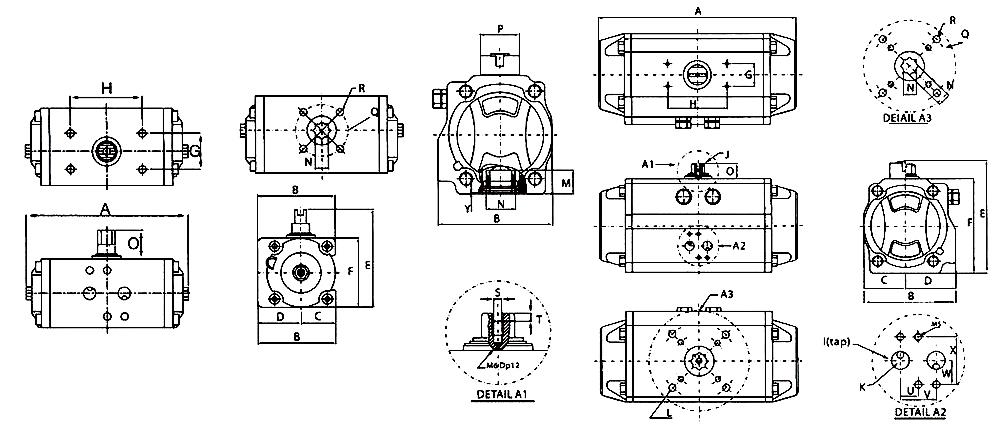
ATO-AT088D
| Q | A | B | C | D | E | F | G | H | I |
| Φ50/Φ70mm | 250mm | 105mm | 49.5mm | 55.5mm | 145mm | 115mm | 30mm | 80mm | PF |
| J | K | O | P | S | T | U | V | W | X |
| M6 | 1/4" | 20mm | 40.5mm | 4mm | 4mm | 12mm | 24mm | 16mm | 32mm |
Details
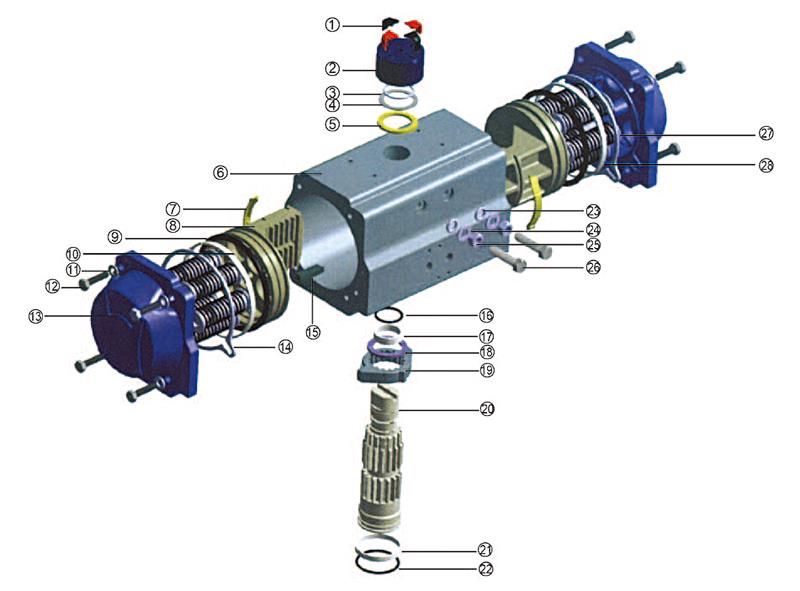
| PN | Number | Name | Standard Material |
| 1 | 4 | Position Indicator | Polypropylene+GF |
| 2 | 1 | Position Indicator Seat | Polypropylene+GF |
| 3 | 1 | Snap Ring | Stainless Steel |
| 4 | 1 | Bearing | Stainless Steel |
| 5 | 1 | Bearing | Polyphthalamide |
| 6 | 1 | Bore Body | Extruded Aluminum alloy |
| 7 | 2 | Bearing | Polyphthalamide |
| 8 | 2 | Piston | Die Cast Aluminum |
| 9 | 2 | O-Ring | Nitrile(NBR70) |
| 10 | 2 | Bearing | Polyphthalamide |
| 11 | 8 | End Cover bolt gasket | Stainless Steel |
| 12 | 2 | End Cover bolt | Stainless Steel |
| 13 | 2 | Left and Right end Cover | Die Cast Aluminum |
| 14 | 2 | O-Ring | Nitrile(NBR70) |
| 15 | 2 | Guide Sleeve | Polypropylene+GF |
| 16 | 1 | O-Ring | Nitrile(NBR70) |
| 17 | 1 | Bearing | Nylon46 |
| 18 | 1 | Bearing | Polyphthalamide |
| 19 | 1 | Cam Switch | Stainless Steel |
| 20 | 1 | Actuating Shaft | Steel alloy |
| 21 | 1 | Bearing | Nylon46 |
| 22 | 1 | O-Ring | Nitrile(NBR70) |
| 23 | 1 | O-Ring | Nitrile(NBR70) |
| 24 | 2 | Spacer for Limit Bolt | Stainless Steel |
| 25 | 2 | Limit Nut | Stainless Steel |
| 26 | 2 | Limit Bolt | Stainless Steel |
| 27 | min.5/max.12 | Spring | High alloy Spring Steel |
| 28 | 1 | Spring Seat | Polypropylene+GF |
Tips: Difference between double acting and spring return pneumatic valve actuator
- Double acting pneumatic valve actuator
The output torque of the double acting pneumatic valve actuator is obtained by multiplying the piston pressure (supplied by the air source pressure) by the pitch circle radius (force arm). And the friction resistance is small and the efficiency is high. , the output torque is linear both clockwise and counterclockwise. Under normal operating conditions, the recommended safety factor for double-acting actuators is 25-50% - Spring return pneumatic valve actuator
The output torque of the single acting pneumatic valve actuator is obtained in two different operation processes, and each operation generates two different torque values according to the stroke position. The output torque of the spring return actuator is obtained by multiplying the force (air pressure or spring force) by the force arm. In this case, the pressure of the air source forces the piston to turn from 0 to 90 degrees. Due to the reaction force generated by the compression of the spring, the torque gradually decreases from the maximum value at the starting point until it reaches the second condition: the output torque is that the spring recovers when the middle cavity loses air. The force acting on the piston is called "spring stroke output torque". In this case, due to the elongation of the spring, the output torque gradually decreases from 90 degrees to 0 degrees. As mentioned above, it is designed on the basis of generating a balance moment under such conditions. In each case, by changing the relationship between the number of springs per side and the air supply pressure (eg. 2 springs per side and 5.5 bar air supply or vice versa) it is possible to obtain an unbalanced moment. In spring return applications two conditions can be obtained: Air loss on or air loss off. Under normal operating conditions, the recommended safety factor for spring return actuators is 25-50%.
Only registered users can write reviews
Related products

Double Acting Pneumatic Valve Actuator, 100mm Bore Size
ATO-AT-100D
$205.39
Factory price pneumatic valve actuator for butterfly or ball valve, double acting type, 100mm bore size, aluminum alloy body material, powered by compressed air, air supply port 1/4 inch. ATO air operated actuator has small size and large torque, which is perfect for valve control.

Double Acting Pneumatic Valve Actuator, 115mm Bore Size
ATO-AT-115D
$270.99
ATO pneumatic valve actuator with low price for butterfly or ball valve, double acting type, 115mm bore size, aluminum alloy body material, powered by compressed air, air supply port 1/4 inch, air pressure 2.5bar ~ 8bar. Air operated actuator has small size and large torque, which is perfect for valve control.

Double Acting Pneumatic Valve Actuator, 125mm Bore Size
ATO-AT-125D
$293.99
Double acting pneumatic valve actuator for butterfly or ball valve, powered by compressed air, air supply port 1/4 inch, bore size 125mm, air pressure 2.5bar ~ 8bar. Small size, light weight, quick opening and closing, easy to install & operate.

Double Acting Pneumatic Valve Actuator, 145mm Bore Size
ATO-AT-145D
$463.29
ATO pneumatic valve actuator for opening and closing butterfly or ball valve, double acting, powered by compressed air, air supply port 1/4 inch, bore size 145mm, air pressure 2.5bar ~ 8bar, aluminum alloy material. Low price, small size, light weight, easy to install and operate.