
Through beam photoelectric sensor with reverse power protection, short circuit protection, current overload protection, can be directly connected with PLC.
Application: Through beam photoelectric sensors are used in industrial environments for tasks such as object detection on conveyors, material handling, packaging, automatic doors, liquid level sensing, printing and label detection, assembly line automation, vehicle detection, security systems and robotics. These photo electric switches use infrared light beams and are valued for their reliability and adaptability in different industrial processes.
Specification
| Type | Round type |
| Dimension | M18*1 |
| DC type | NPN, NO |
| Detection range | 5m±10% |
| Detection target | Opaque object |
| Detection range regulation | Fixed |
| Response time | 1ms |
| Connection delay | 1.5ms |
| Light source | Infrared light 660nm |
| Power supply | DC type: DC 12-24V (6-36V) |
| Withstand voltage | AC1000V 50/60Hz 1min between charging part and housing |
| Voltage influence | Inside ±15% rated supply voltage range, at rated supply voltage value, inside ±10% detection distance |
| Consumption current | N/P type: ≤20mA, A type: ≤1.7mA |
| Control output | N/P type: ≤300mA, A type: ≤400mA, J type: ≤2A (contact service life: 0.1 million times) |
| Loop protection | N/P/D type: reversal connection protection, surge absorption, load short-circuit protection, A type: surge absorption |
| Ambient temperature & humidity | Operation temperature/storage temperature: -30~65℃ (no freeze, no dew); Operation humidity/storage humidity: 35~95%RH |
| Temperature influence | Temperature range -30~65℃, at +23℃, ±15% detection distance; Temperature range -25~60℃, at +23℃, ±10% detection distance |
| Insulation impedance | ≥50MΩ (DC500 megameter) between charging part and housing |
| Material | Housing: Nickel plated brass (ABS), Detection surface (lens): PMMA |
| Protection class | IP67 |
| Cable length | 0.9~1.2m |
Wiring Diagram
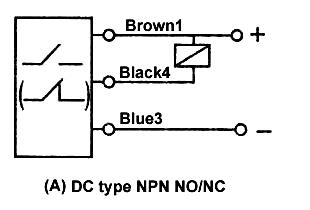
Tips: How to choose the right photoelectric sensor for my application?
There are several key factors to consider when choosing the right photoelectric sensor:
- Sensing distance: Determine the distance between the photoelectric sensor and the object to be detected. Choose a sensor with a sensing range that can easily cover this distance.
- Environment: Evaluate the environmental conditions in which the photoelectric sensor will be installed. Factors such as ambient light, dust, humidity, and temperature can affect sensor performance. Choose a sensor with the appropriate environmental rating for your application (such as an IP rating for dust and water resistance).
- Output type: Decide whether you need a sensor with a digital (on/off) output or an analog output. Digital sensors provide a simple indication of the presence of an object, while analog photoelectric sensors provide more detailed information about the object's distance or reflectivity.
- Response time: Consider how quickly an object moves through the photo sensor detection area and the response time required for your application.
- Mounting options: Determine how you plan to mount the photoelectric sensor, such as through-beam, retro-reflective, or diffuse. Depending on your application setup, different installation options provide varying levels of simplicity and flexibility.
Product reviews
High-performance photoelectric switch sensor
Genesis

1/16/2025 6:44 PM
I have purchased this photoelectric switch sensor, M18, DC 12V-24V and I am very satisfied with it. This sensor has a fast response speed and can accurately detect the presence and position of objects, especially in automated control systems. It is also very easy to install. In addition, its stability is also very good, and there is no malfunction or drift after long-term use.
Was this review helpful? (0/0)
Only registered users can write reviews
Customers who bought this item also bought

M12 Proximity Sensor, Inductive, NPN NO, Unshielded, 4mm
ATO-PROS-M12
$38.79
Low cost M12 proximity sensor manufacturer direct sale. It is an NPN inductive proximity switch with a NO output method, an unshielded installation type, and a 4mm detection range, which can detect the presence or absence of metallic objects within a specified range without direct contact. The inductive proximity sensor is designed to detect magnetic metals, with a reduced sensing distance for non-magnetic metals.
Related products

Through Beam Photoelectric Sensor
ATO-PHOS-TB
$41.36
Through beam photoelectric sensor consists of a light projector and a light receiver, both of which are separated in structure. The supply voltage is DC 12V-24V or AC 110V-220V. Infrared photoelectric sensor can distinguish the opaque reflective object, with long effective detection distance 5/15/50m, less susceptible to interference, long life, and high reliability.

Diffuse Reflective Photoelectric Sensor
ATO-PHOS-DR
$59.27
Diffuse reflective photoelectric sensor consists of light projector and light receiver in one, can distinguish transparent or opaque reflective object. The supply voltage is DC 12V-24V (6-36V) or AC 110V-220V (90-250V). Infrared photoelectric sensor can be compensated for longer distance with sensitivity controller, less susceptible to interference, fast reaction, long life, high resolution and high reliability.

Retro-reflective Photoelectric Sensor
ATO-PHOS-RR
$60.22
Retro-reflective photoelectric sensor consists of light projector and light receiver in one, has long effective distance range with the help of reflective board. The supply voltage is DC 12V-24V (6-36V) or AC 110V-220V (90-250V). Infrared photoelectric sensor can distinguish the opaque reflective object, with less susceptible to interference, fast reaction, long life, high resolution and high reliability.

Slot Type Photoelectric Sensor
ATO-PHOS-ST
$63.81
Slot-type photoelectric sensor is also known as U-type photoelectric sensor. It's a type of through beam photoelectric sensor and easier to align through beam. Slot type photoelectric sensor can distinguish opaque objects, with power supply DC 12V-24V (6-36V), small installation space, reverse power protection.