
Inclinometer Sensor
ATO Inclinometer Sensor Selection Guide
Choosing the right inclinometer sensor depends on measurement type (static or dynamic), required accuracy, number of axes, output signal type, and installation environment such as industrial machinery, outdoor structures, or mobile equipment.
ATO offers different types of inclinometer sensors, including tilt switch sensors, analog output sensors, digital RS485 / Modbus sensors, CAN / CANopen sensors, wireless inclinometer sensors, and high-precision digital inclinometer sensors.
These sensors are widely used in construction machinery, solar tracking systems, vehicle attitude monitoring, industrial automation, and structural health monitoring applications.
ATO Inclinometer Sensor Selection Table
Inclinometer sensors are industrial devices used to measure tilt angle relative to gravity, commonly applied in construction machinery, automation systems, AGV/AMR navigation, solar tracking systems, and structural health monitoring. They provide analog or digital outputs such as 4–20mA, RS485 Modbus, CANopen, or wireless signals depending on industrial requirements.
1. Tilt Switches & Alarm Sensors
Tilt switch sensors are commonly used for safety cutoff systems in cranes, construction machinery, and railway monitoring applications. Target environments include construction sites, crane outriggers, and railway safety zones.
| Model SKU | Axis Type | Output Type | Accuracy | Measurement Range | Primary Application |
|---|---|---|---|---|---|
| ATO-TS-ALL | Single / Dual | 4–20mA, Modbus, 0–5V, Relay | 0.1° | ±10° to ±180° | Multi-function tilt alarms |
| ATO-LCA141 | Single / Dual | Relay NO/NC | 0.1° | ±15° | Heavy equipment safety |
| ATO-LCA341 | Single / Dual | Digital Switch | 0.1° | ±15° | Underground drilling rigs |
2. Standard Industrial & Automation Sensors
Industrial inclinometers are used for continuous angular position measurement in PLC automated machinery. Target environments include factory production lines and standard PLC monitoring loops.
| Model SKU | Axis Type | Output Type | Accuracy | Measurement Range | Primary Application |
|---|---|---|---|---|---|
| ATO-IMS-118128 | Single / Dual | 4–20mA Current | 0.01° | ±10° to ±180° | Factory automation loops |
| ATO-IMS-LVT | Single / Dual | 4–20mA, 0–5V, 0–10V Analog | 0.25° | ±10° to ±90° | MEMS dynamic tracking |
| ATO-IMS-MCA | Single / Dual | Analog / Digital | 0.3° | ±10° to ±90° | Outdoor liquid environments |
| ATO-IMS-MK326T | Dual | Digital | 0.2° | ±10° to ±90° | Automatic solar tracking |
3. Digital Communication & Bus Protocol Sensors
Bus protocol inclinometers transmit real-time angular metrics over standardized industrial network topologies. Target environments include distributed control networks and SCADA monitoring setups.
| Model SKU | Axis Type | Output Type | Accuracy | Measurement Range | Primary Application |
|---|---|---|---|---|---|
| ATO-IMS-116126 | Single / Dual | CANopen Bus | 0.05° | ±10° to ±90° | Vehicle attitude tracking |
| ATO-IMS-116126MB | Single / Dual | Modbus RS485 | 0.05° | ±10° to ±90° | Industrial SCADA networks |
| ATO-IMS-MK700 | Single / Dual | RS485, TTL, RS232 | 0.3° | ±90° to ±180° | Oil field drilling rigs |
4. High-Precision & Metrology-Grade Sensors
High-precision inclinometers measure micro-angular surface deviations with internal thermal compensation algorithms. Target environments include metrology laboratories, structural monitoring, and calibration baselines.
| Model SKU | Axis Type | Output Type | Accuracy | Measurement Range | Primary Application |
|---|---|---|---|---|---|
| ATO-IMS-518528 | Single / Dual | 4–20mA Current | 0.005° | ±10° to ±90° | Structural health tracking |
| ATO-IMS-716726 | Single / Dual | CAN 2.0 Bus | 0.008° | ±15° to ±180° | High-speed network logging |
| ATO-IMS-816826 | Single / Dual | RS232, RS485, TTL, RS422 | 0.002° | ±3° to ±30° | Laboratory calibration |
| ATO-IMS-610620 | Single / Dual | 0–5V Voltage | 0.003° | ±10° to ±90° | Precision tool alignment |
| ATO-IMS-AVT | Dual | Modbus, RS232, RS485 | 0.001° | ±5° to ±15° | Metrology base alignment |
5. Dynamic, Wireless & Specialized Devices
Specialized inclinometers track angular orientation during active dynamic movement or via remote wireless telemetry. Target environments include vibrating machinery, remote IoT stations, and field inspections.
| Model SKU | Axis Type | Output Type | Accuracy | Measurement Range | Primary Application |
|---|---|---|---|---|---|
| ATO-IMS-HDA | Three Axis | CAN 2.0, RS485 | 0.05° | ±90° to ±180° | Dynamic motion tracking |
| ATO-IMS-HMI600 | Dual | Bluetooth Wireless | 0.01° | ±90° | Remote IoT tracking |
| ATO-IMS-S2630 | Single / Dual | RS232, RS485, 2.4GHz | 0.1° | ±10° to ±180° | Wireless sensor networking |
| ATO-ISM-600 | Dual | Digital LCD | 0.01° | ±10° to ±180° | Handheld field auditing |
How to Choose the Right ATO Inclinometer Sensor
Choosing the right inclinometer sensor depends on application type, motion condition (static or dynamic), required accuracy, output signal, environmental resistance, and communication method. Different industrial inclinometer sensors are designed for heavy equipment, solar tracking, industrial automation, vehicle systems, wireless monitoring, and ultra-precision measurement.
Key Factors When Choosing an Inclinometer Sensor
Before selecting an inclinometer sensor, consider the following:
- Measurement type: Static or dynamic inclinometer sensor
- Axis type: Single-axis or dual-axis tilt measurement
- Accuracy requirement: Standard industrial accuracy or ultra-high precision
- Output signal: 4–20mA, 0–5V, RS485, Modbus, CANopen, or wireless transmission
- Installation environment: Indoor factory, outdoor structure, high vibration, or harsh weather conditions
- Communication method: Wired industrial bus or wireless remote monitoring
1. For Excavators and Heavy Equipment (Heavy-Duty Inclinometer Sensor)
If you need to monitor cranes, excavators, drilling machines, or mining equipment, choose a heavy-duty inclinometer sensor with strong vibration resistance and rugged casing.
- Recommended Models: ATO-TS-ALL, ATO-IMS-MCA, ATO-IMS-HDA
- Best for: Construction machinery, cranes, excavators, and mining equipment requiring automatic tilt alarms (0-55°), IP67 waterproof protection, and real-time anti-tip monitoring.
2. For Solar Tracking Systems (Solar Tracker Inclinometer Sensor)
If you are installing solar panels or photovoltaic arrays, select an outdoor-grade solar tracker inclinometer sensor designed for long-term weather endurance.
- Recommended Models: ATO-IMS-MK326T, ATO-IMS-MCA, ATO-IMS-118128
- Best for: Photovoltaic systems, solar tracking arrays, and outdoor solar controllers needing continuous angle adjustments within a wide temperature range (-40°C to +85°C).
3. For Factory Automation and PLC Control (Industrial Inclinometer Sensor)
If you are setting up factory automation lines or machine control loops, choose an industrial inclinometer sensor that easily integrates into standard control networks.
- Recommended Models: ATO-IMS-118128, ATO-IMS-116126MB, ATO-IMS-LVT
- Best for: PLC control systems, industrial automation lines, and machine feedback applications requiring standard 4-20mA, Modbus-RTU, or RS485 outputs.
4. For Vehicles and Mobile Robots (Vehicle Inclinometer Sensor)
If you are tracking AGVs, mobile robots, logistics vehicles, or automotive testing systems, choose a specialized vehicle inclinometer sensor that supports rapid dynamic motion.
- Recommended Models: ATO-IMS-HDA, ATO-IMS-116126, ATO-IMS-716726
- Best for: AGVs, mobile robots, autonomous vehicles, and automotive testing systems requiring real-time leveling, dynamic tilt compensation, and CAN bus (CANopen) communication.
5. For High Precision and Lab Testing (High Precision Inclinometer Sensor)
If you are doing laboratory calibration, structural testing, or high-end scientific measurements, choose a metrology-grade high precision inclinometer sensor.
- Recommended Models: ATO-IMS-AVT, ATO-IMS-816826, ATO-IMS-518528
- Best for: Laboratory calibration instruments, structural testing setups, and scientific measurement devices demanding extreme accuracy down to 0.001° and zero temperature drift.
6. For Wireless and IoT Projects (Wireless Inclinometer Sensor)
If you are monitoring bridges, building safety, or remote infrastructure where running power cables is impossible, choose a wireless inclinometer sensor solution.
- Recommended Models: ATO-IMS-HMI600, ATO-IMS-S2630
- Best for: Structural health monitoring, bridge/building tilt detection, and remote IoT projects requiring low-power Bluetooth tracking or automatic 2.4GHz remote networking.
7. For Handheld and Manual Inspections (Handheld Inclinometer Sensor)
If you are a field technician doing on-site manual checks, troubleshooting, or temporary engineering measurements, choose a portable handheld inclinometer sensor.
- Recommended Models: ATO-ISM-600
- Best for: On-site manual verifications, field quality control inspections, and automation troubleshooting requiring a dual digital screen for instant visual readings without a PC.
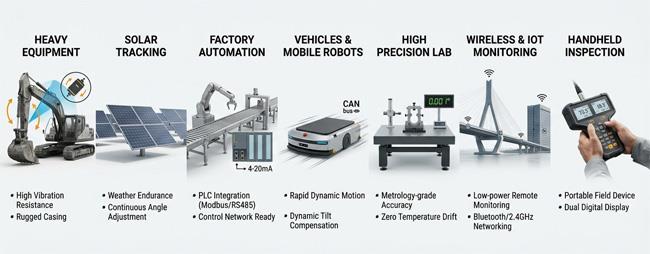
Quick Recommendation by Application
The guide below summarizes the recommended models and key use cases for each industry application scenario to help users identify the most suitable inclinometer sensor.
| Target Application | Recommended Models |
|---|---|
| Excavators & Heavy Equipment | ATO-TS-ALL, ATO-IMS-MCA, ATO-IMS-HDA |
| Solar Tracking Systems | ATO-IMS-MK326T, ATO-IMS-MCA, ATO-IMS-118128 |
| Factory Automation & PLCs | ATO-IMS-118128, ATO-IMS-116126MB, ATO-IMS-LVT |
| Vehicles & Mobile Robots | ATO-IMS-HDA, ATO-IMS-116126, ATO-IMS-716726 |
| High Precision & Lab Testing | ATO-IMS-AVT, ATO-IMS-816826, ATO-IMS-518528 |
| Wireless & IoT Projects | ATO-IMS-HMI600, ATO-IMS-S2630 |
| Handheld Manual Inspections | ATO-ISM-600 |
Conclusion
ATO inclinometer sensors are used for industrial tilt measurement applications including construction machinery, solar tracking, vehicle systems, factory automation, wireless IoT monitoring, and precision laboratory calibration. Users should select a model based on output signal type (4–20mA, Modbus, CAN, or wireless), required accuracy (0.3° to 0.001°), and installation environment.

Wireless Transmission Module for Inclination Sensor


