
Automatic Transfer Switches
An automatic transfer switch (ATS) is a device that automatically transfers a power supply from transfer switch's primary source to a backup source when it senses a failure or outage in the primary source. Auto transfer switches (ATS) on ATO.com have a wide range of selections with ratings from 6 amps to 3200 amps. ATO offers three kinds of auto changeover switches with their own characteristics and functions, which make it applied to different areas. The transfer switches here can be operated both automatically and manually. 3-pole or 4-pole ATS changeover switch, reliable automatic and manual operation, simple structure, easy operation and long service life.
Intelligent automatic transfer switch applied for residential areas, military facilities, hospitals, shopping malls, airports and so on. Go into a detailed product page and find a suitable ATS automatic transfer switch to changeover the source in case of power failure, so as to guarantee the continuous and reliable operation of the critical equipment.
What is Automatic Transfer Switche (ATS)?
An automatic transfer switch (ATS) is a device that automatically transfers a power supply from its primary source to a backup source when it senses a failure or outage in the primary source. When a failure occurs in a primary power system, the intelligent automatic transfer switch invokes a standby power source, such as an uninterruptable power supply. An ATS can also start up more long-term backup power systems, such as local diesel generators, to run electric equipment until utility power is restored.
Since the transfer switch is connected to both primary and backup power sources, auto transfer switch serves as an intermediary between equipment and the power supplies, acting as an electrical relay. An auto changeover switch can also act as a redundant, rack-mounted power supply for equipment that is connected to a power source with only one cord.
How Does Automatic Transfer Switch Work?
An ATS automatic transfer switch can control when a backup generator depends on the voltage in the primary supply for a building. When they do this they have to also transfer the load to the backup generator. The auto changeover switches work by blocking the backup generator from becoming a source of electrical power until the generator itself is on for temporary power.
Switch to automatic mode. We can see that the normal power and reserve power (backup power) indicators are on. Currently using normal power. When the normal power is disconnected the ATS automatic transfer switches to reserve power. Reserve power output indicator is on. When normal power is restored, ATS automatically switches back to normal power. Switch to normal mode. When the normal power is cut off, the load loses power. Manually switch to reserve power and the load resumes operation. Switch back to automatic mode. After the normal power is restored, the ATS automatically switches back to the normal power mode.
Automatic Transfer Switch Troubleshooting
- Generator will not start during a power outage
An Automatic Transfer Switch communicates with the generators controller using a industry standard two wire system. When purchased power is interrupted there is a relay in the Automatic Transfer Switch that drops out, shorting the two wires from the generators controller together. This causes the generator to start and run.
Troubleshooting this kind of problem is as easy as removing the two wires coming from the generators controller and shorting them together. This will cause the generator to start and run. If the generator does not start and run then the problem is in the generator. If the generator starts then the problem is in the Automatic Transfer Switch.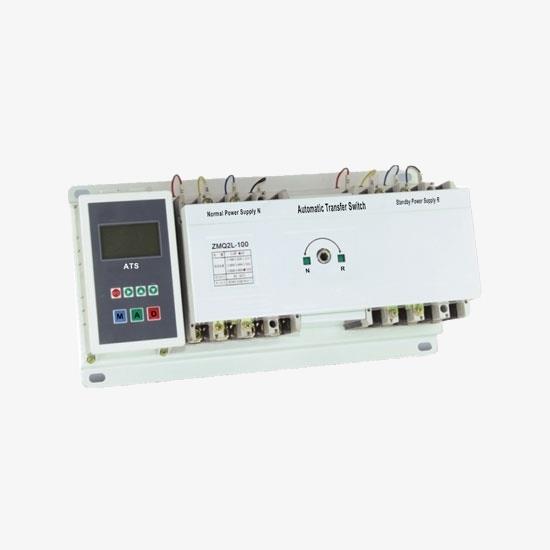
- Generator will not stop running
If the generator will not stop running the first thing to do is to check the Automatic Transfer Switch and determine if it is recognizing purchased power as acceptable. This is as easy as looking at the control panel on the Automatic Transfer Switch.
If the utility power is not being recognized as acceptable,check the phase to phase voltage. It needs to be within 5% of the nominal value plus or minus. If the utility voltage is within 5% of the nominal value then the Automatic transfer Switch has a control board failure. This is most often caused by Transient Surges due to lightning strikes.
If the Automatic Transfer Switch is recognizing and is supplying purchased power to the load as indicated on the control panel, then remove the two wires that connect the generator controller to the Automatic transfer Switch. If the generator stops then the Automatic Transfer Switch controller is defective, if the generator does not stop then the problem is in the generator. - Automatic transfer switch will not transfer to generator power
The first step to troubleshoot this problem is to determine if the Automatic Transfer Switch is recognizing the generators power as acceptable. This is as easy as looking at the control panel on the Automatic Transfer Switch.
If the Automatic Transfer Switch is not recognizing the generators power as acceptable then check the phase to phase voltage at the emergency lugs on the Automatic Transfer Switch TS unit. This voltage needs to be within 5% plus or minus. If this is acceptable then check the frequency using a digital voltmeter, not the on the generator. If the generators frequency is not plus or minus 3.0 hertz then the Automatic Transfer Switch will not recognize the generator power as acceptable and will not switch the load to it.

Automatic Transfer Switch, 3/4 Pole, 6 to 63 Amps

Automatic Transfer Switch, 3/4 Pole, 10/20 to 100 Amps

Automatic Transfer Switch, 3/4 Pole, 100/125 to 225 Amps

Automatic Transfer Switch, 3/4 Pole, 250/350 to 630 Amps

Automatic Transfer Switch, 3/4 Pole, 630/700/800 Amps

Automatic Transfer Switch, 4 Pole, 100/160/250 Amps

1000 Amp Dual Power Automatic Transfer Switch, 4 Pole

1250 Amp Dual Power Automatic Transfer Switch, 4 Pole

1600 Amp Dual Power Automatic Transfer Switch, 4 Pole

2000 Amp Dual Power Automatic Transfer Switch, 4 Pole

2500 Amp Dual Power Automatic Transfer Switch, 4 Pole

3200 Amp Dual Power Automatic Transfer Switch, 4 Pole

Automatic Transfer Switch, Single Phase Power Control


