
I want 7 of these units to be able to monitor from 0 to 100ppm of formaldehyde. We will use these inside a hatcher to monitor the levels as the chickens hatch out. I need to monitor for 3 days and I need the data to be able to be graphed out. Can you help me? Do you have a picture of the graph or does it just get exported to excel and then I have to do it myself?
We typically use drager, but the new models (PAC 8000) don’t work like the old discontinued PAC III. Here is an example of how it charts over the 72 hour period.
High cost-effective multi gas detector is used for monitoring 4 gas concentration of LEL, O2, CO, and H2S, widely applicable for tunnels, tube well, laboratory, and other confined spaces.
Features
- LCD dot matrix display, direct readout of gas type, unit, concentration, local time, etc.
- Support English/Chinese operation, easy to shift.
- Gas concentration unit PPM and mg/m3 can be shift quickly.
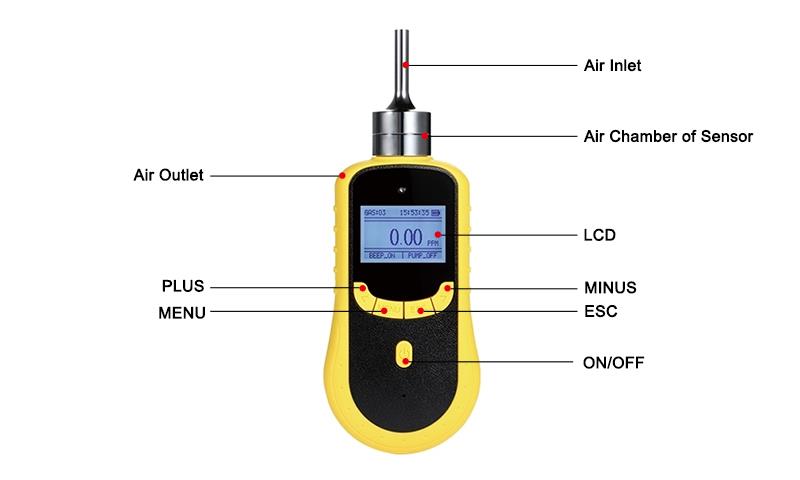
- Built-in micro-sampling pump, 10 grades of suction are available.
- Explosion-proof certification
Gas Detector Functions
- With self-calibration and zero calibration functions, makes the detection more accurate and reliable.
- One key to restore factory setting, free from maloperation.
- With temperature and pressure compensation, able to realize the compensation for the gas concentration under different temperature and pressure environments.
- Two-stage alarm with sound and light, and alarm point is settable.
- Rechargeable lithiumpolymer battery with large capacity.
- High-strength special engineering plastic housing, with anti-slip, waterproof, dustproof and explosion-proof.
Specification
| Model | GD200-M4 |
| Sampling Method | Pumping suction, flow rate can be up to 750ml/min |
| Detection Principle | Electrochemistry (O2, CO, H2S), Catalytic combustion (LEL) |
| Gas | LEL, O2, CO, H2S |
| Range (Optional)* | CO: 0-500/1000/2000ppm, H2S: 0-100/200ppm, O2: 0-25% VOL/0-30% VOL, LEL: 0-100% LEL |
| Resolution | CO: 1ppm, H2S: 0.1ppm, O2: 0.1% VOL, LEL: 1% LEL |
| Accuracy | ≤±3% F.S. |
| Responce Time | ≤10s |
| Repeatability | ≤±1% |
| Recovery Time | ≤10s |
| Linearity Error | ≤±1% |
| Zero Shift | ≤±1% (F.S./year) |
| Data Logging (Optional Function) | High speed data transmission by USB, available for data downloading and printing (The built-in IC card has about 2G memory, which can record 100,000 sets of data.) |
| Alarms | Sound, light and vibration |
| Display | LCD dot matrix display |
| Language | Chinese/English |
| Battery | 3.7V rechargeable lithium battery, 3.7 Watt (Charger included: Input AC 100-240V 50/60Hz with optional USA, Europe or UK plug) |
| Operating Time | 100h (Pump off) |
| Explosion-proof Grade | II 1G Ex da ia IIC T4 Ga |
| Case Material | ABS+PC |
| Protection Grade | IP66 |
| Certification | CE, ATEX (Standard: EN IEC 60079-0:2018, EN 60079-1:2014) |
| Operating Temperature | -20℃~50℃ |
| Operating Humidity | 0~95%RH (non-condensing) |
| Operating Pressure | 0.8~1.2bar |
| Dimension | 205*75*32mm |
| Weight | 300g |
| Warranty | 12 months |
| Extension Probe | About 480mm (Total Length), About 300mm (Probe Head) |
| Accessories (Optional) | Calibration kit - gas pressure regulator (calibration gas cylinder NOT included)
|
Note 1:
If you require a gas detector with a measuring range not listed in the table above, please contact us with details about your operating environment. We can help you choose the right detector for your application.
- We also offer gas detectors for other common gases. Please refer to the ATO Gas Detector Catalog for available gas types and measuring ranges.
Note 2:
Regarding the flow rate for gas detectors, there are 2 types:
- Pump-Suction Type: Equipped with a built-in pump, with a flow rate of 600 mL/min. (Models: GD200, GD400, GD600)
- Diffusion Type: Not equipped with a built-in pump, with a flow rate of 300 mL/min. (Models: GD300, GD500, GD800)
If you require a customized flow rate, please let us know your specific requirements. We will evaluate whether customization is possible. A flow rate that is too high or too low can affect measurement accuracy, so we recommend using an appropriate flow rate for your application.
Flow rate only needs to be considered when sampling gas from pipelines. For measuring gas concentrations in normal ambient air, you do not need to consider the flow rate. To measure confined spaces such as pipelines, please get in touch with us and provide the detailed conditions of use.
*** Other Common Gases and Ranges Available for Portable Gas Detectors
| Gas Type | Measure Range | Resolution |
| Ammonia (NH3) | 0-10/20/50/100/200/500/1000/2000/5000ppm | 0.01ppm/0.1ppm/1ppm |
| Benzene (C6H6) | 0-1/5/10/20/50/100/200/500/1000/2000/5000/10000ppm | 0.001ppm/0.01ppm/0.1ppm/1ppm |
| Carbon Dioxide (CO2) | 0-1000/2000/5000/10000/20000/50000ppm, 0-10%/20%/30%/50%/100% VOL | 1ppm, 0.01% VOL |
| Carbon Monoxide (CO) | 0-10/20/50/100/500/1000/2000ppm | 0.001ppm/0.01ppm/1ppm |
| Chlorine (Cl2) | 0-5/10/20/50/100/200ppm | 0.001ppm/0.01ppm/0.1ppm |
| Chlorine Dioxide (ClO2) | 0-1/5/10/20/50/100ppm | 0.001ppm/0.01ppm/0.1ppm |
| Ethylene (C2H4) | 0-10/20/50/100/500/1000/2000ppm | 0.001ppm/0.01ppm/0.1ppm/1ppm |
| Flammable | 0-100% LEL | 1% LEL |
| Formaldehyde (CH2O) | 0-10/20/50/100/500/1000ppm | 0.01ppm/0.1ppm/1ppm |
| Hydrocarbons (HC) | 0-100% LEL | 1% LEL |
| Hydrogen (H2) | 0-10/20/100/500/1000/2000/3000/5000/10000/20000/40000ppm, 0-4% VOL | 0.001ppm/0.01ppm/0.1ppm/1ppm, 0.001% VOL |
| Hydrogen Chloride (HCl) | 0-10/20/50/100/200/500/1000/2000ppm | 0.01ppm/0.1ppm/1ppm |
| Hydrogen Cyanide (HCN) | 0-10/20/50/100ppm | 0.01ppm/0.1ppm |
| Hydrogen Fluoride (HF) | 0-1/5/10/50ppm | 0.001ppm/0.01ppm |
| Hydrogen Sulfide (H2S) | 0-5/10/20/50/100/200/500/1000/2000ppm | 0.001ppm/0.01ppm/0.1ppm/1ppm |
| Methane (CH4) | 0-100% LEL, 0-50%/100% VOL | 1% LEL, 0.01%VOL |
| Methyl Bromide (CH3Br) | 0-50/100/200/500/1000/2000/3000ppm | 0.1ppm/1ppm |
| Nitric Oxide (NO) | 0-20/50/100/250/500/1000ppm | 0.01ppm/0.1ppm/1ppm |
| Nitrogen (N2) | 0-99.99%/100% VOL | 0.01% VOL |
| Nitrogen Dioxide (NO2) | 0-20/50/100/500/1000ppm | 0.01ppm/0.1ppm/1ppm |
| Oxygen (O2) | 0-25%/30%/100% VOL | 0.01% VOL |
| Ozone (O3) | 0-1/5/10/20/50/100/200/500/1000/2000ppm | 0.001ppm/0.01ppm/0.1ppm/1ppm |
| Phosgene (COCl2) | 0-1/5/10ppm | 0.001ppm |
| Phosphine (PH3) | 0-10/20/50/100/500/1000/2000/3000ppm | 0.01ppm/0.1ppm/1ppm |
| Sulfur Dioxide (SO2) | 0-20/50/100/500/1000ppm | 0.01ppm/0.1ppm/1ppm |
| Sulfur Hexafluoride (SF6) | 0-1000/2000/3000ppm | 1ppm |
| Volatile Organic Compounds (VOC) | 0-1/5/10/20/100ppm | 0.01ppm/0.1ppm |
Details
Tips: Service Life of Gas Detector
A gas detector is mainly composed of a sensors, circuit board and other components. It can be divided into two main parts, that is, the first part is the sensor part, and the second part is the body part of the detector, so for the service life of equipment, we also need to tell based on the two parts of the gas detector.
Let's look at the sensor in the gas detector first. The sensor has a fixed service life. The service life of the sensor varies with different principles. For example, the electrochemical sensors are usually designed for two-year service life and it has to be replaced when it expires. The replacement time is generally not related with use times and storage time, because the electrochemical sensor has the electrolyte at its internal which will naturally reduce in the process of the placement of the sensor even if you don't use it. Basically, it has a fixed replacement cycle, so it must be replaced once it comes due. It is suggested that it is unnecessary to prepare a sensor in advance in the use of gas detector, otherwise it is a kind of waste and loss.
The second part is the circuit board of the gas detector. From this point of view, generally a reliable designed circuit board with sufficient materials can guarantee the service life of the detector body for 3-5 years. Of course, we also refer to normal use, without rough operation, discarding and other bad and irregular preservation and operation. Some portable gas detectors include suction pumps and batteries that last about two years.
As for the service life of the gas detector, generally speaking, there will be no problem with the circuit board under normal use. In most cases, it is the sensor failure that causes the instrument failure. Therefore, the service life of the gas detector is equal to the service life of the sensor. The service life of the electrochemical sensor is about 2 years. After 2 years, the performance of the instrument needs to be tested and the sensor needs to be replaced.
Product reviews
High-quality gas detector
Sevath

9/14/2021 8:23 PM
Was this review helpful? (0/0)
Works perfectly, provide security for my family
Vincent
4/12/2022 3:01 AM
In order to buy a good carbon monoxide gas detector, I bought several manufacturers. I am very satisfied with the purchase this time. The ATO technicians have helped me a lot, and I am very grateful to them. This four-in-one gas detector monitors data quickly.
Was this review helpful? (0/0)
I would like to place an order for a suitable gas detector
carson
7/17/2023 12:09 AM
I would like to place an order for this product (RKI GX-3R Personal 4 Gas Monitor) from your reputable organization.
I will be grateful if you can get back to me with the availability and your quote.
I will be grateful if you can get back to me with the availability and your quote.
Was this review helpful? (0/0)
question
Isaac
11/23/2023 8:06 PM
If the customer purchase computer connectivity/software option, What is the least time he can record measurements, every one second or every one minute, or what?
Was this review helpful? (0/0)
I need a multifunctional gas detector
Pinole
3/12/2025 2:43 AM
I need a multifunctional gas detection instrument that can detect the lower explosion limit (LEL) of hydrogen, oxygen (O₂), carbon monoxide (CO) and methane at the same time. Any recommendations?
Was this review helpful? (0/0)
Only registered users can write reviews
Related products

Handheld Carbon Monoxide (CO) Gas Detector, 0 to 500/1000/2000 ppm
GD200-CO
$398.76
Handheld carbon monoxide (CO) detector use high accuracy sensor, pump suction type, selectable measuring range of 0 to 500 ppm, 0 to 1000 ppm, 0 to 2000 ppm, gas leak alarm with audible, visual and vibrating, compact size and light weight, long working time, easy to carry and operation.

Handheld Hydrogen Sulfide (H2S) Gas Detector, 0 to 50/100/500 ppm
GD200-H2S
$478.96
This pump-type single gas detector is suitable for detecting the leakage of hydrogen sulfide (H2S), with a range of 0-50ppm, 0-100ppm, 0-200ppm, 0-500ppm etc., for options, and gives light, sound and vibration alarm. Favorable price and high reliability.

Portable Oxygen (O2) Gas Detector, 0 to 30% Vol
GD200-O2
$479.22
Portable oxygen detector, ideal for monitoring O2 gas concentration in the range of 0 to 30% Vol or 0 to 100% Vol, with sound, light and vibrating alarm, light and compact, easy to setting and operation, long working time with large capacity battery, high accuracy and low price.

Handheld Multi-Gas (4-Gas) Detector, CO, H2S, O2, LEL
GD500-4GAS
$449.67
Handheld multi-gas detector provides 4 gases detection, monitoring CO (0-1000ppm), H2S (0-100ppm), O2 (0-30%VOL), EX (0-100%LEL) with high accurate sensors, and give sound, light and vibration alarms, light weight and mini size, portable and easy to carry, long battery life, reliable quality and low price.