
PH3 gas sensor with 0-20ppm detecting range. Precision is ±5%FS, resolution is 0.1ppm. Can be operated with electric heat unplugging, factory accurate calibration, the use of no need to re-calibrate. It can be used for phosphine detector, industrial site phosphine gas detection, intelligent municipal phosphine detection, electric power phosphine detection.
Module Features
- Supports electric hotplugging and unplugging for seamless operation.
- Comes factory-calibrated with high accuracy, eliminating the need for recalibration before use.
- Provides both simultaneous digital (UART) and analog outputs for enhanced usability.
- Utilizes the standard MODBUS communication protocol for easy integration.
- Compatible with various sensors, including infrared, electrochemical, catalytic, semiconductor, and others.
Specification
| Model | ATO-K-5S-PH3-20PPM |
| Detecting Gas | PH3 |
| Detecting Range | 0-20ppm |
| Working Voltage | DC 5V±0.5V |
| Power Consumption | ≤1W |
| Working Temperature | -20℃~50℃ |
| Humidity | 15%~95%RH (no condensation) |
| Working Pressure | 86~106Kpa |
| Adoption Method | Natural diffusion |
| Detection Unit | ppm |
| Resolution | 0.1ppm |
| Technical Principle | Electrochemical three electrodes |
| Tolerance | ≤±3% |
| Repeatability | ≤±1% |
| Response Time | ≤60s |
| Communication Format | UART baud rate 9600, data bit: 8; stop bit: 1; check bit: none |
| Communication Protocol | Modbus-RTU communication protocol |
| Analog Output | 0~3V |
| Warm-up Time | 30s (user adjustable) |
| Lifetime | 2 years |
| Weight | 10g |
Structure
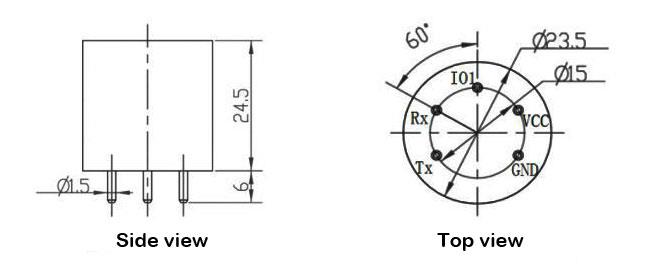
Note: Tolerance range ±0.25mm
Working Principle
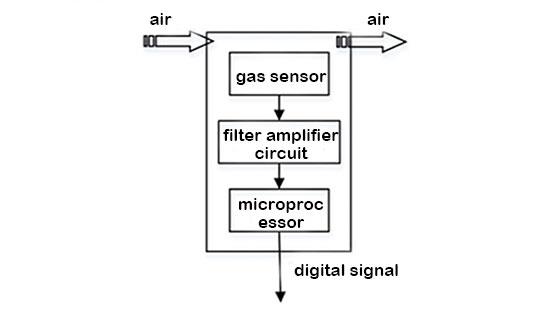
The signal of the gas sensor is amplified and filtered, and then the microprocessor performs theoretical calculations on the signal and outputs a digital signal. For different sensors, the filtering and amplifying circuits are also different.
Application

Tips: Sensor Shows Constant Zero or Maximum Reading
Possible Causes
- Sensor saturation
- Faulty sensor or circuit
- Blocked sensor
Solutions
- Check for the presence of high concentrations of gas that might saturate the sensor, and ventilate the area if necessary.
- Inspect the sensor and associated circuitry for faults.
- Ensure the sensor is not blocked by any physical obstruction.
Product reviews
It detects accurately, works great
Layne

1/26/2026 6:34 PM
The setup was quick, and calibration was easy. It’s very reliable with precise readings.
Was this review helpful?
(0/0)
Reliable gas sensor
Ben
6/16/2026 7:24 PM
This phosphine gas sensor runs great for our workshop daily safety inspection. Plug-and-play hot plug design cuts maintenance time, readings stay precise even after weeks of continuous operation. No complicated setup required out of the box, clear signal output makes data reading straightforward.
Was this review helpful?
(0/0)
Only registered users can write reviews
Related products

Alcohol Gas Sensor, 25ppm to 500ppm
ATO-GS-3Q
$29.52
This gas sensor has high sensitivity to alcohol gas and can resist interference from gasoline, smoke, and vapor. Quality semiconductor alcohol gas sensor has a detection range of 25ppm to 500ppm, widely used in household alcohol gas alarms, industrial alcohol gas alarms and portable alcohol detectors.

Ammonian (NH3) Gas Sensor, 0-100ppm
ATO-GS-NH3
$269.68
The ammonian (NH3) gas sensor is a highly accurate detector for domestic and industrial use, detecting NH3 in the range of 0-100ppm. It utilizes electrochemical three-electrode technology, with a resolution of 1ppm, an error of ≤±3%, a repeatability of ≤±1%, a DC 5V power supply, a power consumption of ≤1W, and a fast response time of 90 seconds, as well as reliable Modbus-RTU communication. With 90 seconds fast response and reliable Modbus-RTU communication, it is an ideal choice for home/ industry gas detection.

Carbon Monoxide (CO) Gas Sensor, 0 to 1000ppm
ATO-GS-CO-ACM
$54.22
Factory price CO gas sensor provides electrochemical principle, 0ppm to 1000ppm detection range, high sensitivity, low power consumption, fast response & recovery and simple driving circuit, perfect for Carbon Monoxide leak detection for residential or industrial use.

Carbon Monoxide (CO) Gas Sensor, 5ppm to 5000ppm
ATO-GS-CO-702B
$30.03
The provided Carbon Monoxide gas sensor uses a simple circuit to convert conductivity changes in gas concentration into corresponding output signals. MEMS CO gas sensor with a detection range 5ppm to 5000ppm is a good choice for carbon monoxide leak detection in residential or industrial applications.

Formaldehyde (CH2O) Gas Sensor, 0-10ppm
ATO-GS-CH2O
$165.71
ATO formaldehyde (CH2O) gas sensor, now on sale, offers precise detection with a 50 ppm load concentration and 0.55 ± 0.15 μA/ppm sensitivity at 20°C. Engineered for stability with <1 ppm baseline drift and 0.1 ppm resolution, it operates from -20°C to +50°C, ideal for home environmental monitoring and industrial safety. Act now to secure this high-quality CH2O sensor at a competitive price.