
This formaldehyde sensor is designed to meet a range of specifications and is available with or without a module. The module offers RS485 or TTL communication interface options, allowing customers to select the best fit for their needs.
Specification
| Model | ATO-S4-CH2O |
| Measurement Range | 0-10ppm |
| Load Concentration | 50ppm |
| Sensitivity (20℃) | 0.55±0.15μA/ppm |
| Baseline Drift | <1ppm |
| Resolution | 0.1ppm |
| Response Time | ≤90s |
| Operating Pressure | 90-110kPa |
| Communication Interface (optional) | RS485, TTL (optional) |
| Operating Temperature | -20℃~+50℃ |
| Operating Humidity | 15~90%RH (non-condensing) |
| Repeatability | <±2% of signal value per month |
| Long-term Stability | <2% of signal value per month |
| Linearity | Linearity up to 200ppm |
| Service Life | 2 years |
Features
- Engineered in accordance with electrochemical principles, it is more compact and precise than comparable items on the market.
- The use of high-precision, dense integrated circuits ensures the reliable, interference-free processing of signals, offering enhanced stability.
- It is designed with anti-interference, short circuit, and reverse polarity protection.High-sensitivity gas detection probe with stable signal and high accuracy.
Cross-Interference Gas Table
| Interfering Gas | Concentration (ppm) | Output Signal (μA) |
| Carbon Monoxide (CO) | 50 | 0.6 |
| Ethanol (C2H5OH) | 2000 | 0.2 |
| Acetic Acid (CH3COOH) | 2000 | -0.3 |
| Ethylene (C2H4) | 100 | 0.6 |
| Methanol (CH3OH) | 100 | 0.3 |
| Isopropylene (C3H6) | 100 | 0.2 |
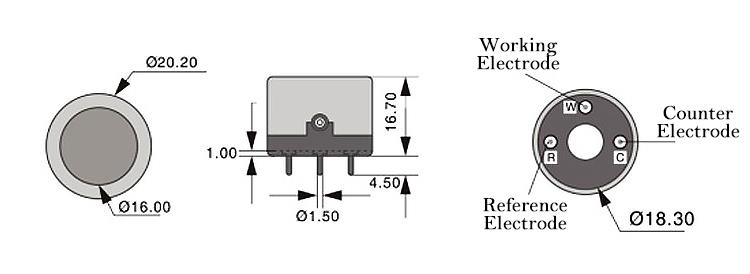
Dimension (unit: mm)
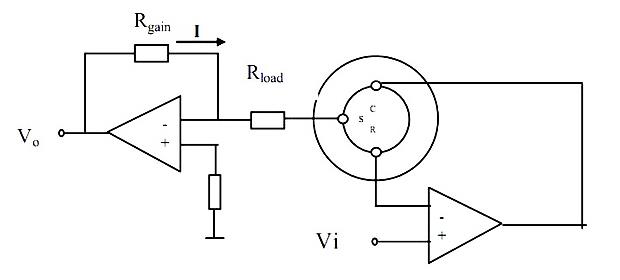
Basic Test Circuit
Application

Tips:6 precautions when using CH2O gas sensors
- The CH2O gas sensor pins must be connected through a PCB socket and should not be bent; soldering may cause damage.
- When storing the sensor, the working electrode and the reference electrode should be in a short-circuited state.
- The sensor should be kept away from organic solvents, alcohol, paints, oils, and high-concentration gases, including silicone and other adhesives.
- The sensor should not be used for extended periods in environments containing corrosive gases.
- Calibration with the target gas is recommended; cross-sensitivity may vary by up to 30%. Calibration with cross-sensitive gases (e.g. carbon monoxide, acetic acid, ethylene, methanol, etc.) does not guarantee measurement accuracy.
- It is not advised to test the formaldehyde gas sensor using non-standard methods, such as submerging it in concentrated ammonia, spraying smoke towards the sensor, or bringing the sensor close to alcohol.
Only registered users can write reviews
Related products

Carbon Monoxide (CO) Gas Sensor, 5ppm to 5000ppm
ATO-GS-CO-702B
$30.03
The provided Carbon Monoxide gas sensor uses a simple circuit to convert conductivity changes in gas concentration into corresponding output signals. MEMS CO gas sensor with a detection range 5ppm to 5000ppm is a good choice for carbon monoxide leak detection in residential or industrial applications.

Flammable Gas Sensor, 300ppm to 10000ppm
ATO-GS-MQ2
$5.83
High-quality gas sensor has good sensitivity to flammable gases and smoke from 300ppm to 10000ppm. This combustible gas sensor has long life, low cost and simple drive circuit, used for household gas leak alarms, industrial combustible gas alarms and portable gas detectors.

Gas Sensor, Methane(CH4)/ Hydrogen(H2)/ Carbon Monoxide(CO)/ TVOC
ATO-GS-4GAS
$54.12
The gas sensor is based on the MEMS principle and comes with low power consumption, high sensitivity and simple drive circuit. Factory price gas leak sensor is designed to measure Hydrogen H2 (30~3000ppm), Methane CH4 (1 %LEL~25%LEL ), Carbon Monoxide CO (50~1000ppm) and TVOC (50~5000ppm) concentration.

NDIR CO2 Gas Sensor, 0 to 2000/ 5000 ppm
ATO-GS-CO2-Z16
$138.73
Lower cost NDIR CO2 sensor for sale online. The carbon dioxide sensor with wide range measuring range from 0 to 5000 ppm, working voltage 5VDC, UART/ PWM two output signal can be chosen. Infrared carbon dioxide sensors are widely used in various occasions where flammable and explosive gases exist.