
After purchasing one ATO load cell, you can buy a special digital panel meter to obtain readings directly, or buy a transmitter to output standard signal to PLC, DCS and other systems. Customized output signal is 0-5V, 0-10V, or 4-20mA.
Note: The load cell cannot be connected to both the transmitter and the controller at the same time — only one can be selected.
Tension and compression load cells have capacity range from 1kg, 2kg, 3kg, 10kg to 50kg. Load cell capacity can be customized according to customer requirements. It is able to measure both tensile and compressive forces, and it offers good hardenability and strong resistance to mechanical fatigue, quite durable for heavy-duty use.
Specification
| Model | ATO-LCS-DYLY-106 |
| Weight | 0.06kg |
| Capacity Range * | 0kg~50kg |
| Matched Display Controller | ATO-DDC5-CHB (Click it to the controller page) |
| Matched Transmitter | ATO-LCTR-OA (Click it to the transmitter page) |
| Accuracy | 0.05%F.S (linearity + hysteresis + repeatability) |
| Sensitivity | 2.0±0.05mV/V (Low range variations may differ) |
| Frequency Response | 8 kHz |
| Creep | ±0.03%F.S/30min |
| Zero Output | ±1%F.S |
| Temperature Effect on Zero | ±0.03%F.S/10℃ |
| Temperature Effect on Output | ±0.03%F.S/10℃ |
| Operating Temperature | -20℃~+80℃ |
| Input Impedance | 350±20Ω |
| Output Impedance | 350±5Ω |
| Insulation Resistance | ≥5000MΩ |
| Safety Overload | 150%F.S |
| Bridge Voltage (excitation voltage) | DC 5-15V, suggest DC 10V |
| Material | Alloy steel |
| Protection Class | IP67 |
| Cable Length | 2m |
| Wiring | EXC+: Red, EXC-: Black, SIG+: Green, SIG-: White |
Feature
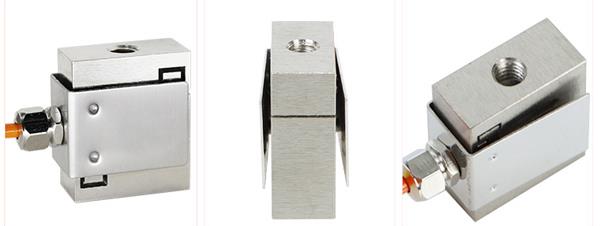
- Durable Alloy Construction: Made of high-quality 42CrMo alloy steel with rounded edges and sandblasted finish for longevity.
- Compact & High Precision: Micro load cell small size with high accuracy, suitable for various weighing applications.
- Industrial-Grade Strain Gauge: Ensures high measurement precision and operates in extreme environments like high/low temperatures and high pressure.
- Bidirectional Force Measurement: S type load cell supports both tension and compression testing for versatile applications.
- Threaded Hole Design: Top and bottom threaded holes for easy installation in belt scales, hopper scales, and batching systems.
- Stable Signal Transmission: 3mm diameter shielded signal cable with strong anti-interference capability.
Dimension (unit: mm)
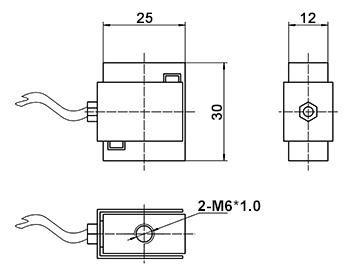
Note: Length of M6 screw is 6mm.
Wiring Method
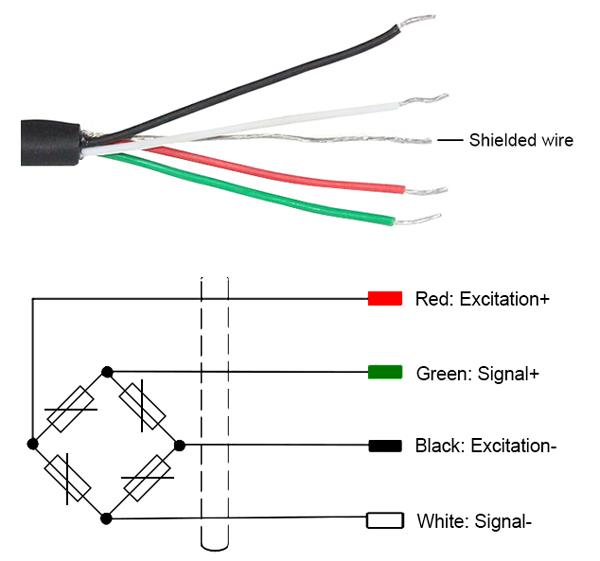
Tips: How to judge lead wire of load cell?
The output resistance of the load cell is generally 350Ω, 480Ω, 700Ω, 1000Ω. The input terminal will be conducted with temperature and sensitivity compensations. Therefore, the resistance of the input terminal will be 20~100Ω higher than that of the output terminal. Therefore, if the multimeter is used to measure the resistance value, the input and output terminals can be judged. Normally, the colors of the input and output terminals are red, black, green and white. They are respectively marked as EXC+, EXC-, SIG+ and SIG-.

1. For this load cell, the weight is shown as 100g. From my calculations, it couldn’t be over 70g even if it were solid stainless steel. Does the 100g mass include the cable? If not, what is the total mass of the sensor and the cable?
2. Just to confirm, I understand this is a strain gauge-based load cell. Is there a datasheet that shows the configuration or information about the bridge that’s chosen? I have some concerns about the signal creep.
3. The other load cell I am currently considering is this 50kg load cell. I wanna know the mass of the load cell, the linearity of the signal, and the signal creep are the most important features.
The load cell I have has a 50 kg capacity and 2 mV/V sensitivity. I am using a 4V excitation voltage. I am unsure of how to determine the resolution of my ATO load cell with the specifications.
Can you all provide any information on this?
In your calculation of the resolution, where did 0.05% come from?
Secondly, I was under the impression that my DAQ would contribute to the resolution.
My DAQ resolution is 15 bits. So I thought the resolution I could read would be in the range of 50kg.
Could you offer any clarification? Since the resolution I could read based on the DAQ is lower, does that mean both of those resolutions should be considered but the laid cell itself will be the limiting factor?
1. Is the actual accuracy specification for the 50 kg model indeed 0.03% F.S.?
2. Could you also provide the following information for the 50 kg model: response frequency, response time, natural frequency, and the recommended maximum bandwidth for dynamic force measurement?
3. Our application requires measuring transient dynamic forces immediately after a rapid rotational movement. Is the ATO-LCS-DYLY-106 (50 kg model) suitable for transient dynamic force measurement?

Load Cell Transmitter, Output 0-5V/0-10V/4-20mA

Tension and Compression Load Cell, 1 kg - 500 kg

Digital Load Cell Amplifier, Output 4-20mA/0-10V/RS485

Micro Load Cell, S Type, 5N/500N/1000N, 1kg/10kg/30kg/200kg

5 Digit Display Controller for Load Cells

Strain Gauge Load Cell, S type, 5kg/20kg/30kg/500kg to 7 ton
Micro Load Cell, S Type, 5N/500N/1000N, 1kg/10kg/30kg/200kg
Tension and Compression Load Cell, 1 kg - 500 kg