Fixed Nitrogen Oxides (NOX) Gas Detector, 0 to 20/50/100/500/1000 ppm

$781.59
Low price fixed NOX gas detector is an essential safety monitoring equipment designed to continuously monitor and detect Nitrogen Oxides (NO and NO2) in industrial environments. This gas sniffer comes with an advanced sensor and sound & light alarm, measuring ranges of 0-1/5/10/20/50/100/250/500/1000ppm.
SKU: GD300-NOX
*
*
*
*
*
Free Shipping
Delivery date: 6-12 days

ATO fixed NOX gas detector is a stationary device designed to continuously monitor and detect the presence of Nitrogen Oxides (NO and NO2) in the environment. Nitrogen Oxides are harmful pollutants commonly found in industrial settings, power plants, and areas with heavy vehicle traffic.

Features

  • Fixed NOX gas detector adopts high precision sensor for accurate gas leak detection.
  • Nitrogen Oxides gas detector is equipped with 3-wire system 4-20mA analog output, relay output, RS485 output (optional).
  • The Nitrogen Oxides gas monitor is compatible with various controlled alarms, PLC, DCS and other control system, and can be remote monitored.
  • Explosion-proof design, fast, relaible and stable.
  • Infrared ray controller can remote control the alarm point settings, zero calibration, and address modification.
  • Two-stage alarm with sound and light, and the alarm point is settable.
  • The industrial NOX gas detector has self-calibration function, and three standard keys will be used to realize on-site maintenance.
  • Fixed Nitrogen Oxides gas detector can output one or two on-off signals, can drive ventilator, solenoid valve or other external devices.

Specification

ModelGD300-NOX
Detection PrincipleElectrochemistry
GasNitrogen Oxides (NOX)
Range (Optional)0 to 1ppm, 0 to 5ppm, 0 to 10ppm, 0 to 20ppm, 0 to 50ppm, 0 to 100ppm, 0 to 250ppm, 0 to 500ppm, 0 to 1000ppm
Resolution0.001ppm (0-1/5ppm), 0.01ppm (0-10/20/50ppm), 0.1ppm (0-100/250ppm), 1ppm (0-500/1000ppm)
Calibration KitGas pressure regulator (calibration gas cylinder NOT included)
Accuracy≤±3% F.S.
Response Time≤10s
Repeatability≤±1%
Recovery Time≤10s
Linearity Error≤±1%
Zero Shift≤±1% (F.S./year)
Signal Output (Optional)4-20mA and RS485
Relay output: one group of relay output (1NO+1NC, 5A/30V) for one alarm (default), or two groups of relay output (2NO+2NC, 5A/30V) for high/low alarm (optional).
AlarmsSound, light
DisplayHigh light nixie tube display
InstallationWall-mounted, piping type, flow-type (according to the detected environment)
ConnectionPower connection type: G1/2 male thread explosion-proof flexible pipe
Pipe-mounted type: M45*P2.0
Operating Time24h
Explosion-proof GradeII 2G Ex db IIC T4 Gb
Protection GradeIP65
CertificationCE, ATEX (Standard: EN IEC 60079-0:2018, EN 60079-1:2014)
Working Voltage12-36V DC
Case MaterialDie-casting aluminum housing
Operating Temperature-20℃~50℃
Operating Humidity0~95%RH (non-condensing)
Dimension206*179*90mm
Weight≤1.6kg
Power AdapterInput 100-240VAC 50/60Hz, Output 24VDC 1A (Optional USA plug, Europe plug, AU plug or UK plug)
Accessories (Optional)Calibration kit - gas pressure regulator (calibration gas cylinder NOT included)
  • Body Material: Brass
  • Max. Input Pressure: ≤15MPa
  • Max. Output Pressure: 0.25MPa
  • Flowmeter Range: 0.1-1.5 L/min
  • Mounting Connection: Inlet port: W21.8-14; Outlet port: Ф6 flexible tube


Notes

Regarding the flow rate for gas detectors, there are 2 types:

  • Pump-Suction Type: Equipped with a built-in pump, with a flow rate of 600 mL/min. (Models: GD200, GD400, GD600)
  • Diffusion Type: Not equipped with a built-in pump, with a flow rate of 300 mL/min. (Models: GD300, GD500, GD800)

If you require a customized flow rate, please let us know your specific requirements. We will evaluate whether customization is possible. A flow rate that is too high or too low can affect measurement accuracy, so we recommend using an appropriate flow rate for your application.

Flow rate only needs to be considered when sampling gas from pipelines. For measuring gas concentrations in normal ambient air, you do not need to consider the flow rate. To measure confined spaces such as pipelines, please get in touch with us and provide the detailed conditions of use.

Dimensions (Unit: mm)
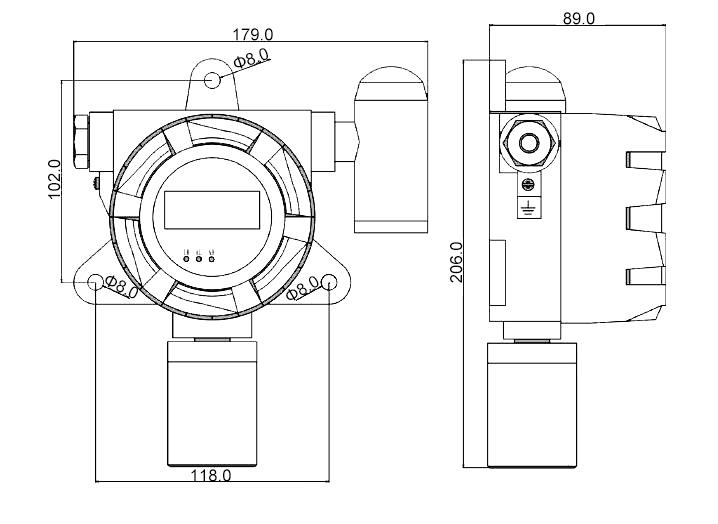
Fixed gas detector dimensions

Installation Guide

The following precautions apply when connecting the GD300 series fixed gas detector to a pipeline:

  1. Working pressure should be stable at 1 bar ±10%, and the flow rate should be controlled at 300 mL/min.
  2. Working temperature is -20°C to +50°C.
  3. Working humidity is 0–95% RH. When the humidity is above 60% RH, it is recommended to use a dehumidifier or add a filter. When the humidity is above 95% RH, the gas is essentially saturated with water, making measurement impossible.
  4. The gas detector should be installed indoors. If it is installed outdoors, a rain cover should be added to protect the entire instrument.
  5. For the second pipeline connection method of the GD300 gas detector, the pipe-mounted installation, the detector mounting thread size is M45 × P2.0. During installation, hold the detector with both hands, keeping the sensor parallel to the mounting thread. Align it with the threaded port, rotate the detector clockwise, and install it in the desired position. To prevent gas leakage at the threaded connection, an appropriate amount of thread seal tape can be wrapped around the sensor head thread before installation.

***Other Common Gases and Ranges Available for Fixed Gas Detectors

Gas TypeMeasure RangeResolution
Ammonia (NH3)0-50/100/200/500/1000/2000/5000ppm0.01ppm/0.1ppm/1ppm
Benzene (C6H6)0-1/10/50/100/200/1000/2000/5000/10000ppm0.001ppm/0.01ppm/0.1ppm/1ppm
Carbon Dioxide (CO2)0-1000/2000/5000/9999ppm, 0-2/5/10/20/25/30/50/100%VOL0.1ppm/1ppm/0.001%VOL/0.01%VOL/0.1%VOL
Carbon Monoxide (CO)0-10/20/50/100/500/1000/2000ppm0.01ppm/0.1ppm/1ppm
Chlorine (Cl2)0-5/10/20/50/100ppm0.001ppm/0.01ppm/0.1ppm
Chlorine Dioxide (ClO2)0-1/5/10/20/50/100ppm0.001ppm/0.01ppm/0.1ppm
Combustible Gas (EX)0-100%LEL1%LEL
Ethylene (C2H4)0-10/20/50/100/500/1000/2000ppm0.01ppm/0.1ppm/1ppm
Formaldehyde (CH2O)0-10/20/50/100/500/1000ppm0.01ppm/0.1ppm/1ppm
Hydrocarbons (HC)0-100%LEL1%LEL
Hydrogen (H2)0-10/20/500/1000/2000/5000/9999ppm, 0-2/4% VOL, 0-100% LEL0.1ppm/1ppm/0.001%VOL/1%LEL
Hydrogen Chloride (HCL)0-10/20/50/100/200ppm0.01ppm/0.1ppm
Hydrogen Cyanide (HCN)0-10/20/50/100ppm0.01ppm/0.1ppm
Hydrogen Sulfide (H2S)0-5/20/50/100/200ppm0.001ppm/0.01ppm/0.1ppm
Methane (CH4)0-50/100%VOL, 0-100%LEL0.01%VOL/0.1%VOL/1%LEL
Nitric Oxide (NO)0-1/5/10/20/50/100/250/500/1000ppm0.001ppm/0.01ppm/0.1ppm/1ppm
Nitrogen (N2)0-99.99/0-100%VOL0.01%VOL/0.1%VOL
Nitrogen Dioxide (NO2)0-1/5/10/20/50/100/500/1000ppm0.001ppm/0.01ppm/0.1ppm/1ppm
Nitrogen Oxides (NOX)0-1/5/10/20/50/100/250/500/1000ppm0.001ppm/0.01ppm/0.1ppm/1ppm
Oxygen (O2)0-25/30/100%VOL0.01%VOL/0.1%VOL
Ozone (O3)0-1/5/10/20/50/100ppm0.001ppm/0.01ppm/0.1ppm
Phosphine (PH3)0-10/20/50/100/500/1000/2000/3000ppm0.01ppm/0.1ppm/1ppm
Sulfur Dioxide (SO2)0-1/5/10/20/50/100/500/1000ppm0.001ppm/0.01ppm/0.1ppm/1ppm
Volatile Organic Compounds (VOC)0-1/5/10/20/50/100/200/500/1000/2000/5000/10000ppm0.001ppm/0.01ppm/0.1ppm/1ppm

Note: Some common gases and the measuring ranges are listed in the above table. For more information, please feel free to contact us.

Details

Fixed Benzene (C6H6) Gas Detector Details

Tips: Where should fixed NOX gas detectors be installed?

Fixed NOX gas detectors should be installed in locations where nitrogen oxide gases are likely to accumulate, ensuring optimal safety and monitoring efficiency. Key areas include:

  • Near Sources of Emission: Position detectors close to potential Nitrogen Oxides emission sources such as boilers, furnaces, engines, and industrial processes that involve combustion.
  • Ventilation Systems: Install detectors in HVAC systems and exhaust ducts to monitor and control indoor air quality.
  • Low-Lying Areas: Since NOX gases can be heavier than air, placing detectors at lower levels can help in the early detection of leaks.
  • Enclosed Spaces: Areas like basements, tunnels, or enclosed parking garages where Nitrogen Oxides can accumulate due to poor ventilation should have detectors.
  • Entry and Exit Points: Place detectors near doors, windows, and other openings to monitor NOX entering or leaving confined spaces.

Regular maintenance and calibration are essential to ensure accurate detection and response to NOX gas levels. Proper installation in these strategic locations enhances safety and compliance with environmental regulations.

Product reviews
Calibration Kit
5
Kalite
Avatar
8/6/2026 3:54 AM
We need a NOx detector with a measurement range of 0-1000 ppm. What are the details of what items are included in the calibration kit?
Was this review helpful? Yes No (0/0)
ATO Responded
Hello, the calibration kit includes: a pressure reducing valve and a flow meter.
Write your review
  • Only registered users can write reviews
*
*
  • Bad
  • Excellent
*
*
*
*

ATO fixed NOX gas detector is a stationary device designed to continuously monitor and detect the presence of Nitrogen Oxides (NO and NO2) in the environment. Nitrogen Oxides are harmful pollutants commonly found in industrial settings, power plants, and areas with heavy vehicle traffic.

Features

  • Fixed NOX gas detector adopts high precision sensor for accurate gas leak detection.
  • Nitrogen Oxides gas detector is equipped with 3-wire system 4-20mA analog output, relay output, RS485 output (optional).
  • The Nitrogen Oxides gas monitor is compatible with various controlled alarms, PLC, DCS and other control system, and can be remote monitored.
  • Explosion-proof design, fast, relaible and stable.
  • Infrared ray controller can remote control the alarm point settings, zero calibration, and address modification.
  • Two-stage alarm with sound and light, and the alarm point is settable.
  • The industrial NOX gas detector has self-calibration function, and three standard keys will be used to realize on-site maintenance.
  • Fixed Nitrogen Oxides gas detector can output one or two on-off signals, can drive ventilator, solenoid valve or other external devices.

Specification

ModelGD300-NOX
Detection PrincipleElectrochemistry
GasNitrogen Oxides (NOX)
Range (Optional)0 to 1ppm, 0 to 5ppm, 0 to 10ppm, 0 to 20ppm, 0 to 50ppm, 0 to 100ppm, 0 to 250ppm, 0 to 500ppm, 0 to 1000ppm
Resolution0.001ppm (0-1/5ppm), 0.01ppm (0-10/20/50ppm), 0.1ppm (0-100/250ppm), 1ppm (0-500/1000ppm)
Calibration KitGas pressure regulator (calibration gas cylinder NOT included)
Accuracy≤±3% F.S.
Response Time≤10s
Repeatability≤±1%
Recovery Time≤10s
Linearity Error≤±1%
Zero Shift≤±1% (F.S./year)
Signal Output (Optional)4-20mA and RS485
Relay output: one group of relay output (1NO+1NC, 5A/30V) for one alarm (default), or two groups of relay output (2NO+2NC, 5A/30V) for high/low alarm (optional).
AlarmsSound, light
DisplayHigh light nixie tube display
InstallationWall-mounted, piping type, flow-type (according to the detected environment)
ConnectionPower connection type: G1/2 male thread explosion-proof flexible pipe
Pipe-mounted type: M45*P2.0
Operating Time24h
Explosion-proof GradeII 2G Ex db IIC T4 Gb
Protection GradeIP65
CertificationCE, ATEX (Standard: EN IEC 60079-0:2018, EN 60079-1:2014)
Working Voltage12-36V DC
Case MaterialDie-casting aluminum housing
Operating Temperature-20℃~50℃
Operating Humidity0~95%RH (non-condensing)
Dimension206*179*90mm
Weight≤1.6kg
Power AdapterInput 100-240VAC 50/60Hz, Output 24VDC 1A (Optional USA plug, Europe plug, AU plug or UK plug)
Accessories (Optional)Calibration kit - gas pressure regulator (calibration gas cylinder NOT included)
  • Body Material: Brass
  • Max. Input Pressure: ≤15MPa
  • Max. Output Pressure: 0.25MPa
  • Flowmeter Range: 0.1-1.5 L/min
  • Mounting Connection: Inlet port: W21.8-14; Outlet port: Ф6 flexible tube


Notes

Regarding the flow rate for gas detectors, there are 2 types:

  • Pump-Suction Type: Equipped with a built-in pump, with a flow rate of 600 mL/min. (Models: GD200, GD400, GD600)
  • Diffusion Type: Not equipped with a built-in pump, with a flow rate of 300 mL/min. (Models: GD300, GD500, GD800)

If you require a customized flow rate, please let us know your specific requirements. We will evaluate whether customization is possible. A flow rate that is too high or too low can affect measurement accuracy, so we recommend using an appropriate flow rate for your application.

Flow rate only needs to be considered when sampling gas from pipelines. For measuring gas concentrations in normal ambient air, you do not need to consider the flow rate. To measure confined spaces such as pipelines, please get in touch with us and provide the detailed conditions of use.

Dimensions (Unit: mm)

Fixed gas detector dimensions

Installation Guide

The following precautions apply when connecting the GD300 series fixed gas detector to a pipeline:

  1. Working pressure should be stable at 1 bar ±10%, and the flow rate should be controlled at 300 mL/min.
  2. Working temperature is -20°C to +50°C.
  3. Working humidity is 0–95% RH. When the humidity is above 60% RH, it is recommended to use a dehumidifier or add a filter. When the humidity is above 95% RH, the gas is essentially saturated with water, making measurement impossible.
  4. The gas detector should be installed indoors. If it is installed outdoors, a rain cover should be added to protect the entire instrument.
  5. For the second pipeline connection method of the GD300 gas detector, the pipe-mounted installation, the detector mounting thread size is M45 × P2.0. During installation, hold the detector with both hands, keeping the sensor parallel to the mounting thread. Align it with the threaded port, rotate the detector clockwise, and install it in the desired position. To prevent gas leakage at the threaded connection, an appropriate amount of thread seal tape can be wrapped around the sensor head thread before installation.

***Other Common Gases and Ranges Available for Fixed Gas Detectors

Gas TypeMeasure RangeResolution
Ammonia (NH3)0-50/100/200/500/1000/2000/5000ppm0.01ppm/0.1ppm/1ppm
Benzene (C6H6)0-1/10/50/100/200/1000/2000/5000/10000ppm0.001ppm/0.01ppm/0.1ppm/1ppm
Carbon Dioxide (CO2)0-1000/2000/5000/9999ppm, 0-2/5/10/20/25/30/50/100%VOL0.1ppm/1ppm/0.001%VOL/0.01%VOL/0.1%VOL
Carbon Monoxide (CO)0-10/20/50/100/500/1000/2000ppm0.01ppm/0.1ppm/1ppm
Chlorine (Cl2)0-5/10/20/50/100ppm0.001ppm/0.01ppm/0.1ppm
Chlorine Dioxide (ClO2)0-1/5/10/20/50/100ppm0.001ppm/0.01ppm/0.1ppm
Combustible Gas (EX)0-100%LEL1%LEL
Ethylene (C2H4)0-10/20/50/100/500/1000/2000ppm0.01ppm/0.1ppm/1ppm
Formaldehyde (CH2O)0-10/20/50/100/500/1000ppm0.01ppm/0.1ppm/1ppm
Hydrocarbons (HC)0-100%LEL1%LEL
Hydrogen (H2)0-10/20/500/1000/2000/5000/9999ppm, 0-2/4% VOL, 0-100% LEL0.1ppm/1ppm/0.001%VOL/1%LEL
Hydrogen Chloride (HCL)0-10/20/50/100/200ppm0.01ppm/0.1ppm
Hydrogen Cyanide (HCN)0-10/20/50/100ppm0.01ppm/0.1ppm
Hydrogen Sulfide (H2S)0-5/20/50/100/200ppm0.001ppm/0.01ppm/0.1ppm
Methane (CH4)0-50/100%VOL, 0-100%LEL0.01%VOL/0.1%VOL/1%LEL
Nitric Oxide (NO)0-1/5/10/20/50/100/250/500/1000ppm0.001ppm/0.01ppm/0.1ppm/1ppm
Nitrogen (N2)0-99.99/0-100%VOL0.01%VOL/0.1%VOL
Nitrogen Dioxide (NO2)0-1/5/10/20/50/100/500/1000ppm0.001ppm/0.01ppm/0.1ppm/1ppm
Nitrogen Oxides (NOX)0-1/5/10/20/50/100/250/500/1000ppm0.001ppm/0.01ppm/0.1ppm/1ppm
Oxygen (O2)0-25/30/100%VOL0.01%VOL/0.1%VOL
Ozone (O3)0-1/5/10/20/50/100ppm0.001ppm/0.01ppm/0.1ppm
Phosphine (PH3)0-10/20/50/100/500/1000/2000/3000ppm0.01ppm/0.1ppm/1ppm
Sulfur Dioxide (SO2)0-1/5/10/20/50/100/500/1000ppm0.001ppm/0.01ppm/0.1ppm/1ppm
Volatile Organic Compounds (VOC)0-1/5/10/20/50/100/200/500/1000/2000/5000/10000ppm0.001ppm/0.01ppm/0.1ppm/1ppm

Note: Some common gases and the measuring ranges are listed in the above table. For more information, please feel free to contact us.

Details

Fixed Benzene (C6H6) Gas Detector Details

Tips: Where should fixed NOX gas detectors be installed?

Fixed NOX gas detectors should be installed in locations where nitrogen oxide gases are likely to accumulate, ensuring optimal safety and monitoring efficiency. Key areas include:

  • Near Sources of Emission: Position detectors close to potential Nitrogen Oxides emission sources such as boilers, furnaces, engines, and industrial processes that involve combustion.
  • Ventilation Systems: Install detectors in HVAC systems and exhaust ducts to monitor and control indoor air quality.
  • Low-Lying Areas: Since NOX gases can be heavier than air, placing detectors at lower levels can help in the early detection of leaks.
  • Enclosed Spaces: Areas like basements, tunnels, or enclosed parking garages where Nitrogen Oxides can accumulate due to poor ventilation should have detectors.
  • Entry and Exit Points: Place detectors near doors, windows, and other openings to monitor NOX entering or leaving confined spaces.

Regular maintenance and calibration are essential to ensure accurate detection and response to NOX gas levels. Proper installation in these strategic locations enhances safety and compliance with environmental regulations.

Product reviews
Calibration Kit
5
Kalite
Avatar
8/6/2026 3:54 AM
We need a NOx detector with a measurement range of 0-1000 ppm. What are the details of what items are included in the calibration kit?
Was this review helpful? Yes No (0/0)
ATO Responded
Hello, the calibration kit includes: a pressure reducing valve and a flow meter.
Only registered users can write reviews
Customers who bought this item also bought

Nitric Oxide (NO) Gas Sensor, 0-50/250/1000/5000ppm

ATO-GS-NO
$182.99
High precision nitric oxide (NO) gas sensor for sale. This nitric oxide gas sensor is available in 0-50/250/1000/5000ppm ranges. The NO gas sensor has a resolution of 1 ppm and a fast response time of ≤30s. It operates with a bias voltage of +300mV and supports a load resistance of 5~30Ω. Suitable for industrial production plants, media mine shafts and alleys, environmental pollution emissions.