
K type thermocouple built-in transmitter can directly provide accurate input signal of temperature changes for display instruments, recording instruments, signal conditioners, scanister and computer.
Specification
1. Thermocouple temperature range chart
| Type of sensing element | Temperature range |
| E type | 0~400℃ |
| 0~600℃ | |
| K type | 0~400℃ |
| 0~600℃ | |
| 0~800℃ | |
| 0~1000℃ | |
| S type | 600~1600℃ |
| B type | 800~1800℃ |
| N type | 0~400℃ |
| 0~600℃ | |
| 0~800℃ | |
| 0~1100℃ | |
| 0~1200℃ |
2. Transmitter parameter chart
| Input | Thermocouple: K, E, B, S, T, N |
| Output | 4-20mA |
| Intrinsic error | ±0.5% |
| Transmission mode | Two wire |
| Supply voltage | DC 12~35V, rated voltage DC 24V |
| Load resistance | 0~600Ω (DC 24V), rated load 250Ω |
| Temperature influence | ≤0.05/1℃ |
| Working environment | Temperature: -25~+80℃,humidity: 5%~95%, mechanical vibration: f≤55Hz, amplitude<0.15mm |
3. Meter and protection head type (unit: mm)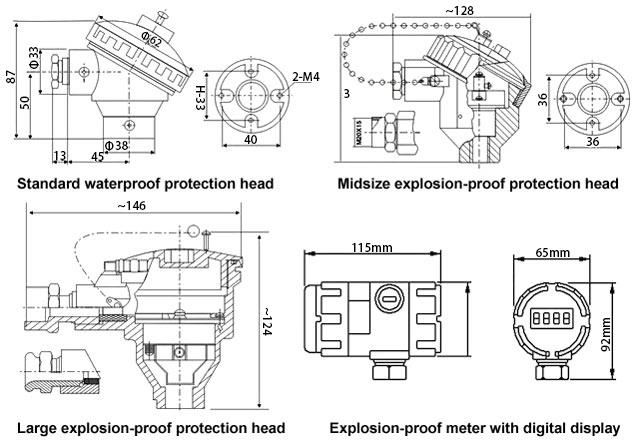
4. Selection chart
| Type of sensing element | Meter type | Installing form | Mode of connection | Thermowell diameter | Thermowell total length |
| S1: E type; S2: K type; S3: S type; S4: B type; S5: T type; S6: J type; S8: N type; | P0: No meter; P2: Meter with digital display; P4: Intelligent meter with digital display | I1: No fixed device; I2: Fixed card sets of thread joint; I3: Movable card sets of thread joint; I4: Fixed card sets of flange; I5: Rectangular movable flange; I6: Taper thermowell and fixing thread | C3: Standard waterproof protection head; C4: Explosion-proof protection head | D0: Φ16mm | 300~2150mm |
Note: The sensing element is sheath thermocouple, thermowell material is stainless steel, and circuit adopts non-isolated type. When ordering products, write the thermowell insertion depth l and the corresponding temperature range for output 4~20mA signal you need.
Application

Tips: Differences between RTD sensor and thermocouple
- The nature of signal. RTD sensor itself has resistance. The change of temperature makes the resistance produce positive or negative resistance changes, and output resistance signal. The thermocouple generates induced voltage that changes with the temperature changes.
- The temperature range detected by these two kinds of sensors is different. RTD sensor is used to low temperature detection while thermocouple is used to high temperature detection.
- In the aspect of material, the thermistor is a single metal material with temperature sensitive changes character.
- The thermocouple is thermometal, which is combined with two different metals. Due to the change of temperature, electric potential differences are produced on both ends of two different metal wire.The thermocouple has positive and negative poles and so does the extension wire. RTD sensor doesn't need extension wire, and it is cheaper than thermocouple. But RTD sensor requires power supply excitation, which can't instantaneously measure the change of temperature.
Only registered users can write reviews
Related products

Thermocouple, K type, Sheath
ATO-TC-KS
$46.15
Sheath thermocouple have shielded thermocouple wire of common length 500mm and sheath diameter Ф3~Φ8mm, with flexibility, high pressure resistant, fast thermal response time and long operating life. K type thermocouple can directly measure the temperature of liquid, vapor, gas medium and solid surface in the range of 0~950 ℃ in various production processes.

Thermocouple, K type, Assembly
ATO-TC-KA
$50.77
K type thermocouple assembles with protection head and stainless steel thermowell, with high pressure resistant, fast thermal response time and long operating life. Its thermo wire diameter is Ф2.5mm. K type thermocouple can directly measure the temperature of liquid, vapor, gas medium and solid surface in the range of 0~1000 ℃ in various production processes.

K type Thermocouple with Transmitter
ATO-TC-KT
$153.94
K type thermocouple assembles with protection head and stainless steel thermowell, built-in small transmitter. It converts temperature to 4-20mA standard signal, and outputs to display instrument or DCS system in control room. Transmitter adopts silicone rubber seal structure, save extension wire, good anti-interference ability. Measuring temperature range 0~1000 ℃.

Digital Temperature Sensor with transmitter, Pt100, 2 Wire
ATO-RTD-D2W
$173.85
RTD sensor with digital meter can directly display high-precision real-time temperature. It converts temperature to 4-20mA standard signal proportional to the electrical signals of thermistor, and outputs to display instrument or DCS system in control room. Built-in small transmitter adopts silicone rubber seal structure, good anti-interference ability, shock and humidity, apply to harsh environments. Measuring temperature range -200~+420 ℃.