
Absolute Encoder
Absolute encoder is a detector that can output angle data within one revolution of the motor to an external target. Absolute encoders are generally capable of outputting 360° with 8 bits to 16 bits. ATO.com online store offers single turn absolute encoder and multiturn absolute rotary encoder for selection, 10 bit/ 12 bit/ 14 bit rotary encoder are available.
Cheap absolute encoder offers high quality, high resolution, high accuracy, lower cost and long service life. Absolute encoders can almost ignore speed, interference and other issues. As long as the encoder stops at a certain position, no matter what the impact is during the rotation, the current position can finally be displayed.
The shaft encoders are used in a wide range of applications that require monitoring or control, or both, of mechanical systems, including industrial controls, robotics, photographic lenses, computer input devices such as optomechanical mice and trackballs, controlled stress rheometers, and rotating radar platforms. Buy a absolute encoder in ATO online store now!
What is absolute encoder?
The high resolution absolute encoder is coded by the mechanical position determination, it does not need to memorize, does not need to find a reference point, and does not need to count all the time. When you need to know the position, you can read its position. In this way, the anti-interference characteristic of the encoder and the reliability of the data are greatly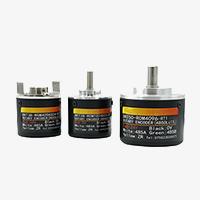 improved. From a single-turn absolute encoder to a multi-turn absolute encoder, the absolute value rotates the single-turn absolute encoder to measure the lines of the photoelectric encoder during rotation to obtain a unique code. When the rotation exceeds 360 degrees, The encoding returns to the origin, which does not conform to the principle of the only absolute encoding. Such encoding can only be used for measurement within a rotation range of 360 degrees, which is called a single-turn absolute encoder. Absolute encoders are feedback devices that provide velocity, position information by outputting digital words or bits related to motion. Unlike incremental encoders, which output a continuous, ubiquitous stream of pulses, absolute encoders output a unique word or bit for each position.
What are the differences between absolute encoder and incremental encoder?
- Different working methods
Incremental encoder needs to go back to the origin after power off. It cannot output the absolute position information of shaft rotation. There is zero accumulated error, and the anti-interference is poor. The receiving equipment needs to be powered off and memorized when it is turned off.
The absolute encoder does not need to go back to the origin, it is coded by the mechanical position, no need to memorize, it needs to find a reference point, and it does not need to count all the time. When you need to know the position, you can read its position. - Cost Efficiency
The code matrix of the encoder disk is more complex and because more light sensors are required, an absolute encoder typically costs twice as much as the incremental encoders. The resolution is limited by the number of tracks on the encoder disk, so it becomes more expensive to obtain finer resolutions without adding more tracks. Incremental encoders, on the contrary, are less complex than their absolute counterparts, thus typically less expensive. - Stability
Thanks to absolute encodersability to provide absolute angle readings, even if a reading is missed, it won’t affect the next reading. A particular reading is not dependent on accuracy of a previous reading. An incremental encoder, on the other hand, needs to be powered on throughout the operation of the device. Each time the power is lost, the reading must be reinitialized or the system shows an error.

Absolute Encoder, 10 bit, Single Turn, RS485/ CAN/ SSI

Absolute Encoder, 12 Bit, Single Turn, RS485/ CAN/ SSI

Absolute Encoder, 14 Bit, Single Turn, RS485/ CAN

Absolute Encoder, 10 Bit, Multi-turn, RS485/ CAN

