
Different ranges of static strain gauge torque sensor correspond to different sizes, 10V DC voltage power supply, working temperature of -20℃~+65℃. It is suitable for static and non-continuous rotation torque force detection, and can be applied to static torque test systems such as torque wrenches, steering gears, bearings, electric actuators, valves, hydraulics, etc.
Specification
| Model | ATO-ZZ600-030 |
| Range | 10~5000 (N·m) |
| Overall accuracy | 0.1~0.5%F·S |
| Sensitivity | 1.0~2.0mV/V |
| Creep | ±0.1~±0.05%F·S/30min |
| Zero point output | ±1%F·S |
| Bridge supply voltage | 10V DC recommended |
| Zero point temperature effect | ±0.05%F·S/10℃ |
| Output temperature effect | ±0.05%F·S/10℃ |
| Operating temperature | -20℃~+65℃ |
| Input impedance | 380±10Ω or 750±15Ω |
| Output impedance | 350±3Ω or 700±5Ω |
| Insulation resistance | >5000MΩ |
| Safety overload | 120%F·S |
| Material | Alloy steel |
| Certification | ISO |
| Installation type | Key connection at both ends |
| Protection level | IP65 |
| Weight | 100Nm: 0.8kg 200~1000Nm: 3.5kg 2000~5000Nm: 9kg |
Features
- High precision: high comprehensive accuracy and sensitive response.
- Good stability: alloy steel shell, can withstand harsh conditions, making them durable in harsh environments.
- Simple wiring: easy and intuitive wiring method, clear at a glance.
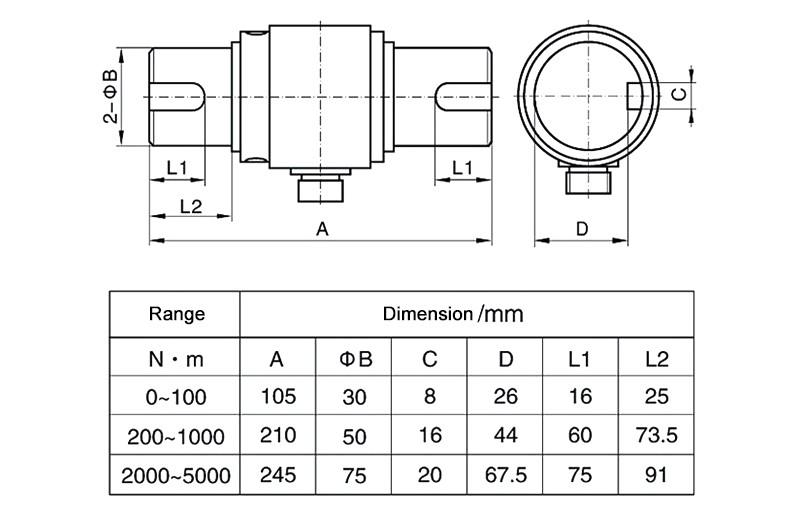
Dimension (unit: mm)
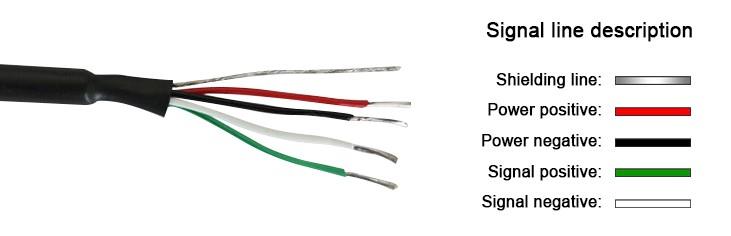
Wiring Drawing
Tips: Precautions for use of static strain gauge torque sensor
- The sensor is a high-precision test component. In order to ensure the accuracy of measurement, the force transmission should be controlled not to be affected by eccentric load and lateral direction. During the test, the line of action of the external force should be guaranteed to coincide with the force axis of the sensor. And use it according to the force direction marked on the sensor beam.
- When installing the sensor, avoid severe impact or strong pulling to cause damage to the beam or lead. If not used for a long time, it should be stored in an environment of -10°C~65°C and relative humidity not exceeding 75%.
- It is strictly forbidden to perform various welding operations on the load-bearing device equipped with the sensor.
- The measured load should be 80% of the rated range of the sensor. Overloading is strictly prohibited.
- Sensors that have not been specially treated shall not be used underwater.
- The natural output of the sensor is mV. Changing the length of the sensor wire will affect the output of the sensor. According to the requirements of the site, a transmitter can be selected to make the output 0-5V, 4-20mA or digital signal. The wire should be connected reliably and should not contact other metal conductors.
Only registered users can write reviews
Related products

Signal Amplifier for Torque Sensor, RS485/0-5V/0-10V/4-20mA
ATO-TQS-FD01
$126.98
Signal amplifier for torque sensor sold at a low price, supports RS485, 0-5VDC, 0-10VDC, and 4-20mA outputs, with a supply voltage of 12~28VDC and <0.02% linearity. It has low output impedance (<1Ω for voltage), minimal temperature drift (≤0.02%FS/10K), and supports standard loads of ≥10kΩ (voltage) or ≤400Ω (current). With a 3.3V <20mA sensor power supply and input signal range of 0.82mV/V, it ensures stable performance. Operating within 0~60°C and 0%~95%RH, it supports up to 1000m transmission for RS485.

Static Torque Sensor, 0-100 Nm
ATO-TQS-N7
$180.39
Small size static torque sensor with affordable price for sale online. Static torque transducer adopts with stainless steel material. The working temperature of compact torque sensor between -20°C to 60°C. This torque sensor is widely used in various torque testers, torque wrenches and other static torque measurement fields.

Static Torque Sensor, Disc Type, 0-10 Nm
ATO-TQS-NJY65
$330.61
High quality and reasonable price static torque sensor with a variety of ranges. This torque transducer has a disc structure. The bridge voltage of electronic torque sensor is 5-12VDC. Static torque sensors provide precise and accurate measurements of torque. This is essential for ensuring product quality and performance.

Static Torque Sensor, Disc Type, 0-50 Nm
ATO-TQS-NJY40
$335.79
Torque sensor with good price for sale. Strong anti-interference and good stability. The safety overload of static torque sensor is 120%F.S. Torque transducer adopts with silicone gel to effectively isolate air and dust, effectively improves shock resistance and ensures stable operation of components.