
This stainless steel diaphragm differential pressure gauge is engineered for precise and reliable measurement of differential pressure in challenging industrial settings. Built with high-quality materials and a thoughtful design, it ensures accuracy, durability, and ease of use across a wide range of applications.
Specification
| Model | ATO-YCSH-100 |
| Material | Stainless Steel |
| Accuracy Class | 1.6 |
| Dial Diameter | 100 mm |
| Connection Method | Threaded Connection |
| Type | Stainless Steel Pressure Gauge |
| Operating Environment | -40°C to 100°C, Relative Humidity ≤ 80% |
| Connection Size | M20x1.5 (Other threads available upon request) |
| Range (MPa) | 0.1, 2.5, 4, 6, 10, 16, 25, 40, 60 (Other ranges available upon request) |
Feature
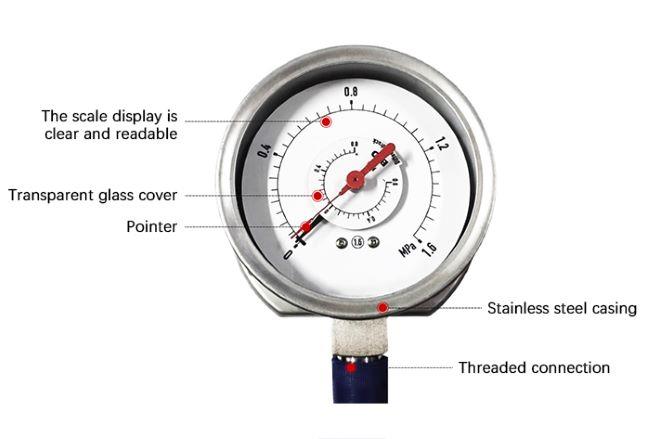
- All-Stainless-Steel Construction: Crafted from selected stainless steel materials, this stainless steel manometer gauge offers excellent corrosion resistance and a sealed housing, making it suitable for harsh environments and ensuring long-term reliability.
- Dual-Needle & Dual-Tube Design: The innovative dual-needle and dual-tube system of this differential pressure gauge provides clear and simultaneous readings, enhancing measurement accuracy and making data interpretation intuitive and straightforward.
- High Precision & Stability: With a well-defined scale and robust internal mechanism, the stainless steel pressure test gauge delivers highly accurate measurements, excellent stability, and consistent performance, ensuring you get dependable data.
- High Sensitivity & Vibration Resistance: This diaphragm pressure gauge is highly sensitive to pressure changes and is designed to withstand vibrations, maintaining measurement integrity and accuracy even in dynamic operating conditions.
- Clear Dial & Easy Operation: The manometer pressure gauge features a clear, easy-to-read dial with a standard diameter, facilitating quick and error-free readings. Its design prioritizes user-friendly operation and requires minimal maintenance.
Detail
Applications

Tips: How to Install a Manometer Pressure Gauge?
- Select the Right Location: Choose a point where the gauge can be easily read and is not exposed to extreme temperature fluctuations or excessive vibration.
- Use a Sealant: Apply a suitable sealant (e.g., PTFE tape) to the threaded connection to ensure a leak-proof seal.
- Mount Securely: Screw the diaphragm pressure gauge into the mounting point (e.g., a pipe tap or manifold) by hand first, then use a wrench to tighten it securely. Avoid over-tightening, as this can damage the threads.
- Orientation: Mount the manometer gauge in an upright position for optimal performance and accurate reading, unless the pressure meter is specifically designed for other orientations.
- Consider a Snubber: For pulsating pressure applications, installing a pressure snubber before the gauge is recommended to dampen pulses and protect the internal mechanism, extending the pressure instruments's lifespan. Always ensure the process connection is compatible with your system's pressure media and conditions.
Only registered users can write reviews
Related products

Digital Differential Pressure Manometer with Bluetooth
ATO-DPM-805
$175.66
This digital differential pressure manometer with bluetooth is a high-precision, multi-functional instrument designed for efficient and accurate pressure measurement. It features 11 selectable units and Bluetooth connectivity for real-time data sharing and analysis. This digital differential pressure gauge supports applications in ventilation systems, pressure monitoring, and troubleshooting.

Digital Differential Pressure Manometer, ±103 kPA
ATO-DM-103
$132.69
Differential pressure manometer with backlight display, measuring range ±103 kPA, 11 measurement units switchable. With its intuitive digital display and user-friendly interface, this manometer simplifies pressure readings.

Digital Differential Pressure Gauge, -30Pa~5kPa
ATO-DPG-822
$169.23
Digital differential pressure gauge for sale online. It can measure clean air in the range of -30Pa~5kPa, equipped with a high-precision differential pressure sensor, multiple pressure unit switching, high/low pressure alarm, sound, and light alarm. Cost-effective differential pressure gauge is suitable for differential pressure measurement and control of clean rooms, operating rooms, clean rooms, ventilation systems and fan testing.

Mechanical Differential Pressure Gauge, -1KPa~3KPa
ATO-DPG-200
$60.18
The mechanical differential pressure gauge is a high-precision instrument designed for measuring differential pressures ranging from -1kPa to 3kPa. Featuring strong shock resistance, anti-interference capabilities, and an aluminum shell with an acrylic pane. Its easy-to-read dial and versatile mounting options make manometer gauge ideal for permanent installations.