
The mechanical differential pressure gauge is a robust and highly accurate instrument engineered for measuring low differential pressures in a wide range of industrial and laboratory settings. With its durable construction, clear display, and user-friendly design, analog differential pressure gauge meets the needs of professionals requiring precise pressure monitoring.
Specification
| Parameter | Details |
| Product Name | Mechanical Differential Pressure Gauge |
| Model | ATO-TE2000 |
| Measuring Range | -1kPa to 3kPa (multiple sub-ranges available) |
| Accuracy | ±4% of full scale at 21°C |
| Housing Material | Cast aluminum, dark gray paint, acrylic panel |
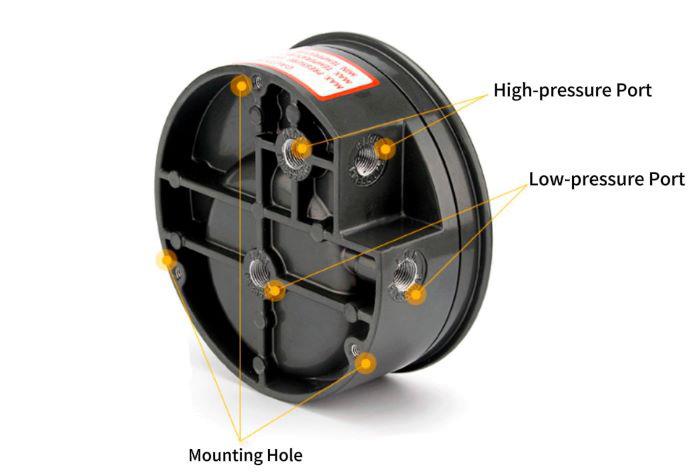
| Interface | 1/8” NPT (two pairs: side/back) |
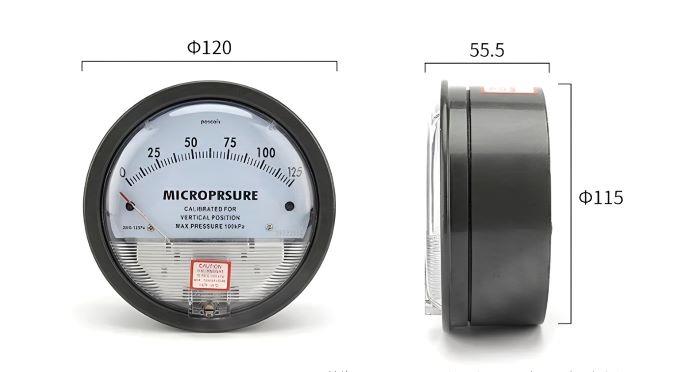
| Dimensions | Φ120mm × 55.5mm |
| Weight | Approx. 560g |
| Temperature Range | -7°C to 60°C (20°F to 140°F) |
| Installation | Vertical |
| Applicable Media | Air and compatible non-flammable gases |
Feature
High Precision & Durability: Offers full-scale accuracy of ±4% at 21°C, mechanical differential pressure meter with strong shock resistance and anti-interference performance, providing the stability needed for sensitive measurements.
Superior Construction for Longevity: Features a cast aluminum shell, acrylic panel, and high-strength PC cover, making this analog differential pressure test gauge resilient in demanding environments. The design ensures excellent cleanability and safety.
Responsive Aluminum Hollow Pointer: Provides inertia-free, drift-free movement with no hysteresis, ensuring this analog differential pressure indicator delivers accurate and immediate readings, a key trait for any reliable differential manometer pressure gauge.
Versatile Installation & Compatibility: Includes multiple 1/8” NPT interface options and mounting accessories. It serves as a fundamental tool in a suite of pressure instruments, ideal for various system integrations where a pressure calibrator or monitoring device is needed.
Dimension (unit: mm)
Detail
Application

Tips:Three Measurement Methods for Mechanical Differential Pressure Gauge
Measuring Positive Pressure: Connect the pressure source to one high-pressure port and seal the unused high-pressure port. Keep one or both low-pressure ports open to atmosphere.
Measuring Negative Pressure: Connect the vacuum or low-pressure source to one low-pressure port and seal the unused low-pressure port. Keep one or both high-pressure ports open to atmosphere.
Measuring Differential Pressure: Connect the higher pressure to a high-pressure port and the lower pressure to a low-pressure port. Seal the remaining unused ports.
For dirty or contaminated environments, it is recommended to use a filter vent plug to keep the gauge interior clean. Use rubber or polyethylene tubing for temporary setups and copper or aluminum tubing for permanent installations.

0~160 psi Pressure Gauge for Water/Air/Oil/Hydraulic, 0 to 11 bar

0~260 psi Tire Inflator with Digital Pressure Gauge

Adjusting RV Water Pressure Regulator with Gauge
