
Low price radar level transmitter for non-contact various corrosive liquid level measurement has maximum measuring range 0-10m, can transmit and output 4-20mA, HART or RS485 signal to remote control system. It has an IP67 protection class, has good dust and water resistance, and is suitable for outdoor or humid environments.
Specification
| Model | ATO-LEVS-RD901 |
| Shipping Weight | 3.5kg |
| Measuring Range | 0-10m |
| Accuracy | ±5mm (Range 5m), ±10mm (Range 10m) |
| Resolution | 1mm |
| Display | LCD Display |
| Measured Interval | 1s (according to parameter setting) |
| Adjustment Time | 1s (according to parameter setting) |
| Microwave Frequency | 26GHz |
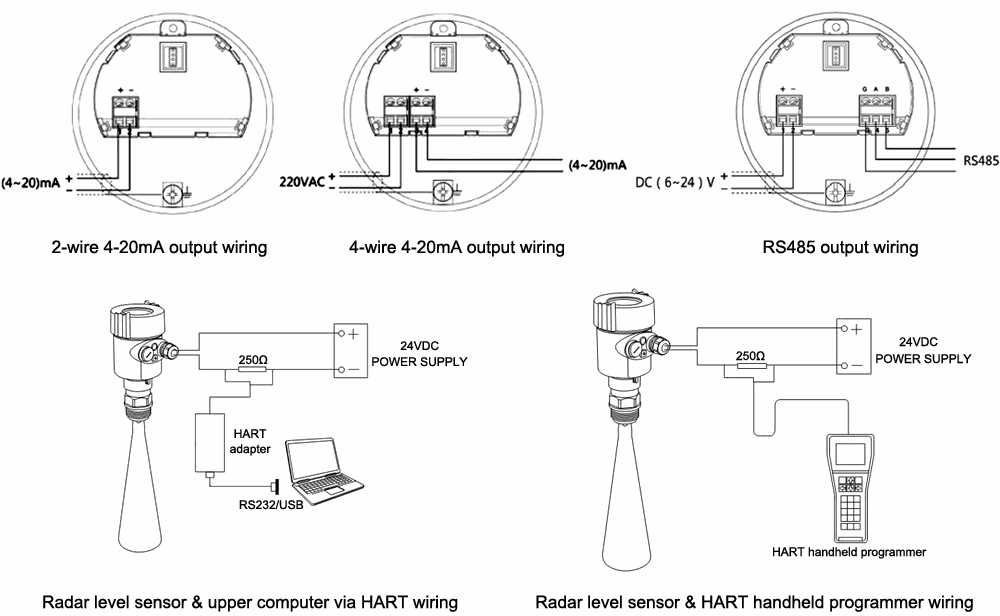
| Output Signal* | 4-20mA, Modbus RTU (RS485 Port), 4-20mA+HART |
| Power Supply* | DC 12-24V, AC 220V/50Hz |
| Material | Shell: Aluminum, Process Connection: 304 Stainless Steel |
| Pressure | -0.1 ~ 0.3MPa |
| Shock Resistance | 10m/s2, (10~150)Hz |
| Communication Protocol | Modbus |
| Medium | Various Corrosive Liquids |
| Storage Temperature | -40~+100℃ |
| Process connection (antenna) temperature | -40~+150℃ |
| Medium Temperature | -40~+130℃ |
| Protection Class | IP67 |
| Electrical Connection | 2 waterproof connectors M20*1.5mm, or 2 waterproof connectors 1/2" NPT |
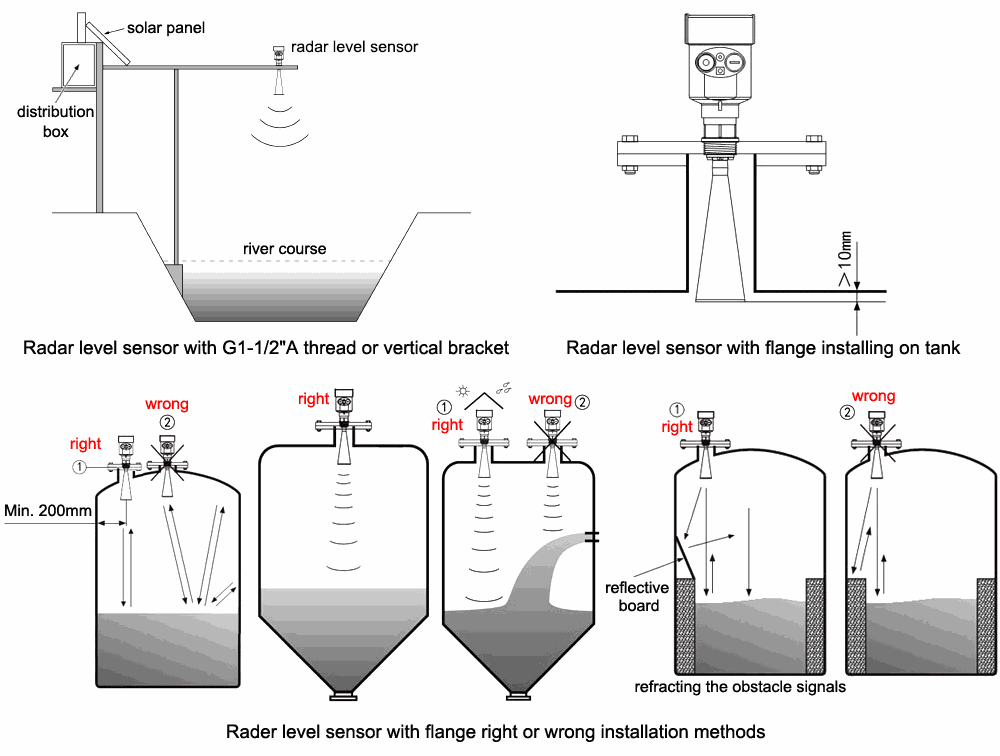
| Installation* | G1-1/2"A thread, Flange |
| Warranty | 12 Months |
Note: * denotes optional parameters, you can select parameters in drop-down lists to finish your order. Some customizable parameters can't be selected from the lists directly, please contact customer service staff for further communication.
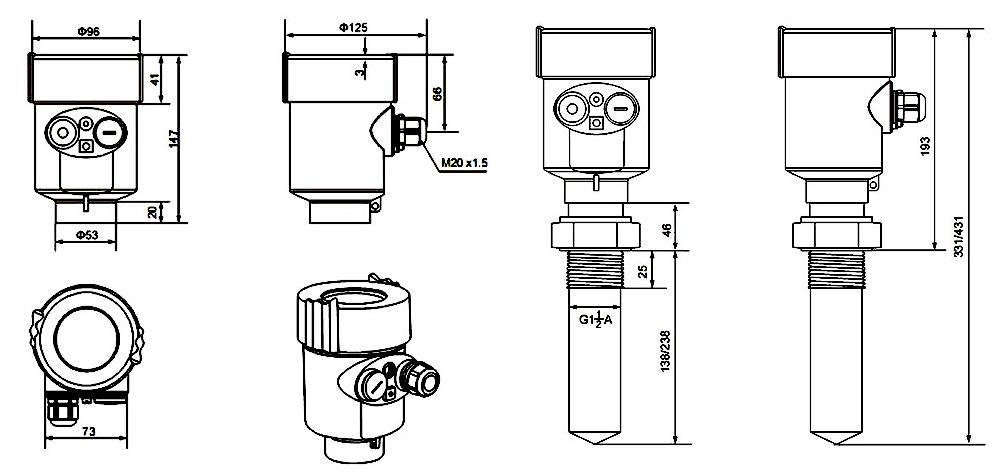
Dimensions (Unit: mm)
Installation
Wiring
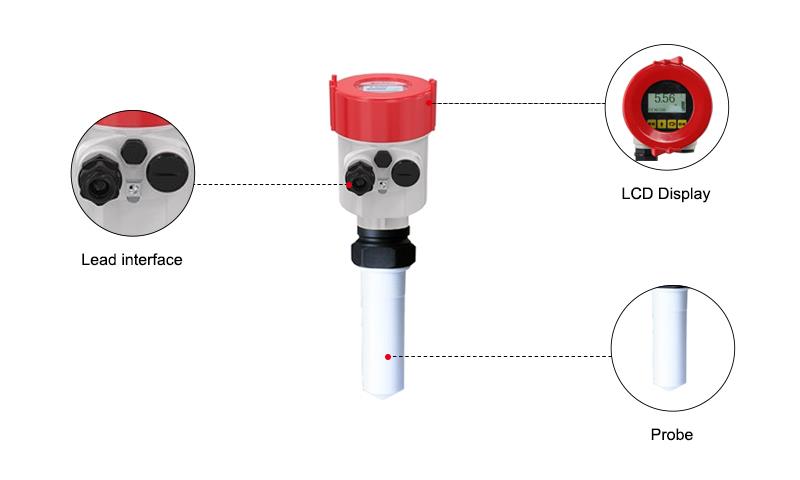
Details
Tips: Radar level sensor purchase guide
- Understand the measuring medium: Choose a sensor suitable for liquids, slurries or solids.
- Consider environmental conditions: Make sure the sensor can withstand the temperature, humidity and pressure of the working environment.
- Choose the appropriate frequency: high frequency is suitable for high precision requirements or complex environments, and low frequency is suitable for conventional applications, combined with the adjustment needs of motors and pumps.
- Installation location: Choose a location that is easy to install and maintain, and avoid interference sources.
- Protection capability: Ensure that the sensor has sufficient protection level to adapt to harsh environments.
- Compatibility: Ensure that the sensor is compatible with existing systems and supports common communication protocols.
- Maintenance and debugging: Choose sensors that are easy to debug and maintain later, and provide debugging tools or software support.
Only registered users can write reviews
Related products

Radar Level Sensor for Corrosive Liquid, Non-contact, 0-20M
ATO-LEVS-RD906
$1,732.89
Factory price radar level sensor is a non-contact measurement for measuring various highly corrosive liquids. Measuring range from 0 to 20m, selectable output signal of 4-20mA, RS485 or 4-20mA+HART, power supply of DC 12-24V or AC 220V, flange installation of DN50~DN200. Radar level transmitter consists of protection head with LCD display, waterproof connectors, internal radar antenna, and installation accessory.

26 GHz Radar Level Transmitter, Non-contact, 4-20mA/RS485, 0-30M
ATO-LEVS-RD902
$1,452.09
Economical price radar level sensor is a non-contact measurement. Measuring range from 0 to 30m, selectable output signal of 4-20mA, RS485 or 4-20mA+HART, power supply of DC 12-24V or AC 220V, installation of G1-1/2"A thread or flange. Radar type level transmitter consists of protection head with LCD display, 26 GHz microwave frequency, waterproof connectors, internal radar antenna, horn and installation accessory for measuring various highly corrosive liquids.

Radar Liquid Level Sensor, Non-contact, 4-20mA/RS485, 0-20M
ATO-LEVS-RD902T
$1,563.49
Economical price radar level sensor is a non-contact liquid measurement. Measuring range from 0 to 20m, selectable output signal of 4-20mA, RS485 or 4-20mA+HART, power supply of DC 12-24V or AC 220V, installation of DN80, DN100 or DN150 flange. Radar level transmitter consists of protection head with LCD display, waterproof connectors, internal radar antenna, horn and installation accessory for measuring various liquids.

Radar Type Level Sensor for Solid, Non-contact, 4-20mA, 0-12M
ATO-LEVS-RD905
$1,796.39
Economical price radar level sensor is a non-contact measurement. The non-contact level sensor supports a measuring range of 0–12m or 0–15m for powder, 0–18m or 0–20m for granules, and up to 20m for chunks, with output options of 4–20mA, RS485, or 4–20mA+HART. It can be powered by DC 12–24V or AC 220V. Radar level transmitter consists of protection head with LCD display, waterproof connectors, internal radar antenna, horn and installation accessory for measuring various solids.