
3-phase bridge rectifier module is made of high-quality materials and can withstand harsh environmental conditions. The compact exterior design facilitates integration into different systems and can be easily used in various environments.
Features
- Provide electrical insulation of 2500V voltage between the chip and the substrate to ensure reliable isolation.
- 3-phase bridge rectifier module has excellent temperature characteristics and power cycling capability, and can operate stably under extreme working conditions.
- Its design achieves low forward voltage drop, thereby improving energy efficiency and reducing power loss.
- The bridge rectifier module supports high surge currents to meet the demand for instantaneous high loads.
- The maximum working junction temperature of the equipment can reach 150 ℃, meeting the requirements of high-temperature environments.
- Its compact design makes it small in size and lightweight, making it easy to install and move.
Specification
| Model | ATO-LJ-MDS60A | ATO-LJ-MDS75A | ATO-LJ-MDS100A |
| DC output current | 60A | 75A | 100A |
| Reverse repetitive peak voltage | 1600V | ||
| Reverse repetitive peak current | 5mA | ||
| Forward non repetitive surge current | 0.36KA | ||
| Square time product of surge current | 0.7A2s*103 | ||
| Threshold voltage | 0.70V | ||
| Slope resistance | 6.0mΩ | ||
| Positive peak voltage | 1.20V | ||
| Thermal impedance (junction to shell) | 0.24℃/W | ||
| Thermal impedance (shell to radiator) | 0.07℃/W | ||
| Insulation voltage | 2500V | ||
| Installation torque (M5) | 4N·m | ||
| Installation torque (M6) | 6N·m | ||
| Storage temperature | -40~125℃ | ||
| Weight | 170g | ||
Note: This product must be installed on a heat sink. Please contact us to choose a suitable heat sink according to the actual situation.
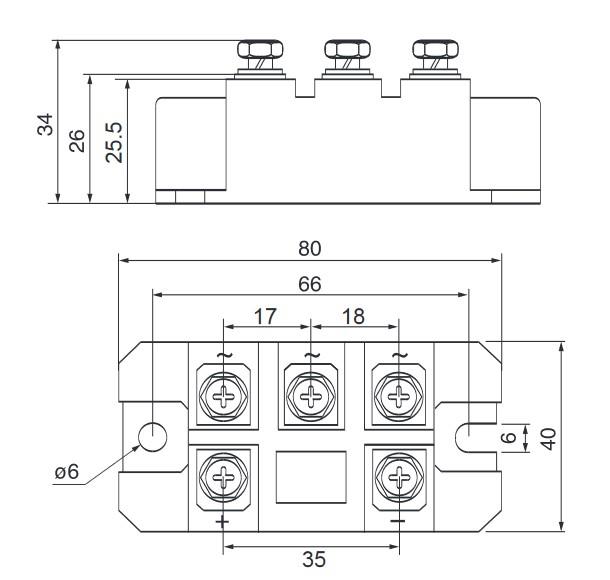
Dimension (mm)
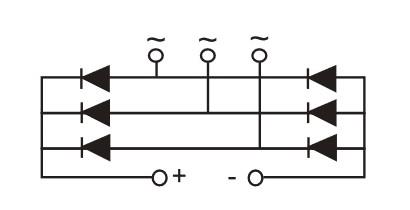
Circuit Diagram
Tips: Precautions for using rectifier modules
- The use environment should be free of severe vibration and impact, and the environmental medium should be free of impurities and atmosphere that corrode metals and damage insulation.
- Product core working junction temperature: diode is -40℃~150℃, the ambient temperature shall not be higher than 40℃, and the ambient humidity is less than 86%.
- The rectifier module must be equipped with a radiator before use. Heat dissipation can be achieved by natural cooling, forced air cooling or water cooling. When the actual load current is greater than 40A, a forced air-cooling design is generally required. The wind speed should be greater than 6 meters/second during forced air cooling.
- How to check whether the radiator is properly configured after the radiator is installed.
a. The temperature of the radiator can be measured with a thermometer (near the joint between the product and the radiator installation) to analyze whether it can operate reliably.
b. The time point for measuring the radiator temperature: wait for the equipment to start running for 30~60 minutes and reach thermal equilibrium.
c. How to analyze the measured temperature data? Generally, we require that the maximum effective temperature rise of the radiator installed with the anti-reverse diode is less than 50℃, that is, when the ambient temperature of the radiator is 25℃, the temperature of the radiator should be less than 75℃. - The control circulation flow in the control cabinet or equipment must be ensured to maintain a good ventilation environment.
Only registered users can write reviews
Related products

Portable Single Phase Bridge Rectifier Module, 60/75/100 Amp
ATO-RF-MDQ01
$52.78
Factory price portable single-phase bridge rectifier module for sale, providing 60/75/100 Amp DC output options, efficiently converting 1-phase AC power to DC power. With high insulation voltage of 2500V, it ensures good electrical protection and is suitable for various industrial and commercial applications.

High Power Single Phase Bridge Rectifier Module, 300/400 Amp
ATO-RF-MDQ03
$76.93
High-power single-phase bridge rectifier module for sale online and designed for high current DC power conversion. The rectifier module supports a maximum DC output current of 300/400 amperes. Its insulation voltage of 2500V ensures safety and is suitable for various industrial and commercial high current applications, such as power systems and motor drives.

Three Phase Diode Bridge Rectifier Module, 150/200/250 Amp
ATO-RF-MDS02
$67.87
Factory price three-phase diode bridge rectifier module for sale, converting three-phase AC power into DC power. It has three current levels of 150A, 200A and 250A to choose from, and the insulation voltage is up to 2500V. 3-phase diode bridge rectifier is widely used in power supply systems, motor drives, electrical equipment, etc.

High Power Three Phase Bridge Rectifier Module, 300/400 Amp
ATO-RF-MDS03
$84.65
Buy high power three-phase bridge rectifier modules online, providing 300/400 amps of high current handling capacity, with 2500V insulation voltage to prevent electrical interference. 3-phase bridge rectifier module efficiently converts AC to DC, suitable for industrial power control, motor drive and inverter applications.