
Industrial pneumatic brake provides a static friction torque of 53Nm to 636Nm at 0.6MPa air pressure. The replaceable friction plate design allows replacement without changing the original state of the machine. The cooling fins are installed on the disc with the hub to effectively dissipate the heat generated by friction.
Features
- By adjusting the air pressure, the pneumatic brake can achieve a smooth and stable stop.
- Its unique high thermal capacity and excellent heat dissipation make the brake durable under high frequency and heavy load conditions, and it can also operate in idle mode.
- The torque can be reliably adjusted over a wide range using air pressure.
- The friction pads are designed to be thicker, resulting in minimal wear and a long service life, and they can be replaced without altering the original condition of the machinery.
Specification
| Model | ATO-NAB-5T | ATO-NAB-10T | ATO-NAB-20T | ATO-NAB-40T | ATO-NAB-65T | |
| Static friction torque (kgm/(Nm)) | At 0.6Mpa | 5.3 (53) | 10 (100) | 21.6 (216) | 51 (510) | 63.6 (636) |
| Volume of air chamber (cm3) | Minimum Vn | 10.31 | 16.78 | 17.03 | 28.5 | 34.54 |
| Minimum Vo | 23.31 | 34.55 | 54.2 | 141.9 | 193.9 | |
| Permissible wear of friction plate Vf (cm3) | 14.74 | 25.12 | 58.05 | 146.6 | 299.8 | |
| Rotation speed limit Nb (r/min) | 3600 | 2800 | 2200 | 1800 | 1600 | |
| Moment of inertia J (kg·m2) | 9.69x10⁻⁴ | 4.59x10⁻³ | 1.694x10⁻² | 4.74x10⁻² | 1.076x10⁻¹ | |
| Weight (approximately) | 3.5kg | 6.6kg | 12kg | 25kg | 36kg | |
Vn: Air chamber volume with new friction pads
Vo: Air chamber volume before the friction pads are replaced
Dimension (mm)
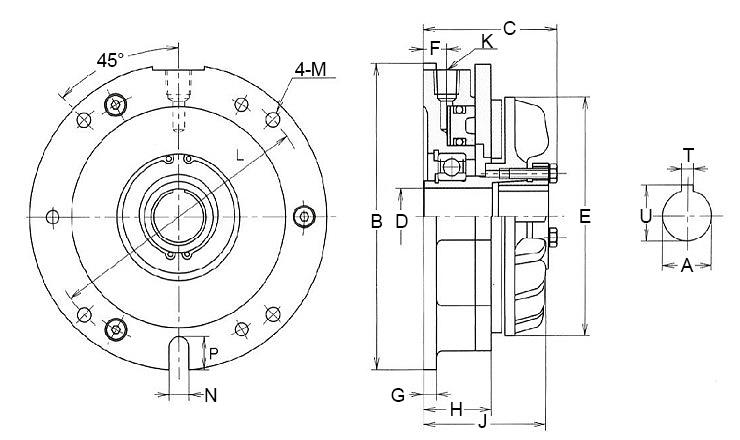
| Model | ATO-NAB-5T | ATO-NAB-10T | ATO-NAB-20T | ATO-NAB-40T | ATO-NAB-65T |
| A | 25 | 35 | 50 | 75 | 75 |
| B | 150 | 182 | 228 | 302 | 350 |
| C | 68.5 | 79.5 | 96 | 120 | 135 |
| D | 27.8 | 38 | 57 | 83 | 83 |
| E | 117 | 155 | 204 | 256 | 280 |
| F | 12 | 12 | 11 | 18 | 20 |
| G | 6.5 | 10 | 10 | 13 | 18 |
| H | 34.5 | 44 | 47 | 58.5 | 70 |
| J | 64 | 77 | 87 | 114 | 141 |
| K | Rc1/4 | Rc1/4 | Rc1/4 | Rc1/4 | Rc1/4 |
| L | 135 | 165 | 210 | 278 | 320 |
| M | 7 | 9 | 9 | 14 | 18 |
| N | 10 | 16 | 20 | 22 | 25 |
| R | 16.5 | 17 | 20 | 22 | 30 |
| T | 6 | 10 | 12 | 18 | 18 |
| U | 27.8 | 38.3 | 53.3 | 79.4 | 79.4 |
| Key | 6x6x25 | 10x8x30 | 12x8x45 | 18x11x65 | 18x11x65 |
Note: If the machine is used continuously under constant tension control, the M5 air inlet must be connected to air pressure for forced air cooling to increase sliding power and extend service life.
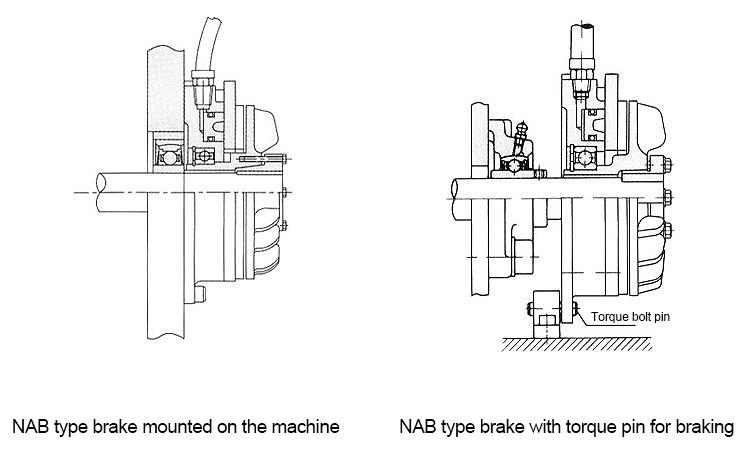
Install Instance
Structure
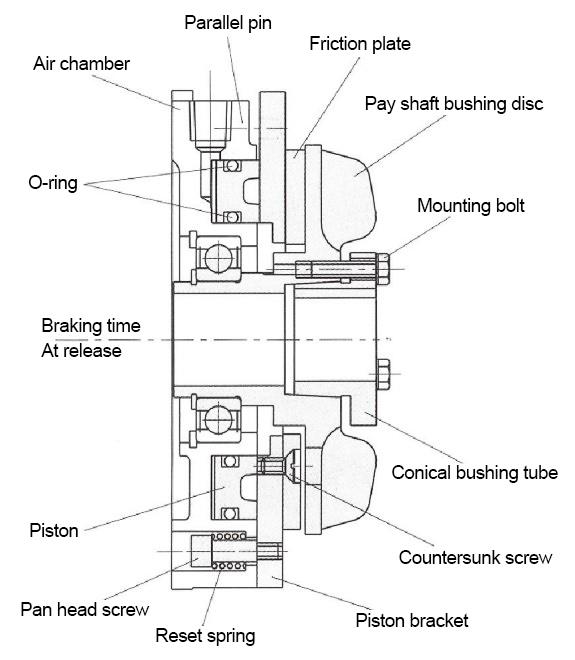
Tips: Working principle of pneumatic brake
The pneumatic brake operates by using compressed air as its power source. When air enters the brake, the pressure pushes an internal piston, causing the friction pads to press against the brake disc, generating the friction needed to achieve the braking effect. Users can adjust the air pressure to precisely control the braking force, adapting to various working conditions. During braking, the heat generated from friction is dissipated through cooling fins, ensuring stable operation under high frequency and heavy load conditions. When the air pressure is reduced or cut off, the friction pads separate from the brake disc, returning the brake to its initial state, allowing the equipment to rotate freely.

Pneumatic Clutch, Shaft Mounted, 50Nm-400Nm

Vertical Pneumatic Disk Brake, 10mm/20mm
