
Plating Rectifier
You want hard chromium plating, copper plating, electrolysis process or other metal surface treatment? Then choose a high-frequency electroplating rectifier power supply.
ATO plating rectifier for sale, provides a series of forced air cooling plating rectifiers, features with higher efficiency and more reasonable price, continuously adjustable current from 100A to 6000A, three phase four wire 50-60Hz 380V/ 400V/ 415V/ 480V AC input voltage and 10V/ 12V/ 15V/ 24V DC output voltage. (Wide range of 220-1000V AC input, 8-500V DC output and higher output current are customizable). They adopt pulse width modulation (PWM) as the control circuit and world-famous IGBT power modules, equipped with a standard antiseptic remote controller box, separate the power from the plating tank. Compared with manual operation, it is more reliable and easy to operate.
How does a plating rectifier work?
When a voltage is applied to the PN junction, the P junction is connected to the positive voltage and the N junction is connected to the negative voltage, current flows from the P junction to the N junction, and holes and electrons move toward the interface, making the space charge area narrower, current can pass smoothly, and current conducts. If the N junction is connected to the positive side of the voltage, the P junction is connected to the negative side, the holes and electrons are moving away from the direction of the interface so that the space charge area becomes wider, and the current can not flow through the current cutoff. This is the unidirectional conductivity of the PN junction. Using this property, it is possible to make the forward voltage conductive and the reverse voltage cutoff to rectify the AC current. The above is the working principle of an electroplating rectifier.
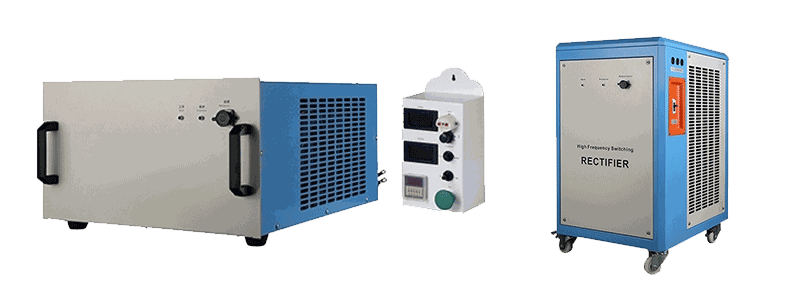
AC to DC Plating rectifier features
- Small size and lightweight: plating rectifier is easy for you to plan, expand, move, maintain and install.
- Good energy-saving effect: The switching power supply of the plating rectifier adopts a high-frequency transformer, and the conversion efficiency is greatly improved, which is more than 10% higher than that of silicon controlled equipment under normal conditions, and more than 30% higher than that of silicon controlled equipment when the load rate reaches below 70%.
- High output stability: due to the plating rectifier system response speed (microsecond level), the network power and load changes have strong adaptability, and the output accuracy can be better than 1%. Switching power supply efficiency is high, so the control accuracy is high, which is conducive to improving product quality.
- The output waveform is easy to modulate: due to the high working frequency of the plating rectifier, the output waveform adjustment cost is low, and the output waveform can be changed according to the user's process requirements, which is conducive to the worksite to improve work efficiency and process product quality.
Functions of ATO plating rectifier
- Plating rectifiers can reduce the porosity, the formation rate of the nucleus is larger than the growth rate, and promote the refinement of the nucleus.
- It improves the bonding force and makes the passivation film break down, which is conducive to the solid bonding between the substrate and the plating layer.
- The plating rectifier improves the coverage and dispersion ability, and the high negative cathode potential enables the deposition of the passivated parts in ordinary plating and slows down the "scorching" and "dendritic" deposition of the protruding parts of complex parts due to the excessive consumption of deposited ions. For obtaining a given characteristic layer (such as color, no porosity, etc.), the thickness can be reduced to 1/3~1/2 of the original, saving raw materials.
- It reduces the internal stress of the plating layer, improves lattice defects, impurities, voids, tumors, etc., easy to get a crack-free plating layer, and reduces additives.
- It helps to get alloy plating layers with stable composition.
- Three-phase plating rectifier improves the dissolution of an anode without an anode activator.
- The plating rectifier can improve the mechanical and physical properties of the plating layer, such as increasing density, reducing surface resistance and body resistance, improving toughness, wear resistance, corrosion resistance and controlling the hardness of the plating layer.
Electroplating rectifier troubleshooting
- Failure: The rectifier occurs with an abnormal rattling sound.
Treatment: The dust accumulation of the rectifier should be cleaned up in time to avoid affecting the normal operation of the whole machine. - Fault: The power indicator light of the plating rectifier is not lit.
Treatment: The power cord is not plugged in or the main switch of the plating rectifier is not closed. - Fault: The power indicator is normal, the fan is normal, and the work indicator is not lit.
Treatment: At this time, you should check whether the position of the start switch is correct, if the position is normal but still can't work, then please re-toggle the start switch. - Fault: The working indicator is normal, but the regulation current and voltage are faulty.
Treatment: Please pay attention to whether the regulated voltage and current have exceeded the minimum and maximum values that the power supply itself can carry and whether the adjustment switch has been turned to the lowest or highest position. - Fault: During the working process, the current output is suddenly interrupted, but the working indication and the voltage and current meter show normal.
Treatment: There is a problem with the wiring between the power supply and the plating tank. At this time, you should check the wiring between the power supply and the tank and connect it in time. - Fault: During the working process, the power output of the plating rectifier is suddenly interrupted and the protection light flashes.
Treatment: The power supply system enters the protection state.

100A Three Phase Plating Rectifier, 12V/24V/36V

200A Three Phase Plating Rectifier, 380V AC to 12V DC

300A Three Phase Plating Rectifier, 380V AC to 24V DC

500A Three Phase Plating Rectifier, 400V AC to 20V DC

1000A Three Phase Plating Rectifier, 12V/18V/24V

1500A Three Phase Plating Rectifier, 480V AC to 24V DC

2000A Three Phase Plating Rectifier, 380V AC to 18V DC

3000A Three Phase Plating Rectifier, 400V AC to 12V DC

4000A Three Phase Plating Rectifier, 480V AC to 24V DC

5000A Three Phase Plating Rectifier, 12V/18V/24V

