
The pH and conductivity electrical conductivity sensors are stable and use a three-composite electrode structure with good measurement results, making them suitable for accurate and repeatable measurements in various measurement applications. The pH and conductivity sensors can be used with portable pH meters to achieve rapid measurement of solutions.
Specification
| Model | ATO-PHB-5 | |
| mV | Range | -1999~1999mV |
| Minimum resolution | 1mV | |
| Electronic unit indication error | ±0.1%FS | |
| pH | Range | 0-14pH |
| Minimum resolution | 0.01pH | |
| Electronic unit indication error | ±0.01pH | |
| Temperature | Range | 5~60℃ |
| Minimum resolution | 0.1℃ | |
| Electronic unit indication error | ±0.2℃ | |
| Liquid Junction | Fiber single salt bridge | |
| Reference Structure | Ag/AgCl | |
| Filling Liquid | 3.0 mol/L KCl | |
| Shell Material | Polycarbonate | |
| Sensitive Membrane | Glass bulb | |
| Temperature Compensation Element | 2.25KQ | |
| Connector | BNC (Q9 type) | |
| Cable Length | 1 meter | |
| Power | Rechargeable lithium battery, power adapter Input: AC 100~240V Output: DC 5V | |
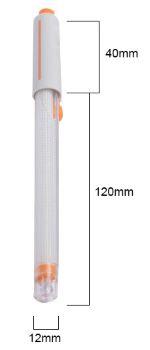
| Sensor Dimension | Φ12x120 mm | |
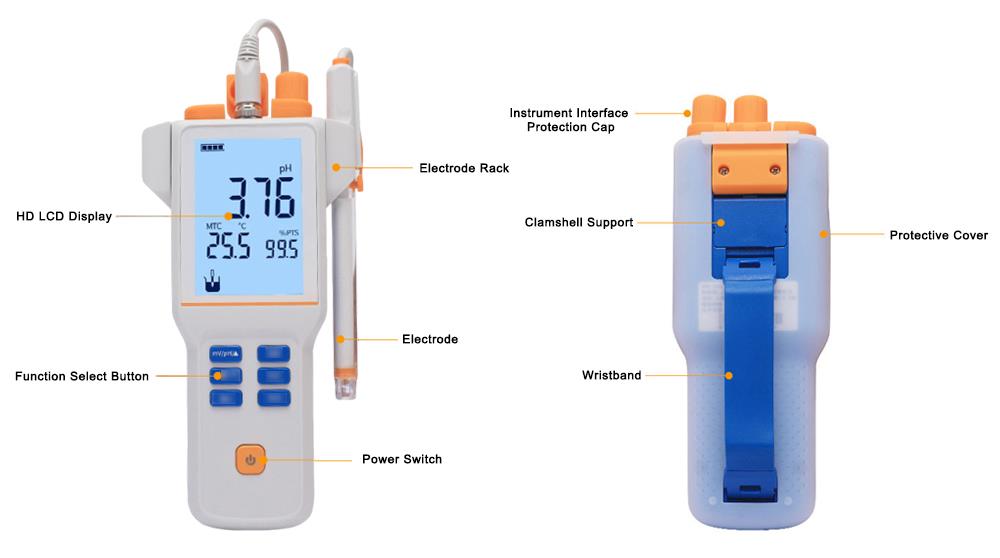
| Detector Dimension | 80x225x35mm | |
| Weight | 0.4kg | |
Features
- The pH and conductivity transmitters use a Q9 pH electrode interface and a four-core aviation plug temperature electrode interface.
- It uses a three-composite electrode structure, including a measuring electrode, a reference electrode and a temperature electrode, which is easy to use.
- Fiber material liquid junction, polycarbonate shell material and electrode measuring end protection foot design.
- The pH and conductivity sensors are rechargeable and the reference solution can be filled.
Dimension (Unit: mm)
Details
Application

Tips: Electrode material type of the conductivity sensor
- Platinum: Platinum electrode conductivity sensor has become the first choice for laboratory precision measurement due to its excellent chemical inertness and stability. In particular, after platinum black plating treatment, it can significantly increase the effective surface area and reduce the polarization effect. It is suitable for high-standard fields such as ultrapure water detection and medical treatment, but care should be taken to avoid ultrasonic cleaning and a hydrogen sulfide environment.
- Graphite: Graphite electrode conductivity sensor is popular in industrial wastewater monitoring and agricultural applications due to its economical and porous characteristics. Although it has the disadvantage of insufficient mechanical strength, the performance can be significantly improved by pyrolysis treatment or graphene coating.
- Stainless steel: Stainless steel electrode conductivity sensor is an ideal choice for food and beverage production lines and municipal water supply monitoring due to its excellent mechanical strength and wide temperature adaptability, but its performance is limited in low conductivity measurement and in a chlorine-containing environment.
- Titanium alloy: Titanium alloy electrode conductivity sensor has excellent corrosion resistance through special treatments such as anodization or tantalum coating, and can be competent in harsh environments such as strong chemical acids and seawater desalination. Different titanium alloy models can be optimized for specific working conditions.
Only registered users can write reviews
Related products

Sanitary Toroidal Conductivity Sensor, 1~2000ms/cm
ATO-CS-DNFA-5
$2,925.84
The low-cost sanitary inductive conductivity sensor has a conductivity measurement range of 1ms/cm ~ 2000ms/cm, an accuracy of ±2% or ±1ms/cm, a built-in temperature probe, temperature compensation Pt1000, and strong anti-interference ability. The sanitary toroidal electrical conductivity sensor can be widely used in monitoring the conductivity measurement of solutions such as thermal power, chemical industry, metallurgy, environmental protection, pharmaceuticals, biochemistry, food and tap water.

Wireless Conductivity Sensor, 0~5000μs/cm
ATO-CS-306
$427.39
Buy high-quality wireless conductivity sensors online, suitable for conductivity measurement in the range of 0~5000μs/cm and TDS measurement in the range of 0-3000 mg/L, providing RS485 signal output. The protection level of the wireless conductivity sensor is IP68, and it can be used with a Bluetooth wireless transmission module for wireless remote control.

Bluetooth Wireless Transmission Module for Conductivity Sensor
ATO-CS-MINI1
$96.62
Popular Bluetooth wireless transmission modules for sale online, which can be used to connect conductivity sensors, with ASCII Bluetooth transmission for output and hexadecimal Bluetooth transmission for input. The storage capacity of the Bluetooth wireless transmission module for the conductivity sensor is 4M bytes, which can store up to 300,000 data.

Portable Laboratory Conductivity Sensor, 2~20000μs/cm
ATO-CS-1VTC
$155.38
Cheap portable laboratory conductivity sensor for sale. The portable laboratory conductivity sensor has a measurement range of 2~20000μs/cm and a temperature range of 0~80℃. The shell material is glass and the electrode material is platinum black. It can be used to quickly measure the conductivity of liquids.