Nema 23 2-phase Stepper Motor, 5A, 1.8 degree, 4 wires

$91.15
Nema 23 stepper motor, 2-phase 4-wire, phase current of 5A, holding torque of 2.2Nm, 1.8 deg. step angle (200 steps/revolution), reasonable price and manufacturer direct sale.
SKU: ATO-STEP-822305
Free Shipping
Delivery date: 6-12 days

Nema 23 Stepper motor, 2.2Nm in 82mm, 1.8 degree, manufacturer direct sale.

Specification

Electrical SpecificationModelATO57STH82-5004
Matched Driver ModelATODSP57(Click it to see more info)
Step Angle1.8°
Holding Torque2.2Nm
Rated Current/phase5A
Phase Resistance0.6Ω
Inductance1.5mH
Rotor Inertia600g-cm2
Physical SpecificationFrame Size57 x 57mm
Length82mm
Shaft DiameterΦ6.35mm
Shaft Length19mm
Motor Leads4
Weight1.2kg
Technical ParametersStep Angle Accuracy±5% (full step, no load)
Resistance Accuracy±10%
Inductance Accuracy±20%
Temperature Rise80℃ Max. (rated current, 2 phase on)
Ambient Temperature-20℃~+50℃
Insulation Resistance100MΩ Min. 500VDC
Dielectric Strength500V AC for one minute
Shaft Radial Play0.02Max. 450g
Shaft Axial Play0.08Max. 450g
Quality AssuranceWarranty Period12 months
CertificateCE, ROHs, ISO/SGS9001

Nema 23 Stepper Motor Dimensions: (Unit=mm)

NEMA 23 hybrid stepper motor dimensionsL Max=82mm

Nema 23 Stepper Motor Wiring Diagram
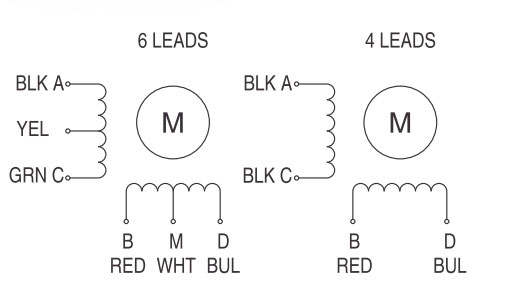
NEMA 23 hybrid stepper motor wiring diagram

Tips: What are differences between stepper motor and reducer motor?

Stepper motor indicates the kind of open-loop control element stepping motor that transforms the pulse signal into angular or linear displacement. Under the circumstance of no-load, the rotational velocity and stop location of the motor only depends on the frequency and pulse number of pulse signal instead of the influences of load change. When the stepper driver receives a pulse signal, it drives the stepper motor to rotate along the set direction by a fixed angle, called stepping angle, which rotates according to the fixed angle step by step. The angular displacement can be controlled by controlling the pulse number to reach the purpose of accurate positioning. In the meantime, the rotational velocity and acceleration of the motor can be controlled by controlling the pulse frequency to ultimately achieve the purpose of speed control.
Reducer motor is comprised of reducer (gear box) and motor. The motor provides high velocity rotation but the torque is small and inertia is large. The function of the reducer is to reduce the rotational velocity, increase torque and reduce inertia to achieve the ideal rotational velocity and torque. For instance, as for common electric curtain and roller gate, the reducer motor is used, featuring slow rotational velocity and large torque.
The difference between the both is that the velocity and time can be set for the stepper motor (the distance and speed can be set too); the rotational velocity of the reducer is decided according to the reduction ratio. The velocity cannot be adjusted but the torque can be adjusted. However, the torque of the stepper motor is small but that of the reducer motor is large.

VFD Two-Wire Control Wiring with Push Button for Forward Motor

In this video we've guided you through how to do VFD control wiring with a self-lock push button switch to run the motor in forward direction. We've covered everything from wiring to programming and even a test run. So just watch it through and hope you'll find it informative and helpful.

Product reviews
Five star for this stepper motor
5
Nathan
Avatar
8/28/2018 7:26 PM
Awesome, this stepper motor is suitable for my driver and performs very well with an arduino.
Was this review helpful? Yes No (0/0)
Write your review
  • Only registered users can write reviews
*
*
  • Bad
  • Excellent
*
*
*
*

Nema 23 Stepper motor, 2.2Nm in 82mm, 1.8 degree, manufacturer direct sale.

Specification

Electrical SpecificationModelATO57STH82-5004
Matched Driver ModelATODSP57(Click it to see more info)
Step Angle1.8°
Holding Torque2.2Nm
Rated Current/phase5A
Phase Resistance0.6Ω
Inductance1.5mH
Rotor Inertia600g-cm2
Physical SpecificationFrame Size57 x 57mm
Length82mm
Shaft DiameterΦ6.35mm
Shaft Length19mm
Motor Leads4
Weight1.2kg
Technical ParametersStep Angle Accuracy±5% (full step, no load)
Resistance Accuracy±10%
Inductance Accuracy±20%
Temperature Rise80℃ Max. (rated current, 2 phase on)
Ambient Temperature-20℃~+50℃
Insulation Resistance100MΩ Min. 500VDC
Dielectric Strength500V AC for one minute
Shaft Radial Play0.02Max. 450g
Shaft Axial Play0.08Max. 450g
Quality AssuranceWarranty Period12 months
CertificateCE, ROHs, ISO/SGS9001

Nema 23 Stepper Motor Dimensions: (Unit=mm)

NEMA 23 hybrid stepper motor dimensionsL Max=82mm

Nema 23 Stepper Motor Wiring Diagram

NEMA 23 hybrid stepper motor wiring diagram

Tips: What are differences between stepper motor and reducer motor?

Stepper motor indicates the kind of open-loop control element stepping motor that transforms the pulse signal into angular or linear displacement. Under the circumstance of no-load, the rotational velocity and stop location of the motor only depends on the frequency and pulse number of pulse signal instead of the influences of load change. When the stepper driver receives a pulse signal, it drives the stepper motor to rotate along the set direction by a fixed angle, called stepping angle, which rotates according to the fixed angle step by step. The angular displacement can be controlled by controlling the pulse number to reach the purpose of accurate positioning. In the meantime, the rotational velocity and acceleration of the motor can be controlled by controlling the pulse frequency to ultimately achieve the purpose of speed control.
Reducer motor is comprised of reducer (gear box) and motor. The motor provides high velocity rotation but the torque is small and inertia is large. The function of the reducer is to reduce the rotational velocity, increase torque and reduce inertia to achieve the ideal rotational velocity and torque. For instance, as for common electric curtain and roller gate, the reducer motor is used, featuring slow rotational velocity and large torque.
The difference between the both is that the velocity and time can be set for the stepper motor (the distance and speed can be set too); the rotational velocity of the reducer is decided according to the reduction ratio. The velocity cannot be adjusted but the torque can be adjusted. However, the torque of the stepper motor is small but that of the reducer motor is large.

Product reviews
Five star for this stepper motor
5
Nathan
Avatar
8/28/2018 7:26 PM
Awesome, this stepper motor is suitable for my driver and performs very well with an arduino.
Was this review helpful? Yes No (0/0)
Only registered users can write reviews