Miniature Tension and Compression Load Cell 3kg/20kg/100kg to 500kg

$172.49
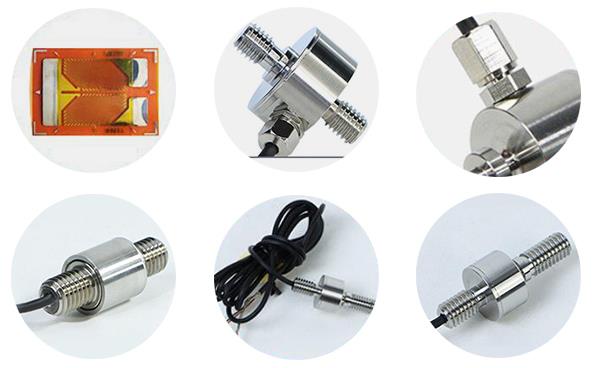
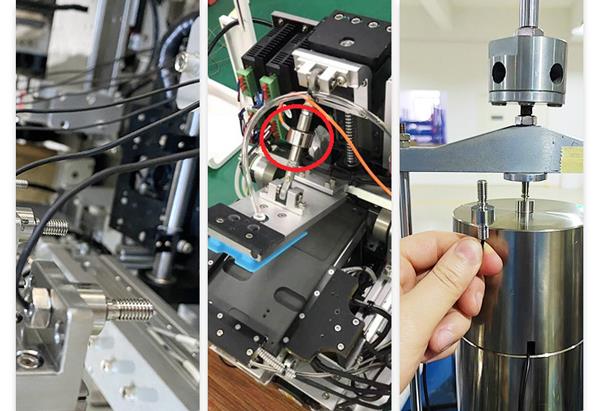
Miniature load cell can bear both tension and compression force, with metal-foil strain gauge, all stainless steel, small size, 1.0±0.2mV/V sensitivity. Miniature tension and compression load cell is used for force tester, riveting machine, laminator and welding machine.
SKU: ATO-LC-TC02
*
Free Shipping
Delivery date: 6-12 days

After purchasing one ATO load cell, you can buy a special digital panel meter to obtain readings directly, or buy a transmitter to output standard signal to PLC, DCS and other systems. Customized output signal is 0-5V, 0-10V, 4-20mA, or RS485.

Note: The load cell cannot be connected to both the transmitter and the controller at the same time — only one can be selected.

Miniature tension and compression load cells have capacity range from 1kg, 5kg, 10kg, 20kg, 30kg, 50kg, 100kg, 200kg, 300kg to 500kg. Load cell capacity can be customized according to customer requirements.

Specification

ModelATO-LCC-DYMH-106
Weight0.1kg
Capacity Range *1kg~500kg
Matched TransmitterATO-LCTR-OA (Click it to the transmitter page)
Matched Display ControllerATO-DDC5-CHB (Click it to the controller page)
Accuracy0.5%F.S (linearity + hysteresis + repeatability)
Sensitivity1.0±20%mV/V (Low range variations may differ)
Creep±0.1%F.S/30min
Zero Output±5%F.S
Temperature Effect on Zero±0.05%F.S/10℃
Temperature Effect on Output±0.05%F.S/10℃
Temperature Compensation Range-10℃~+60℃
Operating Temperature-20℃~+80℃
Input Impedance350±30Ω
Output Impedance350±5Ω
Insulation Resistance≥2000MΩ
Safety Overload120%F.S
Overload Limit200%F.S
Bridge Voltage (excitation voltage)DC 5-15V
MaterialStainless steel
Protection ClassIP66
Cable Length2m (Φ2mm)
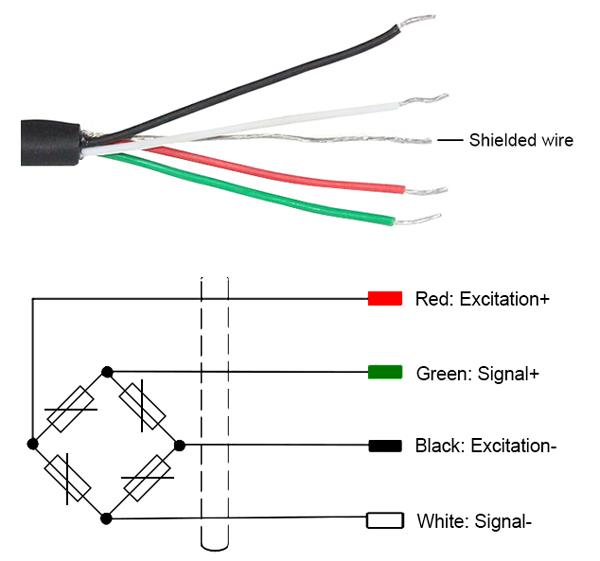
WiringEXC+: Red, EXC-: Black, SIG+: Green, SIG-: White


Feature

Miniature tension and compression load cell 3kg to 500kg feature

  • High-Quality Material: Made from stainless steel, resistant to corrosion, ensuring durability and long service life.
  • Compact Design: Small size with high measurement accuracy, ideal for tight spaces and precise force measurement.
  • Versatile Use: Suitable for tension and compression measurements, widely used in automotive assembly, medical testing, and robotics.
  • Durability: Wear-resistant, high-temperature resistant, and abrasion-resistant for long-term reliability in harsh environments.
  • Sealed Structure: Waterproof and oil-resistant, equipped with a sealed structure to prevent contamination and ensure consistent performance.
  • Easy Installation: Simple to install with tight sealing and secure connections, providing stable operation.
  • Specialized Optic Welding: Equipped with specialized optical welding to meet IP67 waterproof standards for demanding environments.

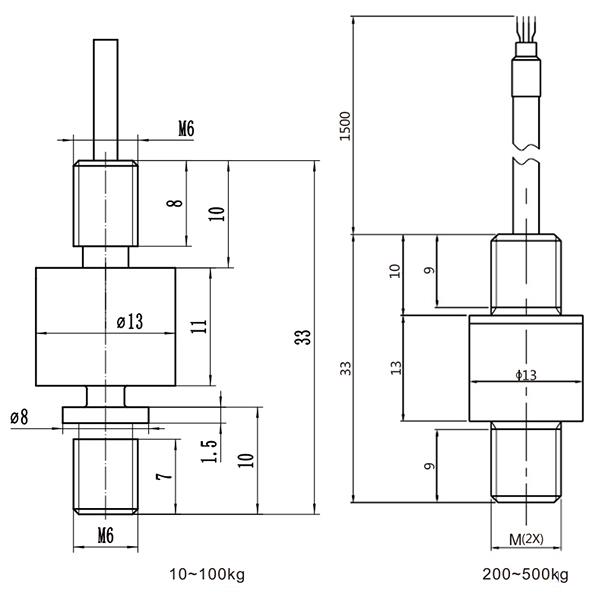
Dimension (unit: mm)

CapacityM
3kg, 5kg, 10kg, 15kg, 20kg, 30kg, 50kg, 100kgM6 (standard thread pitch: 1mm)
200kg, 300kg, 400kg, 500kgM8 (standard thread pitch: 1.25mm)

Miniature tension and compression load cell 3kg to 500kg dimension

Wiring Method

Load cell wiring method

Application

Miniature tension and compression load cell 3kg to 500kg application

Tips: Can the load cell be integrated with other systems for automated control?

Yes, the Miniature Tension and Compression Load Cell can be integrated into automated control systems, especially in applications like:

  • Robotics: For force feedback in robotic arms, ensuring precise control of movement.
  • Industrial Automation: It can be integrated into conveyor systems, robotic arms, or batch processing systems for real-time force measurement and control.
  • Weighing Systems: In automated weighing applications such as packaging, sorting, or quality control.

In this video, ATO will show you how to wire a strain gauge load cell with a display controller.

Low Profile Micro Compression Button Load Cell 100kg
This video introduces the specs, design features and applications of a low profile miniature button load cell DYHW-110 that's intended for compression force measurement. The maximum load capacity it can bear is 100kg. It can achieve 0.5%F.S accuracy with 150%F.S safety overload and temperature compensation.

Shear Beam Load Cell | Single & Double-Ended, Weighbridge Load Cells

The shear beam load cell is a common load cell. Its working principle is based on the deformation of the elastomer when it is acted upon by an external force. This deformation will cause the resistance of the elastomer to change, thereby achieving the measurement of the external force. It is typically used to measure forces in the small to medium range and its working principle is based on the shear effect of elastically deforming materials. This type of force measuring element is usually made of metal or polymer materials. Because of its high elastic modulus and shear modulus, it can produce stable shear deformation when subjected to external forces.

How to Ensure the Accuracy of Your Weighing System?

This video describes five factors that affect the accuracy of a weighing system and provides recommendations for selecting, installing, and operating the system to handle these factors.

Load Cell Transmitter 4~20mA Output Calibration

This video demonstrates how to calibrate the 4~20mA output. The 0~10V is also calibrated in the same way.

How Does PLC Read Data of Load Cell Transmitter?

In this video, it shows how PLC reads data from sensor transmitter. This system mainly consists of PLC, ATO load cell transmitter, ATO load cell, 24VDC power supply, personal computer, etc.

Product reviews
Questions about 3kg/20kg/100kg to 500kg load cell
5
Brendon
Avatar
3/8/2021 8:25 PM
I want to know if your 3kg/20kg/100kg to 500kg load cell is affected by magnetic field?
Was this review helpful? Yes No (0/0)
ATO Responded
Yes, the output voltage signal of the load cell from 3kg/20kg/100kg to 500kg will be affected by the magnetic field, which is proportional to the strength of the magnetic field.
Parameters of load cell
5
Rivera
Avatar
9/15/2021 9:17 PM
Looking for a disc type compressive load cell capable of a max load of ~300kg. What outputs do your load cells have? What is the resolution/accuracy?
Was this review helpful? Yes No (0/0)
ATO Responded
The output of our load cell is 0-20mV.
After purchasing our ATO load cell, you can buy our special digital panel meter to obtain readings directly, or buy our transmitter to output standard signal to PLC, DCS and other systems. Customized output signal is 0-5V, 0-10V, or 4 -20mA.
See all our load cell specs including resolution/accuracy, and price on: https://www.ato.com/load-cell.
I need a load cell that can sustain weight.
5
Mbelken
Avatar
11/25/2021 12:01 AM
I need a load cell which will be constantly under weight (up to 300kg ). In my application, I need to monitor the reduction of that weight (the weight load will decrease by a multiplier of 5KG), and then output that difference in weight change.
Basically a "reverse load cell" or an "unload cell".
My main concern, how do your load cells show under constant weight for prolonged periods, does such a cell exist which is able to handle this scenario?
Was this review helpful? Yes No (0/0)
ATO Responded
Yes, our load cell sensors support the usage described below.
But we don't know where the sensor will be installed, the specific size requirements, etc. So I cannot recommend a certain model.
Please, provide photos of your application, and where will the load cell be installed?
Load cell reading
5
Tiffy
Avatar
1/23/2022 11:46 PM
When we connect 2 load cell to display controller via junction box, what would be the reading refers to?
Was this review helpful? Yes No (0/0)
ATO Responded
When two load cells are connected to the controller through a junction box, the weight value of the two load cells read by the controller is usually the actual weight value, not the sum of the weights measured by the sensor separately!
I want to buy a Miniature Tension and Compression Load Cell 3kg sensor for my application. And I have two questions.
5
DeLisle
Avatar
12/12/2022 7:52 PM
I want to buy a Miniature Tension and Compression Load Cell 3kg sensor for my application. And I have two questions.
1. If I power the sensors with 5 volts, what type of output voltage should I expect for the full range? 0 - 5 V? Do I need an external amplifier?
2. Our application will apply a small (0.05 Nm) torque on the sensor. (if the sensor's main axis is in the Z direction, the torque is around the Rx/ Ry axes). Can you tell me if that is an issue with this sensor? Does it affect the measured force?
Was this review helpful? Yes No (0/0)
ATO Responded
1. The default output voltage of the sensor is mV, if you want to output a 0-5V signal, then you have to purchase/add a transmitter/amplifier;
2. For your application to apply a small (0.05 Nm) torque to the sensor, please, provide a schematic diagram showing how it will be, for further confirmation.
A problem of load cell accuracy
5
tzivia
Avatar
2/5/2023 6:19 PM
I already had switched the green and white cable so that the order was green, white, red, and black. This gave me an inclining positive value as you said but that does not seem to be the problem. When I measure the signal being outputted directly from the load cell, it seems to affect the accuracy if the signal is a negative value. I'm measuring the signal over the S- and S . So when I first tried to calibrate I went through the process as mentioned in the description. But when I removed the weight and put it back it seemed to be way off. So I checked the S- and S  and saw the values being negative. Then I calibrated the zero level til I had a positive value on the S- and S  readings and then the accuracy seemed to be right. Although the zero level was now 2V. How do I fix this?
Was this review helpful? Yes No (0/0)
ATO Responded
Regarding our previous suggestion, first you need to ensure that the voltage signal output by the measuring transmitter is positive after the load cell and the transmitter are wired correctly. You can only perform the calibration step if the output signal is confirmed to be positive, not if the signal is negative.When calibrating, you need to complete 2 steps. First perform no-load zero calibration, and adjust the zero potentiometer to display the signal output to 0. After the completion, perform load target point calibration. For example, if the weight is 50Kg, which is equivalent to 10% of the full scale of 500Kg, then the output voltage signal should be 10% of 5V, which is 0.5V. You need to adjust the span potentiometer until the output signal shows 0.5V.
Pressure/load sensor
4
Levi
Avatar
7/8/2024 3:25 AM
Do you have a pressure/load sensor which can be integrated in the horizontal axis which is perpendicular. I am interested in forces up to 60N.
Was this review helpful? Yes No (0/0)
ATO Responded
Our load cell SKU: ATO-LC-TC02 can be integrated in the horizontal axis to measure thrust force. No problem, you can buy online directly.
Compare the sampling rates of these
5
Ardebilis
Avatar
12/11/2024 6:28 PM
I am interested in the following 3 load cells:
https://www.ato.com/miniature-tension-and-compression-load-cell-3kg-to-500kg
https://www.ato.com/tension-and-compression-load-cell-1kg-to-200kg
https://www.ato.com/small-load-cell-5kg-to-5-ton
I am interested in the 50kg, 30kg, and 20kg capacity version of all of them. I am just looking to compare the sampling rates of all of them and see which one best fits my application.
Was this review helpful? Yes No (0/0)
ATO Responded
The sampling rates of these two models SKU: ATO-LC-TC02 and SKU: ATO-LC-TC01 are higher, about 5KHz.
Write your review
  • Only registered users can write reviews
*
*
  • Bad
  • Excellent
*
*
*
*

After purchasing one ATO load cell, you can buy a special digital panel meter to obtain readings directly, or buy a transmitter to output standard signal to PLC, DCS and other systems. Customized output signal is 0-5V, 0-10V, 4-20mA, or RS485.

Note: The load cell cannot be connected to both the transmitter and the controller at the same time — only one can be selected.

Miniature tension and compression load cells have capacity range from 1kg, 5kg, 10kg, 20kg, 30kg, 50kg, 100kg, 200kg, 300kg to 500kg. Load cell capacity can be customized according to customer requirements.

Specification

ModelATO-LCC-DYMH-106
Weight0.1kg
Capacity Range *1kg~500kg
Matched TransmitterATO-LCTR-OA (Click it to the transmitter page)
Matched Display ControllerATO-DDC5-CHB (Click it to the controller page)
Accuracy0.5%F.S (linearity + hysteresis + repeatability)
Sensitivity1.0±20%mV/V (Low range variations may differ)
Creep±0.1%F.S/30min
Zero Output±5%F.S
Temperature Effect on Zero±0.05%F.S/10℃
Temperature Effect on Output±0.05%F.S/10℃
Temperature Compensation Range-10℃~+60℃
Operating Temperature-20℃~+80℃
Input Impedance350±30Ω
Output Impedance350±5Ω
Insulation Resistance≥2000MΩ
Safety Overload120%F.S
Overload Limit200%F.S
Bridge Voltage (excitation voltage)DC 5-15V
MaterialStainless steel
Protection ClassIP66
Cable Length2m (Φ2mm)
WiringEXC+: Red, EXC-: Black, SIG+: Green, SIG-: White


Feature

Miniature tension and compression load cell 3kg to 500kg feature

  • High-Quality Material: Made from stainless steel, resistant to corrosion, ensuring durability and long service life.
  • Compact Design: Small size with high measurement accuracy, ideal for tight spaces and precise force measurement.
  • Versatile Use: Suitable for tension and compression measurements, widely used in automotive assembly, medical testing, and robotics.
  • Durability: Wear-resistant, high-temperature resistant, and abrasion-resistant for long-term reliability in harsh environments.
  • Sealed Structure: Waterproof and oil-resistant, equipped with a sealed structure to prevent contamination and ensure consistent performance.
  • Easy Installation: Simple to install with tight sealing and secure connections, providing stable operation.
  • Specialized Optic Welding: Equipped with specialized optical welding to meet IP67 waterproof standards for demanding environments.

Dimension (unit: mm)

CapacityM
3kg, 5kg, 10kg, 15kg, 20kg, 30kg, 50kg, 100kgM6 (standard thread pitch: 1mm)
200kg, 300kg, 400kg, 500kgM8 (standard thread pitch: 1.25mm)

Miniature tension and compression load cell 3kg to 500kg dimension

Wiring Method

Load cell wiring method

Application

Miniature tension and compression load cell 3kg to 500kg application

Tips: Can the load cell be integrated with other systems for automated control?

Yes, the Miniature Tension and Compression Load Cell can be integrated into automated control systems, especially in applications like:

  • Robotics: For force feedback in robotic arms, ensuring precise control of movement.
  • Industrial Automation: It can be integrated into conveyor systems, robotic arms, or batch processing systems for real-time force measurement and control.
  • Weighing Systems: In automated weighing applications such as packaging, sorting, or quality control.
Product reviews
Questions about 3kg/20kg/100kg to 500kg load cell
5
Brendon
Avatar
3/8/2021 8:25 PM
I want to know if your 3kg/20kg/100kg to 500kg load cell is affected by magnetic field?
Was this review helpful? Yes No (0/0)
ATO Responded
Yes, the output voltage signal of the load cell from 3kg/20kg/100kg to 500kg will be affected by the magnetic field, which is proportional to the strength of the magnetic field.
Parameters of load cell
5
Rivera
Avatar
9/15/2021 9:17 PM
Looking for a disc type compressive load cell capable of a max load of ~300kg. What outputs do your load cells have? What is the resolution/accuracy?
Was this review helpful? Yes No (0/0)
ATO Responded
The output of our load cell is 0-20mV.
After purchasing our ATO load cell, you can buy our special digital panel meter to obtain readings directly, or buy our transmitter to output standard signal to PLC, DCS and other systems. Customized output signal is 0-5V, 0-10V, or 4 -20mA.
See all our load cell specs including resolution/accuracy, and price on: https://www.ato.com/load-cell.
I need a load cell that can sustain weight.
5
Mbelken
Avatar
11/25/2021 12:01 AM
I need a load cell which will be constantly under weight (up to 300kg ). In my application, I need to monitor the reduction of that weight (the weight load will decrease by a multiplier of 5KG), and then output that difference in weight change.
Basically a "reverse load cell" or an "unload cell".
My main concern, how do your load cells show under constant weight for prolonged periods, does such a cell exist which is able to handle this scenario?
Was this review helpful? Yes No (0/0)
ATO Responded
Yes, our load cell sensors support the usage described below.
But we don't know where the sensor will be installed, the specific size requirements, etc. So I cannot recommend a certain model.
Please, provide photos of your application, and where will the load cell be installed?
Load cell reading
5
Tiffy
Avatar
1/23/2022 11:46 PM
When we connect 2 load cell to display controller via junction box, what would be the reading refers to?
Was this review helpful? Yes No (0/0)
ATO Responded
When two load cells are connected to the controller through a junction box, the weight value of the two load cells read by the controller is usually the actual weight value, not the sum of the weights measured by the sensor separately!
I want to buy a Miniature Tension and Compression Load Cell 3kg sensor for my application. And I have two questions.
5
DeLisle
Avatar
12/12/2022 7:52 PM
I want to buy a Miniature Tension and Compression Load Cell 3kg sensor for my application. And I have two questions.
1. If I power the sensors with 5 volts, what type of output voltage should I expect for the full range? 0 - 5 V? Do I need an external amplifier?
2. Our application will apply a small (0.05 Nm) torque on the sensor. (if the sensor's main axis is in the Z direction, the torque is around the Rx/ Ry axes). Can you tell me if that is an issue with this sensor? Does it affect the measured force?
Was this review helpful? Yes No (0/0)
ATO Responded
1. The default output voltage of the sensor is mV, if you want to output a 0-5V signal, then you have to purchase/add a transmitter/amplifier;
2. For your application to apply a small (0.05 Nm) torque to the sensor, please, provide a schematic diagram showing how it will be, for further confirmation.
A problem of load cell accuracy
5
tzivia
Avatar
2/5/2023 6:19 PM
I already had switched the green and white cable so that the order was green, white, red, and black. This gave me an inclining positive value as you said but that does not seem to be the problem. When I measure the signal being outputted directly from the load cell, it seems to affect the accuracy if the signal is a negative value. I'm measuring the signal over the S- and S . So when I first tried to calibrate I went through the process as mentioned in the description. But when I removed the weight and put it back it seemed to be way off. So I checked the S- and S  and saw the values being negative. Then I calibrated the zero level til I had a positive value on the S- and S  readings and then the accuracy seemed to be right. Although the zero level was now 2V. How do I fix this?
Was this review helpful? Yes No (0/0)
ATO Responded
Regarding our previous suggestion, first you need to ensure that the voltage signal output by the measuring transmitter is positive after the load cell and the transmitter are wired correctly. You can only perform the calibration step if the output signal is confirmed to be positive, not if the signal is negative.When calibrating, you need to complete 2 steps. First perform no-load zero calibration, and adjust the zero potentiometer to display the signal output to 0. After the completion, perform load target point calibration. For example, if the weight is 50Kg, which is equivalent to 10% of the full scale of 500Kg, then the output voltage signal should be 10% of 5V, which is 0.5V. You need to adjust the span potentiometer until the output signal shows 0.5V.
Pressure/load sensor
4
Levi
Avatar
7/8/2024 3:25 AM
Do you have a pressure/load sensor which can be integrated in the horizontal axis which is perpendicular. I am interested in forces up to 60N.
Was this review helpful? Yes No (0/0)
ATO Responded
Our load cell SKU: ATO-LC-TC02 can be integrated in the horizontal axis to measure thrust force. No problem, you can buy online directly.
Compare the sampling rates of these
5
Ardebilis
Avatar
12/11/2024 6:28 PM
I am interested in the following 3 load cells:
https://www.ato.com/miniature-tension-and-compression-load-cell-3kg-to-500kg
https://www.ato.com/tension-and-compression-load-cell-1kg-to-200kg
https://www.ato.com/small-load-cell-5kg-to-5-ton
I am interested in the 50kg, 30kg, and 20kg capacity version of all of them. I am just looking to compare the sampling rates of all of them and see which one best fits my application.
Was this review helpful? Yes No (0/0)
ATO Responded
The sampling rates of these two models SKU: ATO-LC-TC02 and SKU: ATO-LC-TC01 are higher, about 5KHz.
Only registered users can write reviews
Customers who bought this item also bought

Load Cell Transmitter, Output 0-5V/0-10V/4-20mA

ATO-LCTR-OA
$81.27
Load cell transmitter is made of aluminum alloy, output standard signal 0-5V/0-10V/4-20mA, has linear compensation, humidity compensation, external zero debugging, external span debugging, input overload protection and output short circuit protection functions.

Through Beam Photoelectric Sensor

ATO-PHOS-TB
$41.36
Through beam photoelectric sensor consists of a light projector and a light receiver, both of which are separated in structure. The supply voltage is DC 12V-24V or AC 110V-220V. Infrared photoelectric sensor can distinguish the opaque reflective object, with long effective detection distance 5/15/50m, less susceptible to interference, long life, and high reliability.

Tension and Compression Load Cell, 1 kg - 500 kg

ATO-LC-TC01
$137.98
Tension and compression load cell can bear both tension and pressure, with good anti-eccentric load performance, low height, all sealed structure and complete specifications. Miniature load cell with optional capacity 1 kg/ 100kg/ 200 kg/ 300kg/ 500 kg is suited to use in restricted spaces, such as using in vehicle/test instrument/laminator measurement and control.

Digital Load Cell Amplifier, Output 4-20mA/0-10V/RS485

ATO-LCTR-OAR
$109.85
High precision load cell amplifier has a 6 digit LED display, output signal 4-20mA/ 0-5V/ 0-10V/ RS485. There are 3 keys for parameter settings. Digital load cell amplifier can be calibrated on-line by its 3 keys. The setting parameters include zero, capacity, communication rate, division value, decimal digits, etc.

Subminiature Load Cell, Button type, 3kg/5kg/10kg/20kg/50kg/100kg

ATO-LC-BU01
$123.81
Subminiature load cell is a button type load cell with a diameter only 8mm. It is made of stainless steel, with protection class IP66, Φ2*2m cable. Subminiature load cell can be used for keyboard button hand-feeling test, force tester, automated assembly of new energy products and automotive products. It can be customized for the high-temperature working condition such as injection moulding, extrusion and other manufacturing processes.