
The CH4 sensor has built-in temperature compensation, working temperature from -40℃ to 70℃ . The combustible gas sensor has the characteristics of good selectivity, no oxygen dependence, stable performance, long life and ultra-low power consumption.
Features
- High sensitivity, high resolution, low power consumption, quick response.
- UART output.
- Temperature compensation, excellent stability.
- Long lifespan, Anti-poisons, anti-vapor interference.
- Detect combustible gas concentration matching with flame-proof marked detector in area 1&2 explosive environments which mix of Ⅱ A, Ⅱ B, Ⅱ C and T1-T6 flammable gases, vapors and air.
Specification
- Model: ATO-ICDS-7042A
- Detection gas: Combustible gas, other combustible gas sensor can be customized.
- Working voltage: (5.0±0.1) VDC
- Average current: <0.60mA (Peak current< 150mA)
- Interface level: 3.0V (Compatible with 5V)
- Measuring range: 0~100% LEL
- Output signal: UART (TTL)
- Warm-up time: < 30s
- Response time: T90 < 30s
- Working temperature: -40℃ ~ 70℃
- Working humidity: 0~95% RH (no condensation)
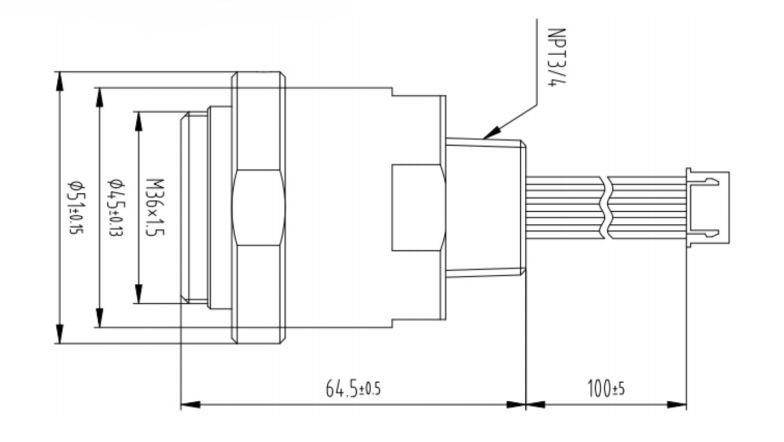
- Dimension: Φ51*65mm
| Gas name | Molecular formula | Range | Resolution | Precision | Note |
| Methane | CH4 | 0~5% Vol | 0.01% Vol | ±3%FS @(10℃-40℃) ±5%FS @(-40℃-10℃,40℃-70℃) | With Temperature Compensation |
| Methane | CH4 | 0~10% Vol | 0.1% Vol | ||
| Methane | CH4 | 0~100% Vol | 0.1% | ||
| Propane | C3H8 | 0-2.2% Vol | 0.01% Vol | ||
| Chloromethane | CH3CL | 0-8.1% Vol | 0.01% Vol | ||
| Acetylene | C2H2 | 0-2.3% Vol | 0.02% Vol | ||
| Ethane | CH3CH3 | 0-3.0% Vol | 0.03% Vol | ||
| Isobutene | C4H10 | 0-1.8% Vol | 0.018% Vol | ||
| Gasoline | C3-C12 | 0-1.1% Vol | 0.01% Vol | ±5%FS @(10℃-40℃), ±10%FS @(-40℃-10℃,40℃-70℃) | Without Temperature Compensation |
| Methanol | CH3OH | 0-5.5% Vol | 0.06% Vol | ||
| Dichloromethane | CH2CL2 | 0-15% Vol | 0.15% Vol | ||
| Toluene | C7H8 | 0-1.2% Vol | 0.012% Vol | ||
| Alcohol | C2H5OH | 0-3.3% Vol | 0.033% Vol | ||
| Oxirane | C2H4O | 0-3.0% Vol | 0.03% Vol | ||
| Acetic acid | CH3COOH | 0-4.0% Vol | 0.04% Vol | ||
| Ethyl acetate | CH3COOC2H5 | 0-2.0% Vol | 0.02% Vol |
Dimension (mm)
Tips: Where should methane sensors be placed?
Methane sensors should be strategically placed in areas where methane gas buildup is likely to occur. Some common locations for placing methane sensors include:
- Near Gas Appliances: Install methane sensors near gas-powered appliances such as stoves, ovens, water heaters, furnaces, and boilers. These appliances are potential sources of methane leaks, especially if they are old or poorly maintained.
- Along Gas Pipelines: Place methane sensors along gas pipelines to detect leaks or emissions along the pipeline route. Monitoring methane levels at various points along the pipeline can help identify and address potential leaks promptly.
- In Industrial Facilities: Install methane sensors in industrial facilities where methane gas is used or produced, such as refineries, chemical plants, wastewater treatment plants, and agricultural operations. These facilities may have equipment or processes that produce methane as a byproduct, posing a risk of leaks or emissions.
- Confined Spaces: Install methane sensors in confined spaces such as basements, crawl spaces, tunnels, and underground vaults where methane gas may accumulate. Poor ventilation in these areas can lead to the buildup of methane gas, posing a risk of explosion or asphyxiation.
Only registered users can write reviews
Related products

NDIR CO2 Gas Sensor, 0 to 2000/ 5000 ppm
ATO-GS-CO2-Z16
$138.73
Lower cost NDIR CO2 sensor for sale online. The carbon dioxide sensor with wide range measuring range from 0 to 5000 ppm, working voltage 5VDC, UART/ PWM two output signal can be chosen. Infrared carbon dioxide sensors are widely used in various occasions where flammable and explosive gases exist.

NDIR CO2 Sensor Module, 400-2000/ 5000/ 10000 ppm
ATO-GS-CO2-Z14A
$103.33
Cost-effective NDIR CO2 sensor module has optional measuring range 0/400~2000/ 5000/ 10000, peak current 125 mA, average current less than 40 mA, UART/ PWM/ 0.4-2V DC three output signals for selection. CO2 gas sensor built-in temperature compensation; digital output and analog voltage output at the same time, easy to use.

Methane (CH4) Sensor, 0 to 5% Vol
ATO-GS-CH4-741A
$684.62
Econimical price methane sensor with wide measuring range from 0 to 100% VOL, working voltage 5 VDC, interface level 3V. The infrared methane sensor adopts the principle of infrared absorption, reliable performance, long life and the adjustment period is more than 1 year.

Infrared CO2 Sensor Module, UART/ PWM output
ATO-GS-CO2-Z19C
$104.56
Resonale price Infrared CO2 sensor module with UART/ PWM two output signal for selection, available measuring range 400~2000 ppm/ 400~5000 ppm/ 400~10000 ppm, working voltage 5VDC. The NDIR CO2 sensor can be used to monitor production processes in smart homes, agricultural greenhouses and animal husbandry.