NDIR CO2 Sensor Module, 400-2000/ 5000/ 10000 ppm

$103.33
Cost-effective NDIR CO2 sensor module has optional measuring range 0/400~2000/ 5000/ 10000, peak current 125 mA, average current less than 40 mA, UART/ PWM/ 0.4-2V DC three output signals for selection. CO2 gas sensor built-in temperature compensation; digital output and analog voltage output at the same time, easy to use.
SKU: ATO-GS-CO2-Z14A
*
Free Shipping
Delivery date: 8-12 days

Low cost NDIR CO2 sensor with 1 min preheat time, interface level 3.3V, working voltage 5VDC. The CO2 module has high sensitivity, lower power consumption and good stability, infrared carbon dioxide sensor is widely used in HVAC refrigeration, air cleaner device, indoor air quality monitoring, smart home and ventilation system.

Features

  • Chamber is gold plated, water-proof and anti-corrosion
  • High sensitivity, low power consumption
  • Good stability, long lifespan
  • Temperature compensation, excellent linear output
  • Multiple output modes: UART, PWM
  • Anti-water vapor interference, anti-poisoning

Specification

  • Model: ATO-ICDS-Z14A
  • Detection gas: CO2
  • Working voltage: 5VDC
  • Peak current: 125 mA
  • Average current: < 40mA
  • Interface level: 3.3V
  • Measuring range: 400~10000 ppm
  • Output signal: UART/ PWM/ 0.4-2V DC
  • Preheat time: 1 min
  • Response time: T90 < 120s
  • Working temperature: -10℃ ~ 50℃
  • Working humidity: 0~95% RH (no condensation)
  • Storage temperature: -20℃ ~ 60℃
  • Dimension (L*W*H): 57.5*34.7*17mm

Measuring range and accuracy

Target gasMeasuring rangeResolutionAccuacy
Carbon Dioxide
(CO2)
400~2000 ppm1 ppm± (50 ppm+5% reading value)
400~5000 ppm
400~10000 ppm

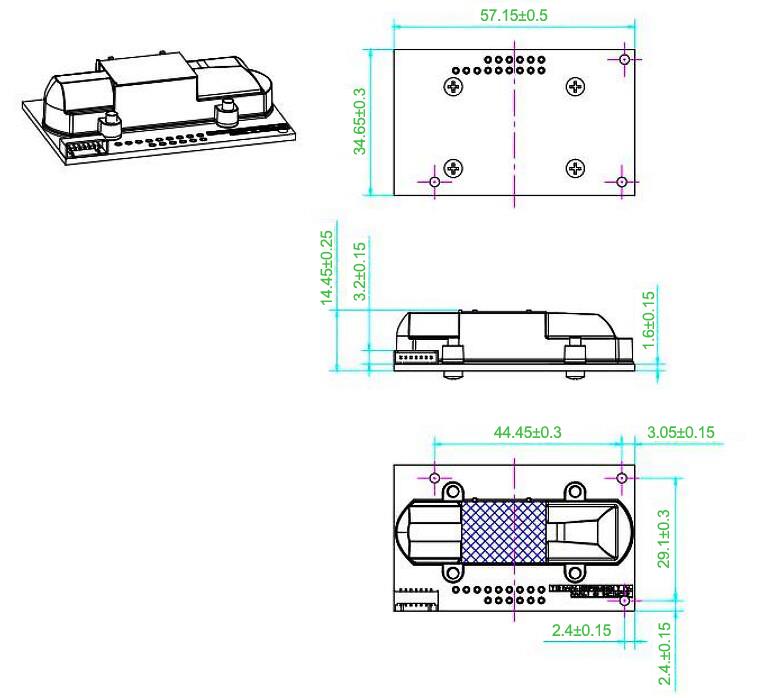
Dimension (mm)

NDIR co2 sensor module 400-1000 ppm dimension

Tips: Why Calibrate NDIR CO2 Sensor Module?

All carbon dioxide sensors need calibration. Depending on the application, this can be accomplished by calibrating the sensor to a known gas or using the automatic baseline calibration (ABC) method. Both have pros and cons you should know.

Most of our CO2 products use non-dispersive infrared (NDIR) carbon dioxide sensors. These rely on an infrared light source and detector to measure the number of CO2 molecules in the sample gas between them. Over many years, both the light source and the detector deteriorate, resulting in slightly lower CO2 molecule counts. The industry calls this "drift".

To combat sensor drift, during calibration a sensor is exposed to a known gas source, multiple readings are taken, an average is calculated, and the difference between the new reading and the original reading when the sensor was originally calibrated at the factory is stored in EPROM memory. This "offset" value is then automatically added or subtracted to any subsequent readings taken by the sensor during use.

Product reviews
Good accuracy, saved my tomato seedlings
4
merry2002
Avatar
9/21/2025 9:50 PM
I've been using this module in my small greenhouse, along with an Arduino controller. My biggest drawback is its 400-2000ppm measurement range, which perfectly covers the CO2 concentration range most needed for plant photosynthesis. The data is very stable and much more accurate than the analog sensor I used before. I can clearly see the concentration rise after CO2 addition and fall after plant absorption. The downside is that the power consumption is a bit high, requiring constant power, and it's a bit pricey. However, for precision farming, it's a worthwhile investment in this core component.
Was this review helpful? Yes No (0/0)
Write your review
  • Only registered users can write reviews
*
*
  • Bad
  • Excellent
*
*
*
*

Low cost NDIR CO2 sensor with 1 min preheat time, interface level 3.3V, working voltage 5VDC. The CO2 module has high sensitivity, lower power consumption and good stability, infrared carbon dioxide sensor is widely used in HVAC refrigeration, air cleaner device, indoor air quality monitoring, smart home and ventilation system.

Features

  • Chamber is gold plated, water-proof and anti-corrosion
  • High sensitivity, low power consumption
  • Good stability, long lifespan
  • Temperature compensation, excellent linear output
  • Multiple output modes: UART, PWM
  • Anti-water vapor interference, anti-poisoning

Specification

  • Model: ATO-ICDS-Z14A
  • Detection gas: CO2
  • Working voltage: 5VDC
  • Peak current: 125 mA
  • Average current: < 40mA
  • Interface level: 3.3V
  • Measuring range: 400~10000 ppm
  • Output signal: UART/ PWM/ 0.4-2V DC
  • Preheat time: 1 min
  • Response time: T90 < 120s
  • Working temperature: -10℃ ~ 50℃
  • Working humidity: 0~95% RH (no condensation)
  • Storage temperature: -20℃ ~ 60℃
  • Dimension (L*W*H): 57.5*34.7*17mm

Measuring range and accuracy

Target gasMeasuring rangeResolutionAccuacy
Carbon Dioxide
(CO2)
400~2000 ppm1 ppm± (50 ppm+5% reading value)
400~5000 ppm
400~10000 ppm

Dimension (mm)

NDIR co2 sensor module 400-1000 ppm dimension

Tips: Why Calibrate NDIR CO2 Sensor Module?

All carbon dioxide sensors need calibration. Depending on the application, this can be accomplished by calibrating the sensor to a known gas or using the automatic baseline calibration (ABC) method. Both have pros and cons you should know.

Most of our CO2 products use non-dispersive infrared (NDIR) carbon dioxide sensors. These rely on an infrared light source and detector to measure the number of CO2 molecules in the sample gas between them. Over many years, both the light source and the detector deteriorate, resulting in slightly lower CO2 molecule counts. The industry calls this "drift".

To combat sensor drift, during calibration a sensor is exposed to a known gas source, multiple readings are taken, an average is calculated, and the difference between the new reading and the original reading when the sensor was originally calibrated at the factory is stored in EPROM memory. This "offset" value is then automatically added or subtracted to any subsequent readings taken by the sensor during use.

Product reviews
Good accuracy, saved my tomato seedlings
4
merry2002
Avatar
9/21/2025 9:50 PM
I've been using this module in my small greenhouse, along with an Arduino controller. My biggest drawback is its 400-2000ppm measurement range, which perfectly covers the CO2 concentration range most needed for plant photosynthesis. The data is very stable and much more accurate than the analog sensor I used before. I can clearly see the concentration rise after CO2 addition and fall after plant absorption. The downside is that the power consumption is a bit high, requiring constant power, and it's a bit pricey. However, for precision farming, it's a worthwhile investment in this core component.
Was this review helpful? Yes No (0/0)
Only registered users can write reviews