
This capacitive label detection sensor is an advanced industrial component designed for reliable label presence detection in demanding automation environments. Its robust differential capacitance sensing principle allows it to handle a wide array of label materials with high accuracy. The labeling machine sensor integrates user-friendly intelligent features for simplified setup and maintenance, making it a versatile and efficient choice for modern production lines.
Specification
| Model | ATO-FGU07-100 |
| Suitable Labels | Transparent & Non-Transparent (non-metallic), Paper, PVC Composite |
| Detection Principle | Differential Capacitance Detection |
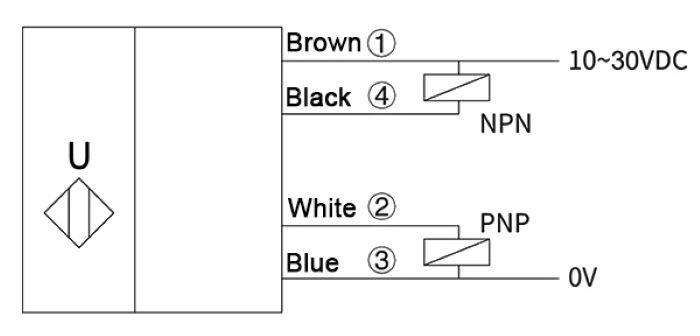
| Supply Voltage | 10-30 VDC |
| Output Mode | NPN, PNP Dual Output |
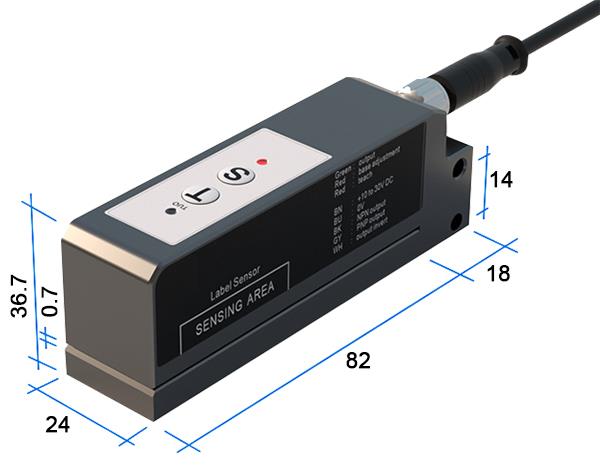
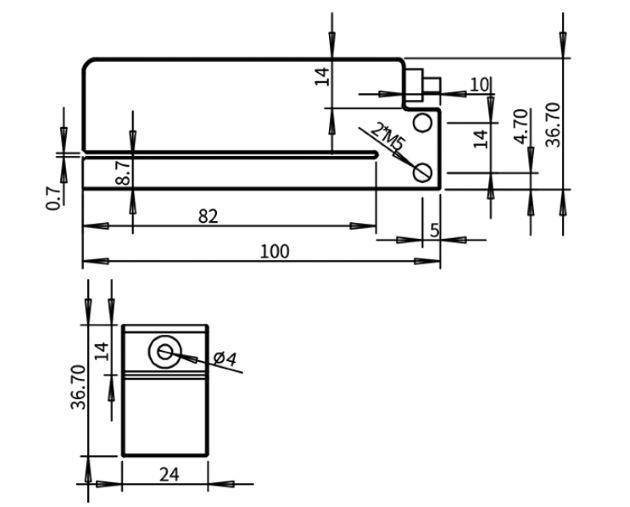
| Slot Width | 0.7 mm |
| Slot Depth | 82 mm |
| Switch Frequency | 5 kHz |
| Response Time | 0.1 ms |
| Minimum Label Width | ≥ 10 mm |
| Minimum Label Gap | ≥ 2 mm |
| Sensitivity Adjustment | Key-based Intelligent Adjustment |
| Output Current | 100 mA |
| Current Consumption | ≤ 25 mA |
| Reverse Polarity Protection | Built-in |
| Short-Circuit & Overload Protection | Built-in |
| Switching Position | Label and Gap detection reversible |
| Operating Temperature / Humidity | 0 ~ 55 °C / 0 ~ 80% RH |
| IP Rating | IP66 |
| Housing Material | Metal |
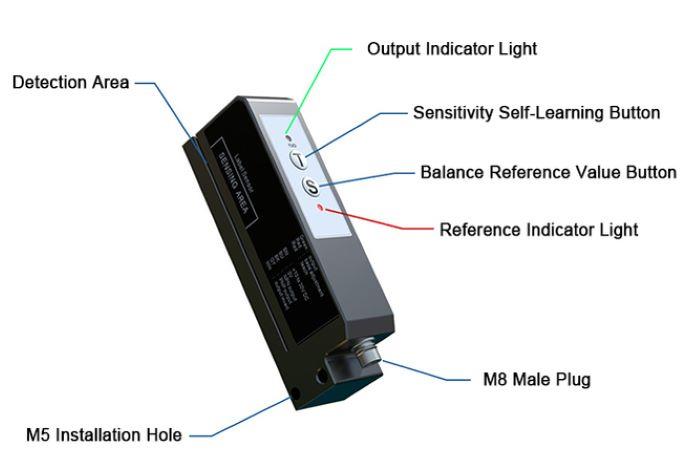
| Connection | M8 Connector, 4-pin |
Feature
- Broad Label Compatibility: The capacitive label detection sensor is engineered for strong applicability, capable of stably detecting transparent, non-transparent, paper, and PVC composite labels without issues.
- Intelligent Self-Learning: Equipped with a one-touch self-learning function, the label eye sensor automatically learns and sets the optimal sensitivity for the specific label and gap, ensuring peak performance with minimal user effort.
- Dual Output Flexibility: This label detection sensor provides both NPN and PNP output signals simultaneously, offering high adaptability and seamless integration with a vast range of PLCs and control system architectures.
- High-Speed Response: With a fast switch frequency and rapid response time, the capacitive label sensor meets the demands of high-speed applications, guaranteeing accurate detection without slowing down the production process.
Dimension (Unit: mm)
Details
Wiring Diagram
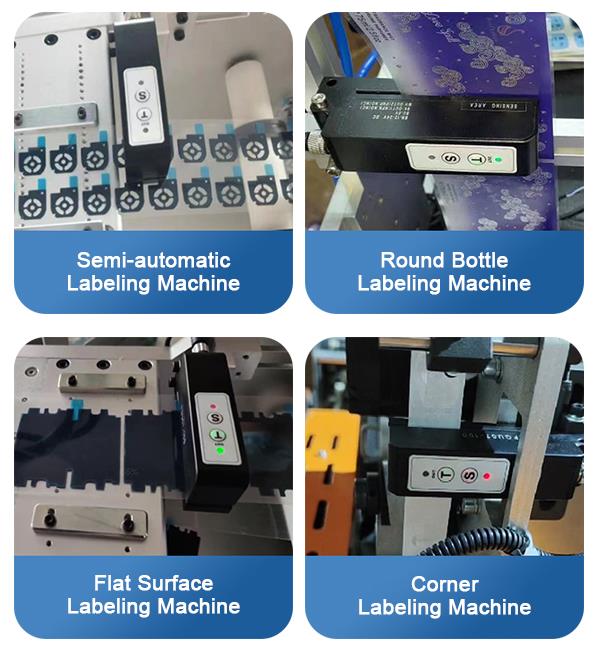
Application
Tips: Capacitive Label Detection Sensor Operating Instructions
Capacitive label detection sensor features intuitive button controls for calibration and setup. The following instructions explain the functions of the S and T keys.
S Key - Setting Balance/Baseline & Output Mode
- Set Balance Value: Remove the label from the detection slot. Press and hold the 'S' key for 3 seconds. The indicator light will blink and then become steadily lit. If the light does not stay on, please repeat the operation.
- Switch Output Mode: To toggle the output signal between Normally Open (NO) and Normally Closed (NC), press and hold the 'S' key for more than 6 seconds.
T Key - Intelligent Sensitivity Setting (Self-Learning)
- Preparation: Insert the label into the sensor's detection slot, ensuring it is within the effective sensing area.
- Teaching/Learning: Press and hold the 'T' key for 3 seconds. The indicator light will blink continuously. Release the key; the sensor will enter a 10-second setup state.
- Action: Gently and slowly pull the label back and forth through the slot. It is best to keep the label gaps parallel to the detection slot and move it steadily, ensuring the movement passes at least five label gaps. The indicator light will stop blinking once the setting is complete.
- Important Note: During the setup state, the label must remain inside the detection slot and must not be completely removed.
Only registered users can write reviews
Related products

Label Gap Sensor for Non-Transparent Detection
ATO-LABEL-03S
$120.15
This label gap sensor is designed for high-speed, precise detection of non-transparent adhesive labels in packaging and labeling applications. Gap sensor for label features a rapid response time of 0.1ms and a maximum switching frequency of 10kHz, ensuring reliable performance even at high line speeds. The gap sensor for label helping to minimize missed labels and enhance production efficiency.

Photoelectric Label Sensor, NPN/PNP, Slot Type
ATO-LABEL-TR03
$189.76
Factory price photoelectric label sensor for sale online, the sensor adopts 3mm slot width and 60mm slot depth design, supports NPN/PNP output optional. Users can choose 2m 3-core cable or 25cm cable + M8 connector connection method according to their needs, which is flexible to install. The label sensor uses infrared light (940nm) as the light source and has high-precision label detection capabilities.

Ultrasonic Label Sensor for Labeling Machine
ATO-LABEL-03C
$895.71
This ultrasonic label sensor is designed for high-speed, high-precision label detection in various labeling machines. Utilizing powerful ultrasonic technology, label detection sensor reliably detects transparent, non-transparent, metallic, and other challenging labels, unaffected by color, pattern, or ambient light. With a rapid response time of 250 µs, it ensures excellent process stability and is ideal for demanding industrial applications.

Universal Label Sensor for Transparent/PVC/Paper
ATO-LABEL-300S
$498.12
High-quality and low-cost universal label sensor has a precision of ±0.2mm, which can accurately detect transparent, non-transparent, PVC and paper labels. Label detection sensor is equipped with NPN/PNP dual output, featuring fast response and high precision, and is suitable for various industrial scenarios.