IoT Air Quality Sensor, Wifi/Bluetooth/RS485/4-20mA Output

$72.53
Low-price IoT air quality sensor is for sale. Smart air quality sensor can accurately detect common gases as well as various special gases, supports multiple output methods including RS485 and Bluetooth, and can perform 24-hour continuous online monitoring, providing real-time and reliable data for air quality monitoring.
SKU: ATO-AQS-802A
*
*
Free Shipping
Delivery date: 6-12 days

ATO IoT air quality sensor adopts a highly integrated sensor design, which can detect common gases such as oxygen, carbon dioxide, and formaldehyde, and also supports the detection of various special gases like hydrogen sulfide, nitrogen dioxide, and oxygen. Smart air quality sensor supports multiple output methods including RS485, Bluetooth, WIFI, and 4-20mA, has 24-hour continuous and stable monitoring capability, with an operating voltage of DC 10V-30V (standard 24V), and uses an ABS flame-retardant shell. It is suitable for multiple scenarios such as smart agriculture, industrial production, and smart homes, providing efficient and accurate IoT solutions for air quality monitoring in various fields.

Specification

ModelATO-FS-00802A
Operating VoltageDC 10V~30V (Standard 24V)
Operating Current≤200mA
Stabilization Time2min
Detection FrequencyData updated once per second (default)
Output ModeModbus-RS485, 0-10V, 4-20mA
MaterialABS Flame-Retardant Shell
Installation MethodCeiling-Mounted, Wall-Mounted
Dimension100x100x30 mm
Operating Temperature-10℃-50℃
Operating Humidity0-95%RH (No Condensation)
Storage Temperature-20℃-60℃
Storage Humidity0-99%RH (No Condensation)


Faetures

  • Comprehensive gas detection: In addition to common gases, it can detect various special gases such as hydrogen sulfide, nitrogen dioxide, and oxygen, meeting the gas monitoring needs of multiple scenarios.
  • Diverse output methods: Supports multiple output methods such as RS485, Bluetooth, and WIFI, which can adapt to different platforms and installation scenarios, with extremely strong compatibility and flexibility.
  • Stable and reliable monitoring: 24-hour continuous online monitoring, stable output signals, and a detection frequency updated once per second, ensuring real-time and accurate data.
  • Excellent design and materials: The convection hole design makes the measurement more accurate, the ABS flame-retardant and high-temperature-resistant shell ensures the safety of the equipment, and the integrated sensor design makes the equipment compact and small, easy to install, with options for ceiling or wall mounting.
  • Wide scene coverage: Suitable for smart agriculture, industrial production, smart home and other fields, providing efficient IoT solutions for air quality monitoring in different scenarios.

Dimension(Unit: mm)
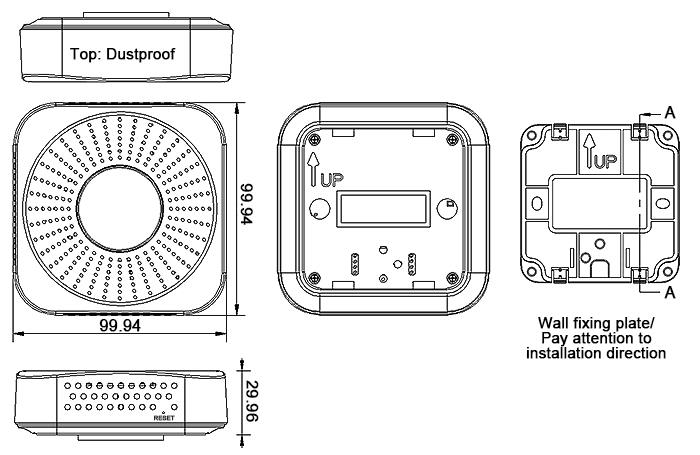
IoT air quality sensor dimension

Application

IoT air quality sensor application

Tips: How to Improve Accuracy of IoT Air Quality Sensor?

To make IoT air quality sensor more accurate, the core lies in controlling four key aspects: Selection, installation, usage and maintenance, and data calibration. The specific methods are as follows:

  1. Choose the right compatible sensor: Match the air sensor type according to the type of gas to be detected, and give priority to products with clear stability parameters, such as models clearly marked with "24-hour signal" to reduce data fluctuations.
  2. Eliminate environmental interference: The installation location should avoid areas in direct contact with oil fumes, water vapor, and dust. Ceiling-mounted installations should be kept away from pipes and cables inside the ceiling. For wall-mounted installations, the recommended height is 1.5-2 meters from the ground.
  3. Maintain sensor performance: Before first use, smart air quality sensor needs to be powered on and preheated for 2 minutes. Wait for the data to stabilize before putting it into formal monitoring to avoid initial data deviation. Clean the sensor surface regularly, wipe the shell with a dry soft cloth, and clean the dust in the convection holes.
  4. Data calibration and correction: Use the data filtering function of the Internet of Things platform to filter out instantaneous fluctuating data, and regularly compare data with standard monitoring equipment in the same environment.

Product reviews
Convenient for Continuous Monitoring
5
Sienna
Avatar
9/18/2026 12:46 AM
I’ve been using this air quality sensor for continuous monitoring, and it has worked reliably so far. The readings are easy to access, and the RS485 and Bluetooth options make it convenient to connect with different systems. It’s also useful for keeping track of air conditions around the clock without needing constant manual checks.
Was this review helpful? Yes No (0/0)
Write your review
  • Only registered users can write reviews
*
*
  • Bad
  • Excellent
*
*
*
*

ATO IoT air quality sensor adopts a highly integrated sensor design, which can detect common gases such as oxygen, carbon dioxide, and formaldehyde, and also supports the detection of various special gases like hydrogen sulfide, nitrogen dioxide, and oxygen. Smart air quality sensor supports multiple output methods including RS485, Bluetooth, WIFI, and 4-20mA, has 24-hour continuous and stable monitoring capability, with an operating voltage of DC 10V-30V (standard 24V), and uses an ABS flame-retardant shell. It is suitable for multiple scenarios such as smart agriculture, industrial production, and smart homes, providing efficient and accurate IoT solutions for air quality monitoring in various fields.

Specification

ModelATO-FS-00802A
Operating VoltageDC 10V~30V (Standard 24V)
Operating Current≤200mA
Stabilization Time2min
Detection FrequencyData updated once per second (default)
Output ModeModbus-RS485, 0-10V, 4-20mA
MaterialABS Flame-Retardant Shell
Installation MethodCeiling-Mounted, Wall-Mounted
Dimension100x100x30 mm
Operating Temperature-10℃-50℃
Operating Humidity0-95%RH (No Condensation)
Storage Temperature-20℃-60℃
Storage Humidity0-99%RH (No Condensation)


Faetures

  • Comprehensive gas detection: In addition to common gases, it can detect various special gases such as hydrogen sulfide, nitrogen dioxide, and oxygen, meeting the gas monitoring needs of multiple scenarios.
  • Diverse output methods: Supports multiple output methods such as RS485, Bluetooth, and WIFI, which can adapt to different platforms and installation scenarios, with extremely strong compatibility and flexibility.
  • Stable and reliable monitoring: 24-hour continuous online monitoring, stable output signals, and a detection frequency updated once per second, ensuring real-time and accurate data.
  • Excellent design and materials: The convection hole design makes the measurement more accurate, the ABS flame-retardant and high-temperature-resistant shell ensures the safety of the equipment, and the integrated sensor design makes the equipment compact and small, easy to install, with options for ceiling or wall mounting.
  • Wide scene coverage: Suitable for smart agriculture, industrial production, smart home and other fields, providing efficient IoT solutions for air quality monitoring in different scenarios.

Dimension(Unit: mm)

IoT air quality sensor dimension

Application

IoT air quality sensor application

Tips: How to Improve Accuracy of IoT Air Quality Sensor?

To make IoT air quality sensor more accurate, the core lies in controlling four key aspects: Selection, installation, usage and maintenance, and data calibration. The specific methods are as follows:

  1. Choose the right compatible sensor: Match the air sensor type according to the type of gas to be detected, and give priority to products with clear stability parameters, such as models clearly marked with "24-hour signal" to reduce data fluctuations.
  2. Eliminate environmental interference: The installation location should avoid areas in direct contact with oil fumes, water vapor, and dust. Ceiling-mounted installations should be kept away from pipes and cables inside the ceiling. For wall-mounted installations, the recommended height is 1.5-2 meters from the ground.
  3. Maintain sensor performance: Before first use, smart air quality sensor needs to be powered on and preheated for 2 minutes. Wait for the data to stabilize before putting it into formal monitoring to avoid initial data deviation. Clean the sensor surface regularly, wipe the shell with a dry soft cloth, and clean the dust in the convection holes.
  4. Data calibration and correction: Use the data filtering function of the Internet of Things platform to filter out instantaneous fluctuating data, and regularly compare data with standard monitoring equipment in the same environment.
Product reviews
Convenient for Continuous Monitoring
5
Sienna
Avatar
9/18/2026 12:46 AM
I’ve been using this air quality sensor for continuous monitoring, and it has worked reliably so far. The readings are easy to access, and the RS485 and Bluetooth options make it convenient to connect with different systems. It’s also useful for keeping track of air conditions around the clock without needing constant manual checks.
Was this review helpful? Yes No (0/0)
Only registered users can write reviews