

This Digital Air Quality Sensor for Home is simply a powerful assistant for home health!
Since purchasing this sensor, I have gained a clearer and more intuitive understanding of the air quality in my home. It can accurately detect harmful substances such as PM2.5, formaldehyde, TVOC in the air, allowing me to monitor indoor air conditions at any time and take timely measures such as ventilation and purification.
Indoor air quality sensor for sale, this ATO shop air quality monitoring sensor with digital display optional isolated/non-isolated RS485 output signal, long service life, maintenance-free, fast response, stable performance and high accuracy. Can be optional relay output, equipped with a display and keys can be set to different relay operating mode, providing 3-color LED indicator intuitive prompts the degree of environmental pollution. Compact size, simple installation, can be widely used in all kinds of commercial complexes, intelligent buildings office environment, hospitals, schools and other places in the air PM2.5/PM10 particle monitoring.
Specification
| Model | ATO-LFG601 |
| Temperature | |
| Sensor | Digital Temperature Sensor |
| Range | 0~50°C |
| Accuracy | ±0.5°C @ 20°C, ±1°C @ 0~50°C |
| Response Time | 10~30s (20°C, slow air) |
| Relative Humidity | |
| Sensor | Digital Humidity Sensor |
| Range | 0~100%RH |
| Accuracy | ±3%RH @ 20°C, 20~80%RH |
| Response Time | ≤10 seconds (20°C, slow air) |
| PM2.5 | |
| Sensor | Laser Dust Sensor |
| Particle Size | 0.3–2.5 μm |
| Range | 0–500 μg/m³ |
| Consistency | ±10% FS @ 100–500/600 μg/m³ |
| Resolution | 1 μg/m³ |
| PM10 | |
| Sensor | Laser Dust Sensor |
| Particle Size | 0.3–10 μm |
| Range | 0–600 μg/m³ |
| Consistency | ±10%FS@100–500/600 μg/m³ |
| Resolution | 1 μg/m³ |
| CO2 | |
| Sensor | NDIR sensor with ABC self-check |
| Range | 0–5000 ppm |
| Accuracy | ±40 ppm ±3% MV |
| Response Time (T90) | 2 min |
| Power Supply | 12–36 VDC / 24 VAC ±20% |
| Output Signal | Isolated/non-isolated RS485 (optional) |
| Operating Environment | 0–50°C & 0–95% RH (no condensation) |
| Storage Temperature | –20–60°C & 0–95% RH (no condensation) |
| Display and Buttons | Yes |
| LED Indicator Lights | Green: Good |
| Yellow: Average | |
| Red: Poor | |
| Protection Rating | IP30 |
| Installation Method | Indoor type |
| Housing Material | PC |
| Net Weight | 148g |
Feature
- This home air quality sensor adopts laser dust sensor, detecting particle size 0.3~10μm.
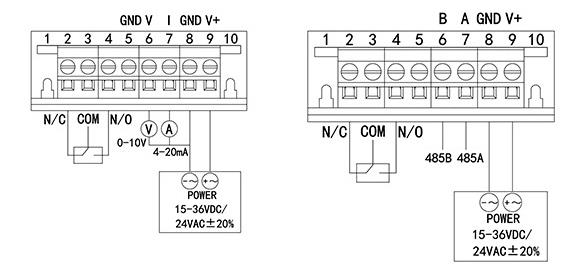
- Equipped with a variety of output methods to choose from, adapting to different scene requirements.
- Perfect over-voltage and reverse connection protection, high long-term reliability.
- 3-color LED indicator can intuitively prompt the degree of environmental pollution.
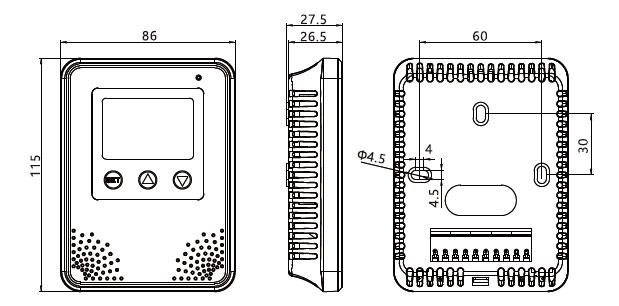
- Air quality monitoring sensor housing design is lightweight and beautiful, standard 86 box mounting hole spacing.
Dimension (unit: mm)
Wiring Diagram
Installation Methods
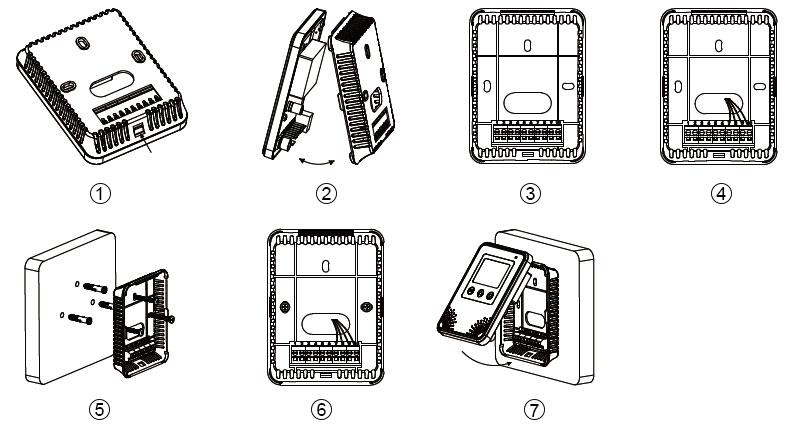
- Open the transmitter by pressing the cover button under the back cover of the indoor air quality sensor (e.g. 1, 2).
- Follow the wiring diagram to complete the electrical connections and introduce the cables through the crossing holes (e.g. 3, 4).
- The back cover of the digital air quality transmitter has three mounting holes, use expansion screws to fix it on the wall (e.g. 5), or you can use screws to fix it on top of the pre-buried 86 box on the wall (e.g. 6).
- Align and fasten the position of the front cover with the bottom case to complete the installation (e.g. 7).
Application

Tips: How to choose the right air quality sensor for home use?
When choosing an air quality sensor for home use, it is recommended to focus on the following points: First, make sure that the air particulate sensor is capable of detecting the type of pollutant you are concerned about. Second, check the sensor's detection accuracy and response speed. In addition, consider whether the air quality monitoring sensor has real-time monitoring, historical data logging, and compatibility with smart home systems. Finally, choose the right sensor according to the size of your home and make sure its coverage is adequate.
Indoor air quality sensors require regular maintenance to ensure their accuracy and long-term stability. Typically, the detection element of an air quality transmitter needs to be replaced every 6 months or 1 year. Some sensors offer automatic calibration, but it is also important to regularly check the working condition of the device and clean the sensor surface to avoid dust accumulation.
Related products

Air Quality Monitor Sensor, CH2O/CH4/CO2, RS485/WIFI Output
ATO-AQS-SMG111
$276.34
High-quality air quality monitor sensor supports formaldehyde (CH2O), carbon dioxide (CO2) and methane (CH4) detection, low cost, wide detection range, support DC 10-30V power supply, power consumption as low as 1.5W, with RS485 or WIFI signal output, easy to remote monitoring and data transmission.

Indoor Air Quality Sensor, Temp/Humidity/PM2.5/PM10/H2S/CO2
ATO-AQS-HAQS
$317.56
Indoor air quality sensor low price for sale, measures temperature -20°C~+60°C, humidity 0~100% RH, PM2.5 0-1000ug/m3, PM10 0-2000ug/m3, H2S 0~100ppm, CO2 0~2000ppm, illumination 0-200Klux. Air particle sensor uses RS485 communication method, 12-24VDC power supply. The air quality sensor is suitable for a wide range of indoor locations, homes, schools, underground garages, hospitals and more.

Industrial Air Quality Sensor, Temp/Humidity/PM1.0/PM2.5/PM10
ATO-AQS-IAQS
$129.98
Higher quality industrial air quality sensor for sale. The air particle sensor can test -40~+80℃ temperature, 0%RH-100%RH humidity, 0~1000μg/m3 PM2.5, 0~1000μg/m3 PM10, 0~1000μg/m3 PM1.0, and has 1μg/m3 resolution, ±3%FS (@0~100μg/m3, 25℃, 50%RH) accuracy. Industrial grade high precision air quality sensor has optional output signal RS485, 4-20mA, 0-5V, 0-10V, can be used for outdoor weather stations, dust monitoring, libraries, archives, and plants.

Laser PM2.5 Air Quality Sensor
ATO-AQS-D7
$64.31
The highly efficient, low-energy laser PM2.5 air quality sensor has a particulate matter measurement range of 0.3–10 µm, and it provides PWM and UART outputs for particulate matter concentrations, making it suitable for a variety of air quality monitoring applications.