
Low price Hall effect sensor is a non-contact measuring speed sensor. M12, low frequency can reach 0Hz, high frequency can reach 20KHz, which can meet the requirements of high speed measurement. Output signal level pulse/NPN/PNP can be chosen. The hall effect gear tooth sensor can be used for zero speed measurement of rotating machinery.
Specifications
| Electrical Parameters | |
| Model | ATO-TSS |
| Type | Hall Effect Speed Sensor |
| Shell Shape | Threaded Cylinder |
| Shell Specifications | M12 |
| Voltage | DC 4V~30V |
| Working Frequency | 0Hz~20kHz |
| Measurement Method | Non-Contact Measurement |
| Sensing Range | Conventional: 0.5mm~3mm, Special Type: 0.5mm~7mm, Measuring Magnet: 0.5mm~30mm |
| Number of Output Channels | Single Channel |
| Output Signal Type | Level Pulse, NPN, PNP |
| Mounting Type | Cable Direct Outlet |
| Cable Length | 2m (Default), Contact Us for Other Options |
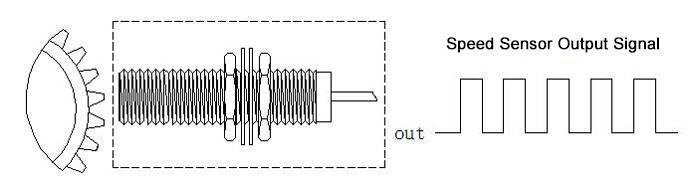
| Output Waveform | Rectangular Wave |
| Output Amplitude | High Level≥Power Supply -0.3V, Low Level ≤0.3V |
| No-Load Power Consumption Current | ≤20mA |
| Insulation Resistance | ≥50MΩ@500V DC |
| Dielectric Strength | AC500V/ 50Hz/60s |
| Electromagnetic Compatibility. | Comply with CE Standard EMC Requirements |
| Protective Function | Power Supply Polarity Protection, Output Short Circuit Protection |
| Mechanical Parameters | |
| Measured Object | There should be protuberances or grooves on the measured body or magnetic conductive. Gear is suggested standard involute gear, modulus ≥1.5. |
| Note: Non-standard gear or unequal width between slot and flat surface will lead to a change of waveform duty ratio. | |
| Material Under Test | Magnetic Mild Steel or Magnet |
| Sensor Housing Material | Integrated Stainless Steel Shell |
| Environmental Parameters | |
| Operating Temperature | -40℃~+135℃ |
| Storage and Transport Temperature | -40℃~+150℃ |
| Relative Humidity | ≤90% |
| High and Low Temperature Performance | High and Low Temperature Cycle Test For 10 Cycles, (Low Temperature: -40 Degrees; High Temperature: 150 Degrees), Each Placed For 30 mins, Cycle Alternately |
| Vibration Resistance | Vertical PSD=20g2/Hz, Transverse PSD=20g2/Hz, Longitudinal PSD=30g2/Hz, 5Hz~1200Hz, Random vibration |
| Impact Resistance | 30g |
| Degree of Protection | IP67 |
Features
- It is a single-channel speed sensor based on the Hall principle.
- Reliable explosion-proof speed sensor measures the speed of gears or rotating objects through non-contact, simple, stable, and maintenance-free.
- The high-quality speed sensor with voltage pulse signal and strong anti-interference ability is more suitable for harsh application environments.
- Threaded installation, specifications and sizes can be customized according to customer needs. If you have a need, please get in touch with us.
Dimension (Unit: mm)
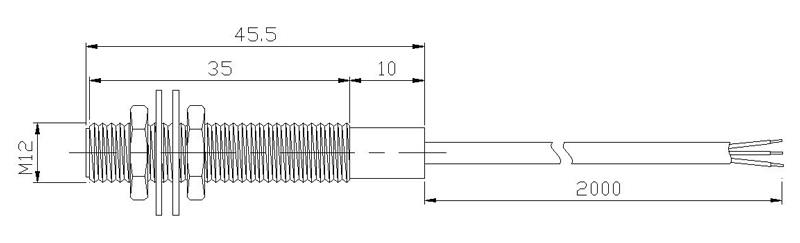
*Note for Electrical Connection:
- The direct outlet of the speed sensor is equipped with a 1~2m shielded cable as standard.
- Contact us for customizing the length or other mounting types (connector or cable direct outlet + connector).
- 3 Wires: Brown/Red - Vcc+, Black/White - Signal, Blue - Gnd
Output Signal
Applications

Tips: What is a Hall effect speed sensor used for?
Hall effect speed sensors, as described earlier, can perform several functions depending on their application. Some of the tasks they can accomplish include:
- Speed measurement: Hall effect speed sensors can accurately measure the speed or rotational velocity of a moving object by detecting changes in the magnetic field generated by the object.
- Position sensing: By detecting the rotation of a magnetic target or a gear with alternating magnetic poles, Hall effect speed sensors can provide position information, enabling precise control and synchronization of devices.
- RPM monitoring: Hall effect speed sensors can be used to monitor the revolutions per minute (RPM) of an engine or a motor, providing feedback for performance optimization and fault detection.
- Motion control: Hall effect speed sensors can be integrated into closed-loop control systems to regulate the speed of motors, conveyors, and other machinery, ensuring accurate and consistent motion.
Product reviews
About hall speed sensor
Karle

7/26/2024 3:34 AM
As I learned, a hall sensor cannot detect the speed of a shaft by itself because there is no air gap change and no flux change. It has to work with a gear wheel to get the speed of a shaft. My project is to test the motor. There is no gear on the motor. Please let me know if this is correct.
Was this review helpful? (0/0)
Only registered users can write reviews
Related products

Explosion Proof Speed Sensor, M16
ATO-EPSS-M16
$332.61
Factory explosion-proof speed sensor, M16, adopts a special explosion-proof cable to meet the explosion-proof requirements of customers in special environments and working conditions. Output signal level pulse/NPN/PNP can be chosen. It is a non-contact measurement sensor with a wide air gap, no wear, and easy installation, more suitable for harsh applications.

Hall Speed Sensor, M12
ATO-HSS-M12
$254.35
The provided Hall effect sensor is a non-contact speed sensor. With M12, 0Hz~20KHz frequency, the speed sensor can meet the requirements of high speed measurement. Output signal level pulse/NPN/PNP can be chosen. Cheap Hall effect rpm sensor can be used for zero speed measurement of rotating machinery.

Magnetic Speed Sensor, M18
ATO-MSS-M18
$270.47
Magnetic speed sensor, M18, adopts a non-contact measurement method, does not need an external power supply. NPN or PNP output signal can be chosen. This speed sensor has no direction requirements, strong anti-interference, and can be used in harsh environments such as smog, oil gas, and water vapor.