
Designed for versatile industrial applications, this rugged fanless industrial PC offers rich connectivity. Industrial-grade SSDs that combine low power consumption, high security, and high speed. Compatible with Linux, Windows 10/ 11, it provides a flexible solution for machine vision, network security, and industrial automation. Upgrade your system with this dependable industrial PC.
Specification
| Model | ATO-Nano-N3322 |
| Chassis Color | Matte Grey (custom color available) |
| Chassis Material | High quality all-aluminum |
| Processor | Onboard Intel Core i5-1235U (10 cores, 12 threads, Turbo 4.4 GHz) |
| Onboard Intel Core i7-1255U (10 cores, 12 threads, Turbo 4.7 GHz) | |
| Memory | Supports 1×DDR5 4800 SODIMM memory slot, Max. 32 GB |
| BIOS | AMI EFI BIOS |
| Display Chip | Intel(R) UHD Graphics |
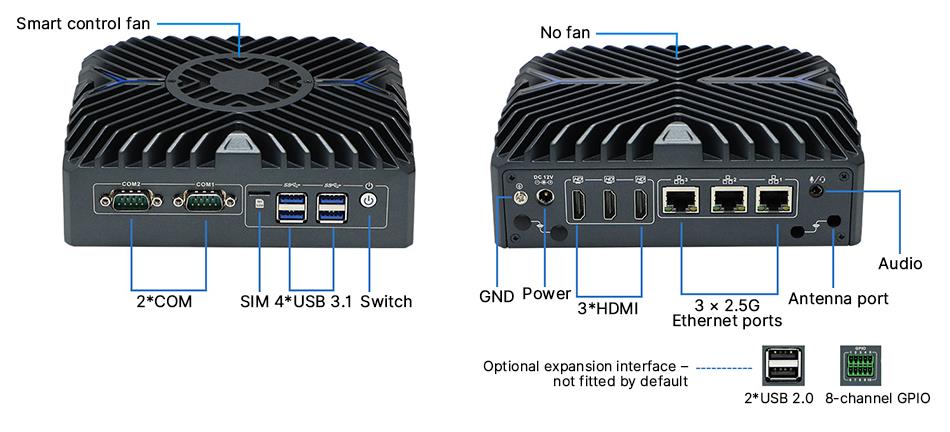
| Display port | 3×HDMI support 4K/synchronous/asynchronous display, max. resolution up to 4096×2160 |
| Front I/O | 2×COM support RS232/RS485, 1×SIM slot, 4×USB 3.1, 1×power button |
| Rear I/O | 1×DC port, 3×HDMI, 3×Intel 2.5G Lan, 1×Audio |
| Expansion Slots | 1×M.2 2280 M-key slot (NVMe, PCIe 4.0 x4) |
| 1×M.2 3052 B-key slot (USB 3.0 signal, supports 4G/5G), External SIM card slot) | |
| 1×2230 E-key slot (supports Wi-Fi, Bluetooth) | |
| Network | 3 × ntel i226-V 2.5G Lan |
| Storage | 1× M.2 2280 slot, 1×2.5 inch HDD |
| Input Voltage | DC 12V input |
| Other Features | Power-on, timed startup, network wake up, PXE startup, watchdog (level 0-255), TPM2.0 security encryption |
| Working temp. | 0℃ ~ +40℃ (business HDD) , -20℃ ~ +50℃ (industrial SSD) , Surface air flow |
| Working humidity | 5% ~ 95% non-condensing |
| Certification | CE, CCC, FCC Class A, RoHS |
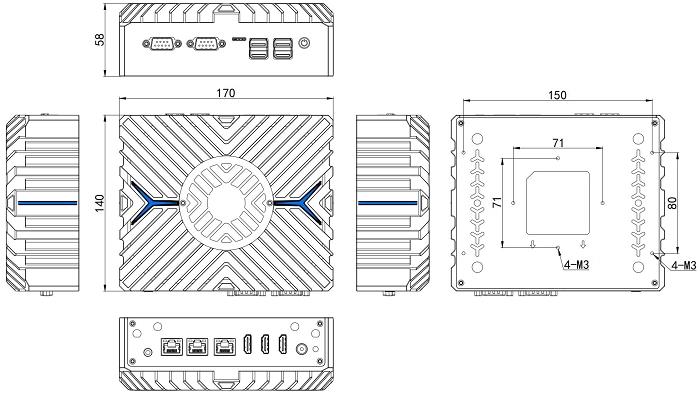
| Dimension | 170×140×58 mm |
| Weight | 1.1 kg |
| Application | Industrial Control, Industrial Automation, Robot, IoT gateway, Edge computing, Machine Vision, AGV/AMR, etc. |
Features
- High-Performance Processor: Powered by Intel Core i5/i7 12th Gen processors with up to 10 cores, 12 threads, and 4.7 GHz turbo frequency, this industrial PC delivers fast, reliable performance for industrial automation, edge computing, and machine vision.
- Flexible Cooling Design: Available in fanless and smart control fan configurations, this industrial PC features a high-quality all-aluminum chassis for efficient heat dissipation and reliable operation in industrial environments.
- All-Aluminum Chassis: This industrial PC features a high-quality all-aluminum enclosure that provides excellent durability and efficient heat dissipation.
- Triple 4K HDMI Display: Featuring 3 × HDMI ports, this industrial computer supports synchronous and asynchronous triple-display output with resolutions up to 4096 × 2160. Ideal for industrial control, robotics, and machine vision applications.
- Rich Industrial Connectivity: This industrial PC provides 4 × USB 3.1 ports, 2 × RS232/RS485 COM ports, and 3 × Intel 2.5GbE LAN ports for versatile industrial connectivity.
- Flexible Expansion: Equipped with 3 × M.2 slots, including M-key, B-key, and E-key interfaces, this industrial PC supports NVMe SSD storage and optional Wi-Fi, and 4G/5G connectivity for flexible industrial applications.
Dimensions (Unit: mm)
Details
Package
| Name | Quantity | Note |
| Power adapter | 1 | 12V 7.5A |
| Power cable | 1 | CN、US、UK、EU.etc |
| VESA mount | 1 | Standard |
Tips: What Is the difference between an industrial PC and a PLC?
An industrial PC is a computer used for industrial control. Its anti-interference performance is better than ordinary computers. It is anti-drop, anti-vibration and strong in stability. PLC is a programmable controller, which is generally installed in a control cabinet. It has input and output points, and can also collect analog signals for communication. Simply put, for industrial PC and PLC, the former is the upper computer and the latter is the lower computer.
- The difference in hardware structure. Both industrial and PLC are composed of central processing unit (CPU), memory, input and output devices, etc. PLC is a dedicated calculator, but it has a different bus architecture from industrial PC.
- The difference in cost performance. Both Industrial PC and PLC have the characteristics of high performance, high integration, modularization, mass production and wide application. When there are no more complicated data processing, graphic display or motion trajectory requirements in the designed control system, the PLC can be used to obtain a better cost performance.
- The difference in peripheral configuration. Compared with PLC, industrial PC has more abundant peripheral equipment, such as monitor, driver, printer and network interface card, etc., and they are all standard components. As long as it is equipped with the corresponding driver software, the peripherals produced by different manufacturers can also be used in common with each other. However, PLC peripherals have fewer types and strong specificity, and peripherals of different brands cannot be used universally.


Mini Fanless Industrial PC, Celeron J1900, Linux/Win 7

Embedded Industrial PC, Celeron 3965U, Linux/Windows 7/8/10

Embedded Fanless Industrial PC, Core i5 i7, Celeron 3865U

Embedded Industrial Edge Computer, Intel i5, 3 LAN, 6 COM
