
Contacting conductivity sensor can measure the conductivity value in water in real time, and has a wide range of applications. The sensing surface material of the contacting electrical conductivity sensor/probe for water adopts a double-cylinder structure of titanium alloy, which can resist the corrosion of most liquids. Low-noise cable directly leads out, 0~2000μs/cm measurement range, real-time response and accurate data. It is an ideal device for measuring water conductivity.
Specifications
| Model | ATO-DDG-1.0 |
| Electrode Constant | k=1.0 |
| Measurement Range | 0μs/cm~2000μs/cm |
| Temperature Range | 0℃~60℃ |
| Accuracy | ±1%F.S. |
| Power Supply | AC 90V~260V |
| Thermistor | NTC10K |
| Withstand Voltage | <0.6MPa |
| Sensing Surface Material | Double cylinder structure titanium alloy |
| Housing Material | 316L, titanium alloy, platinum |
| Thread | NPT 1/2 or NPT 3/4 thread installation is optional |
| Connection | Low-noise cable direct lead-out |
| Installation Method | Immersion type, flow type, pipeline type, etc. |
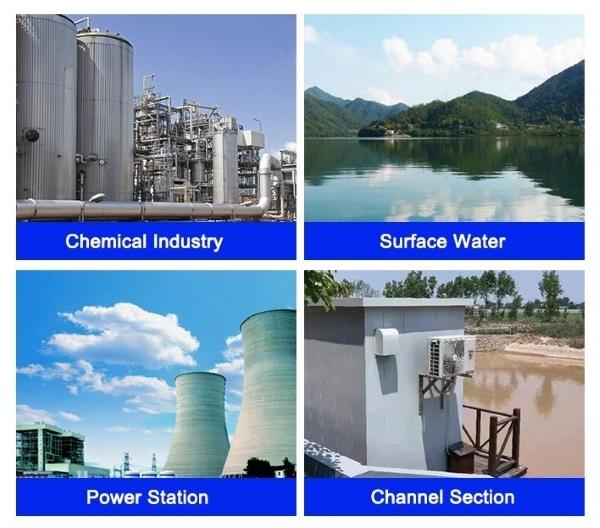
| Application Range | Power plants, water treatment industry, etc. |
| Cable | Standard 5m |
Features
- High accuracy, good stability, accurate measurement results, fast and stable response.
- The contacting conductivity sensor/probe for water adopts a double cylinder structure and is made of titanium alloy.
- The anti-penetration conductive surface is resistant to all liquids except fluorinated acid, and is anti-pollution and anti-interference.
- The contacting conductivity transmitter has a built-in temperature probe for temperature compensation.
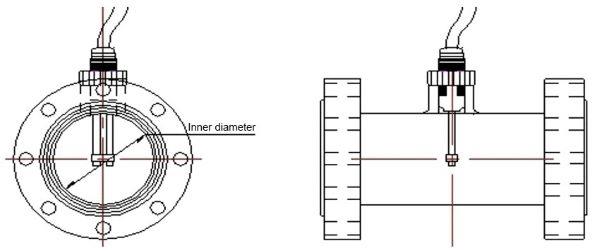
Installation
Application
Tips: Contacting conductivity sensor vs. inductive conductivity sensor
1. Contacting conductivity sensor
- Principle: Directly contact the liquid through two or more electrodes (usually platinum or graphite), measure the current generated in the liquid after applying voltage, and calculate the conductivity.
- Advantage: High accuracy, especially suitable for measuring low conductivity (such as pure water). Fast response, stable data, simple structure and relatively low cost.
- Disadvantage: The electrode is easily contaminated or scaled and needs to be cleaned regularly. It is not suitable for corrosive or high-concentration solutions, has a limited life, and requires good maintenance to maintain measurement accuracy for a long time.
2. Inductive conductivity sensor
- Principle: Using the principle of electromagnetic induction, there are two coils inside the sensor (one transmitting coil and one receiving coil). When the conductive liquid passes through the sensor, the electromagnetic field induces a current in the liquid, which is then detected by the receiving coil and converted into conductivity.
- Advantage: Non-contact measurement, no electrode contamination or corrosion problems, suitable for measuring high-concentration, highly polluted, highly corrosive liquids (such as acid and alkali solutions), almost maintenance-free, long service life, can be used for continuous online monitoring, strong anti-interference ability.
- Disadvantage: Not suitable for low conductivity liquids (such as ultrapure water), high cost, and usually larger in size than contact sensors.
Only registered users can write reviews
Related products

High Temperature Conductivity Sensor, 0~130℃, 0~2000μs/cm
ATO-CS-100-1
$703.07
Buy a high temperature conductivity sensor online. The high temperature conductivity sensor has a measurement range of 0~2000μs/cm, a temperature range of 0~130℃, an accuracy of up to 2%FS, and built-in NTC10K temperature compensation. The high temperature electrical conductivity sensor can be used with instruments and is suitable for online water quality testing, multi-channel water quality testing and intelligent water quality monitoring systems.

Inductive Conductivity Sensor, 0~2000ms/cm, 4-20mA/RS485
ATO-CS-S7S
$1,293.54
Industrial inductive conductivity sensor with 0-1000 mS/cm or 0-2000 mS/cm range. Features RS485 Modbus-RTU & 4-20mA direct PLC integration, PTFE anti-corrosion housing, and IP68 waterproof rating. No meter required.

Inline Conductivity Sensor/Probe for Liquid, 0~5000μs/cm
ATO-CS-406-S
$769.54
Inline conductivity sensors/probes for sale, with protection level up to IP68, are designed for liquid conductivity monitoring. Signal output is optional RS485/4-20mA, with a range of 0~5000μs/cm, which can be easily integrated into different devices. The operating temperature of the inline electrical conductivity sensor/probe for liquid is 0~65℃, and the accuracy level is ±1.5%F.S. and ±0.3℃, which is suitable for the measurement needs of different liquids.