
Coating Thickness Gauge
Coating thickness gauges mainly use the principle of magnetic induction or eddy current measurement to measure the thickness of non-magnetic coatings on magnetic materials, and are suitable for both routine operations and rigorous laboratory measurements.
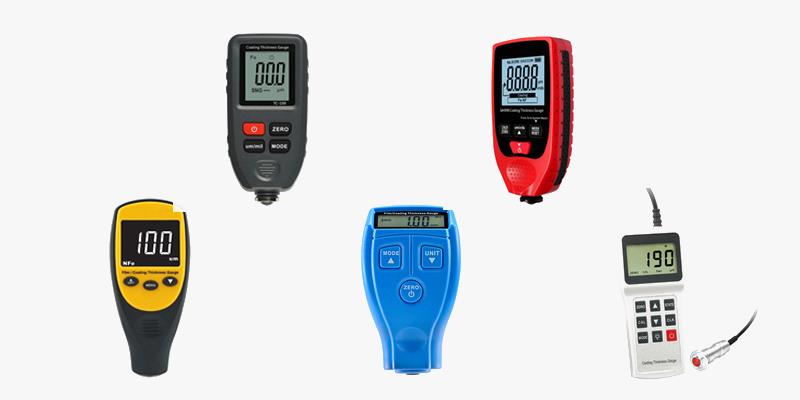
Get a wholesale price precision paint thickness gauge from ATO.com to help measure the thickness of coatings or plating on metals. The paint depth gauge with 0~1300um, 0~1500um, 0~,0~1700um, 0~,0~1800um and 0~10000 measuring ranges are available online. Coating thickness testers are easy and fast to measure, with minor measurement errors and high reliability. ATO high standard paint thickness tester can guarantee the quality of products when coating, so they are widely used in machining and inspection industries.
5 Methods for Paint Thickness Gauges
The coating thickness gauge mainly uses the principle of magnetic induction or eddy current measurement to measure the thickness of non-magnetic coatings on magnetically conductive materials.
- Magnetic thickness measurement method. The magnetic thickness measurement method is suitable for measuring the thickness of the non-magnetic coating on the magnetic conductive material, and the magnetic conductive material for it is steel, iron, silver, nickel and other metal materials.
- Eddy current thickness measurement method. It uses the electromagnetic field generated on the probe coil to form an eddy current in the process of approaching the conductor, and the size of the formed eddy current will be directly reflected by the reflected impedance, which finally reflects the thickness of the non-conductive coating on the conductive substrate. Compared with the magnetic thickness measurement method, the accuracy of this method is slightly lower, and it is suitable for measuring the thickness of non-conductive coatings.
- Ultrasonic thickness measurement. The cost is high and the measurement accuracy is not high. This measurement method can measure the thickness of multi-layer coatings that cannot be measured by magnetic measurement and eddy current measurement;
- Electrolytic thickness measurement method. This method needs to destroy the coating for electrolytic measurement, the measurement process is complicated, and the measurement accuracy is not high, so it is not widely used.
- Radiation thickness measurement method. This kind of measuring instrument is costly and only used on special occasions.
The Calibration Methods of Paint Depth Gauge
Zero calibration
It is performed on the metal substrate (uncoated substrate) of the product.
- Step 1: Select a zero-adjustment board, which is an uncoated metal substrate. (Because the surface roughness of the workpiece is different, after zero adjustments, the re-measurement may not be the absolute zero position, which is a normal phenomenon)
- Step 2: On the side, sheet interface together, select calibration, then zero calibration, and then press the probe vertically and smoothly on the base, and the zero calibration will be performed automatically.
- Step 3: Repeat the above steps 1 and 2 to obtain a more accurate zero point and improve the measurement accuracy.
Multi-point calibration
It uses a standard sheet for calibration, suitable for high-precision measurement and small workpieces, hardened steel, and alloy steel.
- First, calibrate the zero point.
- Then make a measurement on a standard sheet whose thickness is roughly equal to the expected thickness of the cover layer to be measured, and then correct the reading to make it reach the standard value.
- Finally, it is covered by multiple standard sheets to measure, and then the readings are corrected in turn to make them reach the standard value.
How To Choose a Coating Thickness Tester?
- Understand that the data to be measured is the thickness of the coating on the workpiece
- Determine the base material of the workpiece to be measured as metal
- Determine what kind of metal the workpiece substrate is
- Confirm the coating
- Non-metallic coatings (such as paint, powder, rubber, plastic, etc.)
- Non-magnetic metal coatings (such as aluminum, chrome, copper, enamel, rubber, paint, etc.)
- Non-conductive coatings (such as enamel, rubber, paint, plastic, etc.)
Different thickness gauges have different functions, different measurement methods, and different costs. Please contact our professional technicians for consultation before selecting the model, and choose the most suitable thickness gauge according to your needs.

0-1300 μm Digital Paint Coating Thickness Gauge, Film/Powder/Zinc

0-1500 μm Digital Paint Coating Thickness Gauge, Film/Powder/Zinc

0-1700 μm Digital Coating Thickness Gauge

0-1800 μm Digital Coating Thickness Gauge

0-2000 μm Precise Coating Thickness Gauge, Double Probe


