Chloride Sensor for Water Quality, 1.8~35,500 ppm

$584.56
Selling competitively priced chloride sensor for water quality. The chloride water quality sensor measures from 1.8 to 35,500 ppm with a resolution of 0.01 ppm and an accuracy of ±3% FS. It has automatic temperature compensation and supports online monitoring. Application for river water, domestic plant root exudates, soil extract, blood, blood electrolyte, bedside analysis, biological fluids, sludge, electroplating.
SKU: ATO-WQS-ICL
Free Shipping
Delivery date: 6-12 days

Chloride sensor for water quality measures chloride from 1.8 to 35,500 ppm with high precision (0.01 ppm) and ±3% accuracy. It has automatic temperature compensation and supports online monitoring. Ideal for river water, plant roots, soil, blood, biological fluids, sludge, and electroplating. 

Specification

Ion Concentration
Measurement Range 1.8~35500 ppm
Resolution 0.01 ppm
Measurement Accuracy ±3% FS
Temperature
Measurement Range -10.0 to 110.0 ℃
Resolution 0.1 ℃
Measurement Accuracy ±0.5 ℃
Temperature Type Thermistor NTC10K
Temperature Compensation Automatic
Data Transmission
Interface RS-485
Protocol MODBUS-RTU communication protocol
Other Parameters
Working Voltage 9~27 VDC
Dielectric Strength 2500 Vrms
Power Consumption Approx. 0.5 W
Material PPS Solid
Installation Method 3/4 inch front and rear thread
Slope 56±3 mV
Repeatability ±2%
Interference Resistance S²⁻, I⁻, CN⁻, Br⁻
Pressure Range 0~2 atm
Response Time ≤30 seconds to reach 95% response
Storage Long-term: dry storage; Short-term: store in chloride standard solution
pH Operating Range 2~12 pH
Output Impedance 20~50 MΩ
Working Temperature 0~80 ℃
Maintenance & Cleaning Polish with fine sandpaper; clean with chloride standard solution
Online Monitoring Supported
Calibration Point 50000 ppm Cl⁻
Reference Electrode Double junction, single liquid junction structure
Connection Terminal
Applications River water, domestic plant root exudates, soil extract, blood, blood electrolyte, bedside analysis, biological fluids, sludge, electroplating, food


Feature

Ionised water quality sensor features

  • High-Precision Ion-Selective Electrode: This chloride sensor uses an advanced ISE that requires no reagents, is eco-friendly, and delivers more stable and accurate data for long-term monitoring.
  • Standard G3/4 Threaded Connection (Top and Bottom): The water quality sensor features an easy-to-install threaded design that helps reduce installation time and cost.
  • RS485 Signal Output Supported: Supports MODBUS-RTU protocol for seamless integration into data systems, ideal for smart water quality monitoring networks.
  • Low Voltage Power Supply: Designed for energy efficiency, the chloride sensor consumes less than 0.5W, making it suitable for continuous use in remote or solar-powered setups.
  • Premium Low-Noise Shielded Cable: Equipped with a high-quality 5-meter standard cable to reduce signal interference; cable length can be customized as needed.

Dimension (Unit: mm)
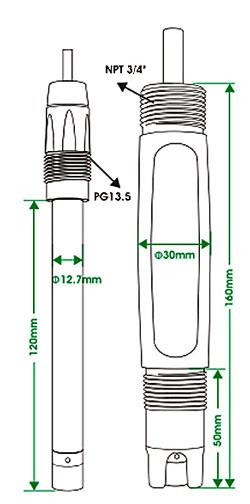
Ionised water quality sensor size 

Wiring Instructions

Function Color Description
Data Transmission Yellow Wire RS-485 Communication T/R+ (A)
White Wire RS-485 Communication T/R− (B)
Power Supply Red Wire DC Power Positive
Black Wire DC Power Ground


Application

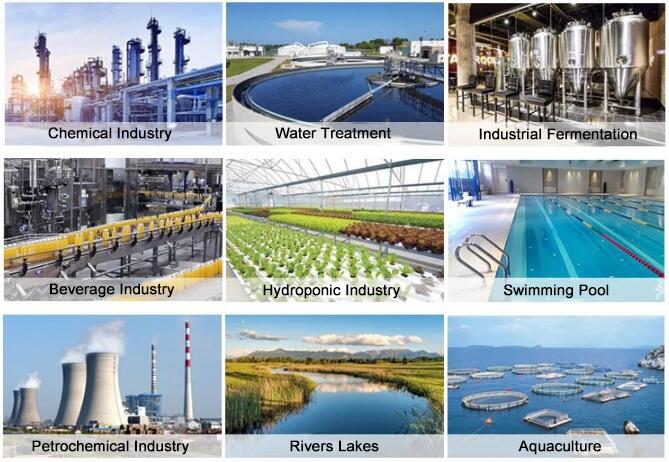
Ionised water quality sensor application

Tips: Can the chloride sensor be used in high-salinity or seawater environments?

Yes, this chloride ion-selective electrode is specifically designed to handle a wide range of chloride concentrations, from as low as 1.8 ppm to as high as 35,500 ppm. This makes it especially suitable for high-salinity conditions such as seawater, brackish water, and industrial brine systems. The materials used—PPS—offer excellent resistance to corrosion caused by high chloride content, and the sensor's membrane is engineered to remain stable even in extreme ion activity. This ensures long-term, accurate monitoring without frequent recalibration or membrane degradation.

Product reviews
Chloride Ion Sensor Inquiry
5
Zalak
Avatar
1/15/2026 6:44 PM
I would like to inquire about the chloride ion sensor (SKU: ATO-WQS-ICL). I need a chloride ion sensor that can operate independently (automatically) in the field for several months without manual intervention. Does this sensor meet my requirements? How often should it be calibrated? Also, can the sensor be set to automatically measure at preset time intervals?
Was this review helpful? Yes No (0/0)
ATO Responded
1. This sensor meets the requirements and can operate independently (automatically) in the field for several months without manual intervention.
2. It is recommended to calibrate it every 1-3 months.
3. This sensor supports automatic measurement and can be configured for fixed time interval measurements via a communication protocol. For detailed information, please refer to the product user manual. See on: https://www.ato.com/Content/doc/chloride-sensor-user-manual.pdf
Write your review
  • Only registered users can write reviews
*
*
  • Bad
  • Excellent
*
*
*
*

Chloride sensor for water quality measures chloride from 1.8 to 35,500 ppm with high precision (0.01 ppm) and ±3% accuracy. It has automatic temperature compensation and supports online monitoring. Ideal for river water, plant roots, soil, blood, biological fluids, sludge, and electroplating. 

Specification

Ion Concentration
Measurement Range 1.8~35500 ppm
Resolution 0.01 ppm
Measurement Accuracy ±3% FS
Temperature
Measurement Range -10.0 to 110.0 ℃
Resolution 0.1 ℃
Measurement Accuracy ±0.5 ℃
Temperature Type Thermistor NTC10K
Temperature Compensation Automatic
Data Transmission
Interface RS-485
Protocol MODBUS-RTU communication protocol
Other Parameters
Working Voltage 9~27 VDC
Dielectric Strength 2500 Vrms
Power Consumption Approx. 0.5 W
Material PPS Solid
Installation Method 3/4 inch front and rear thread
Slope 56±3 mV
Repeatability ±2%
Interference Resistance S²⁻, I⁻, CN⁻, Br⁻
Pressure Range 0~2 atm
Response Time ≤30 seconds to reach 95% response
Storage Long-term: dry storage; Short-term: store in chloride standard solution
pH Operating Range 2~12 pH
Output Impedance 20~50 MΩ
Working Temperature 0~80 ℃
Maintenance & Cleaning Polish with fine sandpaper; clean with chloride standard solution
Online Monitoring Supported
Calibration Point 50000 ppm Cl⁻
Reference Electrode Double junction, single liquid junction structure
Connection Terminal
Applications River water, domestic plant root exudates, soil extract, blood, blood electrolyte, bedside analysis, biological fluids, sludge, electroplating, food


Feature

Ionised water quality sensor features

  • High-Precision Ion-Selective Electrode: This chloride sensor uses an advanced ISE that requires no reagents, is eco-friendly, and delivers more stable and accurate data for long-term monitoring.
  • Standard G3/4 Threaded Connection (Top and Bottom): The water quality sensor features an easy-to-install threaded design that helps reduce installation time and cost.
  • RS485 Signal Output Supported: Supports MODBUS-RTU protocol for seamless integration into data systems, ideal for smart water quality monitoring networks.
  • Low Voltage Power Supply: Designed for energy efficiency, the chloride sensor consumes less than 0.5W, making it suitable for continuous use in remote or solar-powered setups.
  • Premium Low-Noise Shielded Cable: Equipped with a high-quality 5-meter standard cable to reduce signal interference; cable length can be customized as needed.

Dimension (Unit: mm)

Ionised water quality sensor size 

Wiring Instructions

Function Color Description
Data Transmission Yellow Wire RS-485 Communication T/R+ (A)
White Wire RS-485 Communication T/R− (B)
Power Supply Red Wire DC Power Positive
Black Wire DC Power Ground


Application

Ionised water quality sensor application

Tips: Can the chloride sensor be used in high-salinity or seawater environments?

Yes, this chloride ion-selective electrode is specifically designed to handle a wide range of chloride concentrations, from as low as 1.8 ppm to as high as 35,500 ppm. This makes it especially suitable for high-salinity conditions such as seawater, brackish water, and industrial brine systems. The materials used—PPS—offer excellent resistance to corrosion caused by high chloride content, and the sensor's membrane is engineered to remain stable even in extreme ion activity. This ensures long-term, accurate monitoring without frequent recalibration or membrane degradation.

Product reviews
Chloride Ion Sensor Inquiry
5
Zalak
Avatar
1/15/2026 6:44 PM
I would like to inquire about the chloride ion sensor (SKU: ATO-WQS-ICL). I need a chloride ion sensor that can operate independently (automatically) in the field for several months without manual intervention. Does this sensor meet my requirements? How often should it be calibrated? Also, can the sensor be set to automatically measure at preset time intervals?
Was this review helpful? Yes No (0/0)
ATO Responded
1. This sensor meets the requirements and can operate independently (automatically) in the field for several months without manual intervention.
2. It is recommended to calibrate it every 1-3 months.
3. This sensor supports automatic measurement and can be configured for fixed time interval measurements via a communication protocol. For detailed information, please refer to the product user manual. See on: https://www.ato.com/Content/doc/chloride-sensor-user-manual.pdf
Only registered users can write reviews
Customers who bought this item also bought

RTD Pt100 to 4-20mA/RS485 Converter

ATO-RTD-M1
$76.82
Higher quality RTD Pt100 to 4-20mA/RS485 converter for sale, supports measurement ranges up to -50~500°C or -200~50°C. It converts Pt100 resistance signals into 4-20mA or RS485 outputs, operating on 12~36VDC power. With high accuracy (±0.1% FS or ±0.2°C), a fast 20ms response time, and excellent stability (±0.05% FS/year), it ensures reliable performance. With IP54 protection and an operating temperature range of -40~80°C. Ideal for precise and durable industrial temperature monitoring.

ORP Sensor for Water Quality, -1500~+1500mV

ATO-WQS-ORP
$650.79
Good ORP sensor for water quality for sale, measures -1500 to +1500mV with 1mV resolution and ±6mV accuracy. It operates at 0~65°C, <0.1MPa, and uses a 12~24VDC power supply with 0.2W consumption. Featuring a durable POM housing, RS-485/4-20mA output, IP68 protection, and a 5-meter customizable cable, it is installed via immersion and uses single-point calibration. Ideal for environmental monitoring, water treatment, agriculture, industrial automation, and marine applications.

Turbidity Sensor for Water Quality, 0~1000NTU

ATO-WQS-TS
$1,016.59
Buy an ATO turbidity sensor for water quality, which provides precise turbidity measurements using a 90° scattered light method with built-in temperature compensation (Pt1000). It supports a range of 01000 NTU with resolutions as fine as 0.01 NTU and a fast response time (<30 seconds). Ideal for water treatment, environmental monitoring, and aquaculture.

pH Sensor for Water Quality, 0~14pH

ATO-WQS-PH
$239.96
Good price water quality pH sensor for sale. The pH sensor uses the glass electrode method, measuring 0~14 pH with a resolution of 0.01 and accuracy of ±0.1. It has fast response (<30s), automatic temperature compensation (Pt1000), and two-point calibration for precise readings. With RS-485 (Modbus RTU) output, durable ABS construction, and submersion installation (3/4 NPT), it operates efficiently in 0~60°C and ≤0.2 MPa. Ideal for water quality applications.

4 Electrode Electrical Conductivity (EC) Sensor, 0.1~500ms/cm

ATO-CS-CON620D
$616.46
High-quality 4 electrode electrical conductivity (EC) sensors are suitable for measuring the changes in conductivity values in aqueous solution systems within a wide range. The conductivity measurement range is 0.1~500ms/cm, and the salinity measurement range is 0~500ppt. The digital electrical conductivity (EC) sensor has high accuracy and stable performance. The conductivity measurement accuracy is 1.5%F.S and the temperature measurement accuracy is ±0.5℃.